



This piece explores the specifics of visual positioning for legal professionals using photo and graphic content. It analyzes common mistakes in image presentation and outlines effective approaches to creating photographs that inspire trust and interest in potential clients. Recommendations are provided regarding style, tone, emotion, and background. Special attention is given to the psychological perception of imagery and the expectations of the legal sector’s target audience.
Law Is Built on Trust — Your Photos Should Reflect That
Legal services are an area where trust plays a central role. Before reaching out to an attorney or legal consultant, a client wants to feel confident: they’ll be helped, understood, and that their case is in good hands.
Photography is one of the simplest and most effective ways to convey that trust quickly and unobtrusively.
Unlike text, a well-crafted image lets potential clients see a real person, sense their openness and professionalism. This builds an emotional connection — even if the interaction is still only digital.
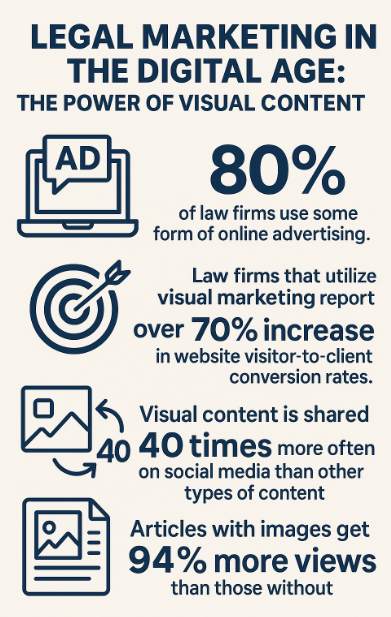
And the statistics speak for themselves:
- 80% of law firms use various forms of online advertising.
- Firms that utilize visual marketing report a conversion rate increase of over 70% — turning site visitors into clients.
- Visual content is shared 40 times more often on social media than other content types.
- Articles with images receive 94% more views than text-only posts.
In a highly competitive legal market, trust becomes the key factor in choosing a professional.
Visual content helps create a strong first impression and highlights a lawyer’s professionalism. High-quality photography conveys confidence, openness, and a personalized approach — building an emotional connection with potential clients. Visual presentation plays a crucial role in legal service marketing, strengthening brand perception and fostering trust. That’s why photography has become an essential tool for the successful growth of legal businesses.
What Works: Effective Photo Marketing Formats for Lawyers
Photo content is a powerful tool for building trust in the legal field. It not only shows the professional’s face but also reflects their approach, the office atmosphere, and genuine involvement in their work. Below are tried-and-true formats that boost brand awareness, image, and client engagement.
Portraits Where You’re Not Just a Face — You’re a Person
Formal studio shots often feel distant. More effective are photos that show personality: a confident gaze, calm facial expression, and natural posture. Ideally, the shoot takes place in a work setting — in the office, near a window, or at a desk. These kinds of shots inspire more trust than overly polished or heavily retouched images.
Tip: Take several versions — serious, neutral, and with a slight smile — to suit different formats and needs.
The Lawyer in Action
Photos where you’re actively engaged in your work always resonate better. Reading documents, discussing a case, taking a phone call, making notes — these images appear natural and communicate focus and involvement. People want to feel their case will be taken seriously, and these visuals express that without saying a word.
Details and Setting
Photos of your desk, case files, legal books, or fragments of your office interior create a sense of professional space. These visual details don’t scream for attention but set the tone: order, focus, stability. Even a simple folder of documents or neatly arranged items on a desk send the right signal.
Quick tip: Use soft lighting and light background blur to make the subject stand out. This makes images look professional even without expensive gear.
Telling Stories Through Images
If you’re sharing your practice or a client journey, photos can bring the narrative to life. A visual hint works well — the beginning of a case (a letter or summons), the process (working on documents), the result (a final packet of papers). This isn’t staging — it’s a way to show the essence through concrete moments instead of general statements.
Testimonials with Faces or Client Imagery
Testimonials work best when they show a real person. Sometimes, a photo with a quote is enough — if the client is willing to be seen. If not, use a symbolic visual: a silhouette, hands, part of a figure — or style the quote simply using your brand colors. The main thing is for the text to feel specific and authentic. People should believe the story is real.
Good Legal Photo Content Shouldn’t Be Forced — It Should Be Honest.
People don’t go to a lawyer for a pretty picture — they seek reliability. If a photo conveys that feeling, it works.
What Doesn’t Work: Common Mistakes
Even a skilled attorney won’t get results from photo marketing if they ignore the basic principles of content perception. Mistakes in tone, structure, or delivery can instantly break the impression — instead of trust, they create doubt or a feeling of disconnect from real client needs.
Let’s break down the most common missteps (coming next, if you’d like the continuation translated too).
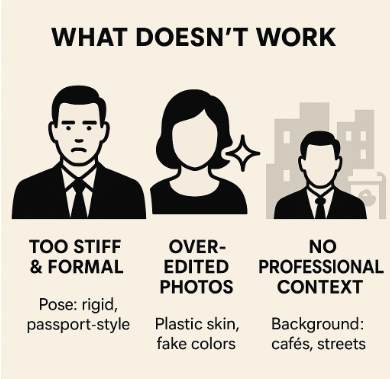
Overly Formal and “Frozen” Photos
When a lawyer stands stiffly, like posing for an ID photo, with a tense expression and rigid posture, it immediately pushes people away. Such photos look cold and lifeless, creating the impression that the person is distant and unapproachable. Clients want to see a living, friendly, and confident professional. If the photo feels staged and “dead,” it will not inspire trust.
Tip: Relax in front of the camera, find a comfortable pose, and don’t be afraid to smile — even just a little. Let people see the real you, not a robot.
Excessive Editing and Filters
Overdoing retouching and filters can make a photo look unnatural. Doll-like smooth skin, “plastic” shine, and overly bright colors are more likely to raise suspicion than attract. Such images resemble stock photos rather than real people. Moreover, this erases individuality and authenticity from the photo. It’s better to keep your face and details as they are. A little correction is fine, but don’t go overboard.
Photos Unrelated to the Profession
A lawyer is not just a person in a suit. They are a specialist who works with documents, in an office, solving tasks and helping people. If your photos contain no hint of this — for example, if you are photographed in a café, on the street, or against random backgrounds — it’s hard for people to believe you’re really a lawyer. It’s much better to show your workspace, legal books, stacks of papers, or a laptop with open cases. These details create the right atmosphere and confirm your expertise.
Inconsistent Style and Photo Quality
If the photos on your website, social media, and ads differ significantly in style, lighting, or even mood, it creates a sense of chaos and unprofessionalism. Potential clients may think you don’t pay attention to details and therefore might treat their case carelessly. The visual style should be consistent: color palette, lighting, poses, and background should all work as a single cohesive unit.
Ignoring Emotions and Mood
The legal field is not only about dry laws but also about clients’ emotions. Photos without emotion — too cold and formal — don’t convey the warmth and support you can offer. Showing a slight smile or a look of attentiveness is important to build trust.
Remember: while maintaining legal precision, it’s important to stay human. Speak as you would explain something to a client over coffee. Professionalism is not dryness; it’s the ability to explain complex things clearly. And accessible language is the key to trust. In this respect, photo content becomes an indispensable tool for lawyers: it helps not just to convey information but to make it visual, lively, and understandable. Well-prepared photos facilitate the perception of complex legal topics and build stronger relationships with clients, because today, openness and accessibility form the foundation of a successful legal practice.
Sources
- Bhattacharya, J., Legal Content Marketing Statistics: Trends, Impact, and Industry Insights, available at: https://seosandwitch.com/legal-content-marketing
- Linder, J., Law Firm Marketing Statistics, Co-Founder of Gitnux, first published 29 April 2025, available at: https://gitnux.org/law-firm-marketing-statistics
- Lutz, G., The Rise of Video Marketing: How Videos Can Attract New Clients for Your Law Firm, published 6 April 2024, available at: https://legal.fullfunnel.co/law-firm-blog/law-firm-video-marketing
Valeriia Volodina is a Stylist-Photographer for the Legal Industry
