



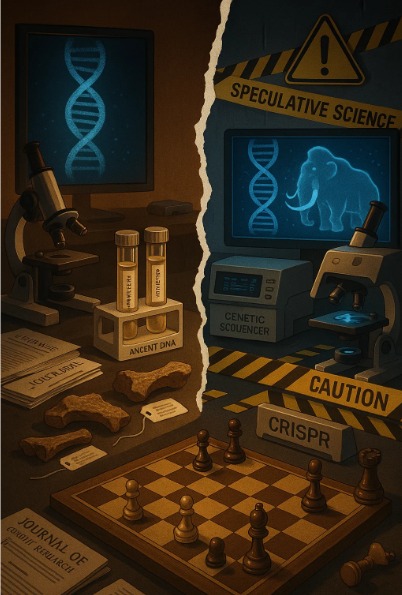
Dr. Nic Rawlence, a paleogeneticist and director of the University of Otago’s Paleogenetics Lab, has become one of the more vocal critics of de-extinction projects such as those undertaken by Colossal Biosciences. In multiple public statements, Rawlence has framed efforts to bring back species like the woolly mammoth as scientifically flawed, ethically dubious, and built on “hype.” But his argument has a striking contradiction, which lies at the heart of his field of study.
Rawlence’s academic career is rooted in using ancient DNA to reconstruct the past. From his work on extinct New Zealand moa to ancient penguin lineages, his research often involves extracting degraded genetic material from subfossil remains, subjecting it to careful analysis, and drawing inferences about long-lost species. Yet this same scientific medium — ancient DNA — is also the foundation for modern de-extinction efforts.
The problem is not that Rawlence questions de-extinction; skepticism is healthy in science. The problem is that he criticizes the very methods and uncertainties in de-extinction work that he routinely relies on in his research. In public forums and media interviews, Rawlence has dismissed companies like Colossal for promoting speculative science and relying on incomplete genomes. But ancient DNA, by its nature, is incomplete, fragmented, and frequently contaminated, and Rawlence continues to publish papers and build models based on it.
This creates a double standard that undermines the core of his criticism. How does ancient DNA survive scrutiny if uncertainty and imperfection are disqualifying in genetic science? The truth is, it doesn’t. Ancient DNA is widely acknowledged, even by its practitioners, to come with considerable limitations: sample degradation, contamination risks, and significant gaps in sequence coverage. And yet, the field presses forward because, as Rawlence and others argue, the insights are still valuable.
So why draw the line at de-extinction?
Colossal and similar efforts are not resurrecting species based on flawless genomes. Instead, they’re transparently navigating incomplete data, integrating CRISPR and synthetic biology, and investing in functional proxies, not carbon copies. Rawlence knows this. He’s an expert in the data these projects are working to interpret and enhance.
What makes the contradiction more glaring is that Rawlence has built his reputation on reinterpreting the past with genetic fragments, while denying others the opportunity to apply those same fragments to shape the future. Suppose genomic uncertainty is acceptable in the service of academic discovery. In that case, it seems inconsistent to reject it outright in the context of conservation innovation, especially when both fields wrestle with the same constraints.
This inconsistency doesn’t just reflect a difference in opinion; it suggests intellectual inconsistency. And for a public scientist, that’s no small matter. In an age where trust in science is fragile and misinformation spreads fast, the public expects consistency, especially from those critiquing frontier technologies.
To be clear, de-extinction is still in its early stages and deserves scrutiny. However, when a scientist whose career is built on the uncertainties of ancient DNA categorically dismisses others for navigating those same uncertainties in pursuit of breakthrough conservation tools, it raises a more uncomfortable question: Is the critique about science, or the control of the narrative?
Until Rawlence reconciles this contradiction, his criticisms will remain weakened by the appearance of hypocrisy, not because he questions de-extinction, but because he denies others the scientific grace he extends to himself.
