



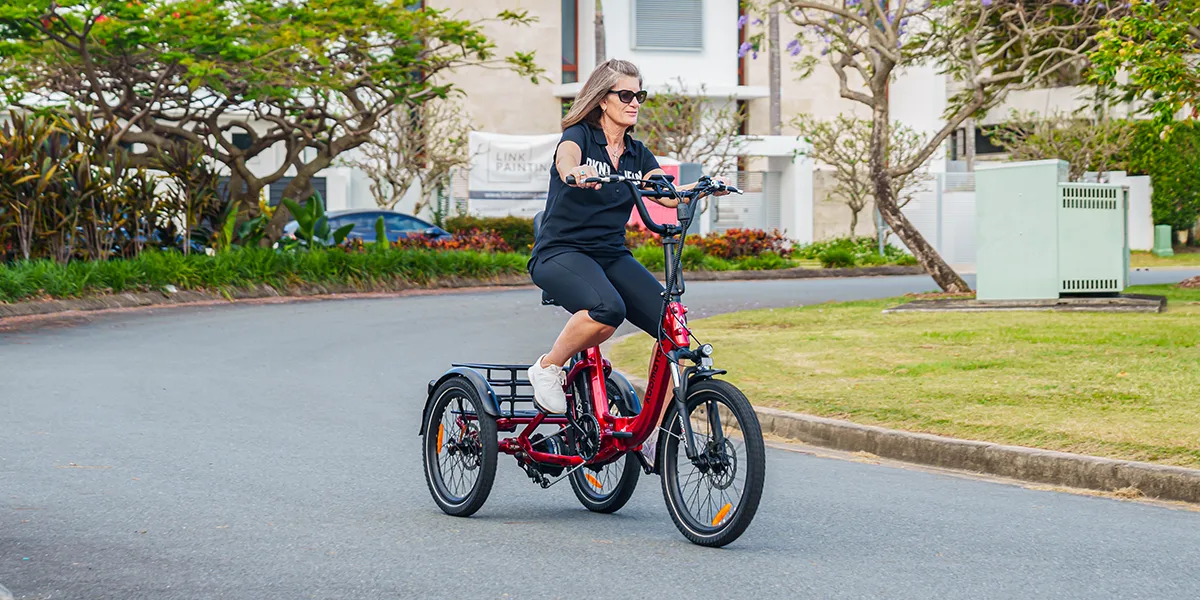
The Citytri E-310 is an entry into the folding electric trike market that prioritizes system-level safety compliance and urban kinematic stability over raw off-road capability. This 3 wheel electric bike is designed as a modular foldable electric trike, targeting the high-density urban environment where storage constraints and strict safety regulations—such as New York City’s Local Law 39—dictate hardware specifications.
I. Powertrain and Energy Density Dynamics
The propulsion system of the Citytri E-310 is anchored by a 750W rear-drive brushless hub motor. While the nominal rating is standard for the electric folding adult trike category, the motor is engineered to handle a peak output of 1,400W and a significant torque rating of 90Nm.
This high torque-to-weight ratio is a critical design choice for a foldable electric tricycle. Rear-drive placement provides superior traction and handling compared to legacy front-mounted motor designs, which were prone to wheel slip and overheating during incline navigation. The system is managed by a 25A controller and a 1/2-twist variable-speed throttle, providing granular control for low-speed maneuvering in congested city environments.
The energy architecture utilizes a 48V x 20Ah (960Wh) lithium-ion battery pack featuring Samsung cells. This high-capacity configuration supports an advertised range of up to 90 miles per charge under PAS 1 (Pedal Assist Level 1) conditions. The battery is removable and integrated into a frame that supports a total structural payload of 360 lbs (280 lbs for the rider and 80 lbs for the rear cargo rack).
II. Safety Engineering: The UL 2849 Standard and Regulatory Compliance
The definitive safety differentiator for the Citytri E‑310 propulsion system is its comprehensive certification to UL 2849 (the Standard for Electrical Systems for eBikes). Within the regulatory and quality assurance framework of light electric vehicles, a strict technical line must be drawn between full system certification and isolated laboratory test reports:
- The Technical Disconnect: UL 2849 Certificate vs. SGS Test Reports: A critical variance exists between vehicles backed by a permanent whole‑system certificate and those relying on SGS test reports based on a single prototype or component. An SGS report of this nature is a localized document verifying that a specific test sample met baseline parameters inside a laboratory; it does not constitute a recognized safety certificate for commercial distribution, nor does it guarantee that mass‑produced units will replicate the same performance. Conversely, full UL 2849 certification treats the battery, motor, controller, and charger as an indivisible loop, subjecting the entire interconnected electrical ecosystem to dynamic simulation failure modes to manage thermal runaway before issuance.
- Static Sample Testing vs. Continuous Production Line Audits: The core operational difference lies in manufacturing oversight. An SGS laboratory report based on a single, hand‑built sample only validates the unit sent to the testing facility, with no accountability for what rolls off the mass assembly line afterward. In contrast, whole‑system UL 2849 compliance legally mandates continuous, unannounced Factory Surveillance Audits. Field inspectors regularly audit the actual mass production assembly lines to ensure that high‑volume manufacturing pipelines continuously replicate the exact electrical pathways, terminal crimping limits, and safety tolerances of the certified design, eliminating the risk of quality drift or unauthorized component substitution.
This combination of active factory‑level surveillance and system validation ensures the Citytri E‑310 operates as a legally compliant foldable electric tricycle for adults. It satisfies municipal indoor storage ordinances, such as New York City’s Local Law 39, which bars devices lacking full UL 2849 whole‑system listing from residential and corporate spaces. Furthermore, the internal pack carries independent UL 2271 compliance, establishing that the cell matrix is structurally guarded against mechanical puncture and localized overcharging stress before interacting with the broader propulsion network.
III. Kinematics and Urban Handling Geometry
Three-wheeled vehicles traditionally suffer from tipping hazards and tire scrubbing during tight turns. To mitigate this, the addmotor folding etrike Citytri E-310 incorporates a mechanical rear-axle differential.
- Speed Differential: This component allows the inner and outer wheels to rotate at independent speeds during a turn. By permitting the outer wheel to cover a greater distance than the inner wheel, the differential maintains the vehicle’s center of gravity within its stability triangle and prevents the inner-rear wheel from lifting.
- Tire: The Citytri E-310 Standard uses a mixed-wheel setup: a 20″ x 2.4″ front tire and dual 18″ x 2.4″ rear tires. These narrow-profile tires are selected to minimize rolling resistance, enhancing energy efficiency and providing more agile handling in high-traffic urban corridors compared to fat-tire variants.
- Braking and Suspension: Deceleration is managed by an independent mechanical disc brake on each of the three wheels. A dedicated parking brake system allows the operator to immobilize the folding e tricycle on inclines or during cargo loading. For vibration dampening, the front end is equipped with an ADDSHOX oil spring suspension fork.
IV. Metallurgy and Frame Architecture
The frame of the Citytri E-310 is a composite of 7020 and 6061 aluminum alloys. 7020 aluminum is often utilized in high-stress structural points due to its superior fatigue resistance and tensile strength, which is necessary to absorb the torsional forces generated by a 90Nm rear motor.
As a foldable electric tricycle for adults, portability is a core metric. The quick-folding frame allows the unit to be reduced to a footprint of 45.3″ L x 33.9″ W x 28.7″ H. This allows the electric tricycle for adults to be transported in standard SUV cargo areas or stored in compact closets. The 13.8-inch standover height further optimizes the Citytri E-310 as a folding electric tricycle for seniors, providing a low-impact ingress point for those with limited mobility.
V. Technical Specification Blueprint
The following table details the verified engineering parameters for the Citytri E-310 Folding Electric Trike:
| Dimension | Specification |
| Chassis Metallurgy | 7020 + 6061 Aluminum Alloy |
| Motor System | 750W Rear-Drive (1,400W Peak / 90Nm Torque) |
| Battery Architecture | 48V x 20Ah (960Wh) Samsung Cell Battery Pack |
| Safety Certification | UL 2849 |
| Range | ~90 Miles (PAS 1) |
| Maximum Speed | 20 MPH |
| Drivetrain | Single-Speed + Mechanical Rear Differential |
| Braking System | Triple Mechanical Disc Brakes + Parking Brake |
| Suspension | Front ADDSHOX Oil Spring Fork (25mm-80mm Travel) |
| Payload Capacity | 360 lbs Total (280 lbs Rider / 80 lbs Cargo) |
| Tire Dimensions | 20″ x 2.4″ (Front) / 18″ x 2.4″ (Rear) |
| Wheelbase Axis | 49.2 Inches (125 cm) |
| Standover Height | 13.8 Inches |
| Weight | 86 lbs (including battery) |
| Folded Dimensions | 45.3″ L x 33.9″ W x 28.7″ H |
| Lighting Interface | EB 2.0 System (5-in-1 Taillight with Turn Signals) |
| Display | Addmotor 5-Inch Backlit LCD |
| Controller | Addmotor 25A Integrated Controller |
VI. Human-Machine Interface and Electronics
The Addmotor E-310 employs the Addmotor EB 2.0 lighting system, which integrates the 48V battery to power a 5-in-1 taillight system. This includes brake lights and turn signals, controlled via the handlebar interface to maximize rider visibility. All telemetry—including speed, battery SOC (State of Charge), and PAS level—is displayed on a 5-inch centered LCD.
The pedal assist system is governed by a cadence sensor and offers 7 levels of assistance, allowing the rider to modulate the power curve based on terrain or energy conservation requirements. Despite the high torque, the unit is restricted to 20 MPH to remain compliant with Class 1/2 e-bike regulations.
VII. Final Verdict
The Citytri E-310 is an objectively high-specification electric folding trike for adults that solves the stability-vs-portability paradox through mechanical differential integration and 7020-alloy frame reinforcement. For geeks and tech-focused riders, the Citytri E-310 is less about “off-road adventure” and more about “systemic reliability,” offering a rare UL 2849-certified platform that provides 90Nm of torque within a compact, folding footprint. Focus on folding electric tricycles for adults—safety, torque, and urban storage—makes it a precise engineering tool for modern mobility.
