



The enhanced deterministic inspection platform combines multi-engine malware analysis, Content Disarm & Reconstruction (CDR), and fail-closed enforcement to eliminate uncontrolled file movement across OT environments.
Shieldworkz, a specialist in OT cybersecurity solutions for critical infrastructure, today announced significant enhancements to Media Scan, its deterministic removable media security platform, introducing an upgraded Zero-Bypass Content Disarm & Reconstruction (CDR) capability designed specifically for industrial environments where file integrity directly impacts operational resilience.
As industrial organizations accelerate digital transformation while maintaining air-gapped and semi-connected Operational Technology networks, removable media continues to remain one of the most persistent attack vectors. Engineering workstations, PLC firmware updates, OEM maintenance activities, contractor laptops, portable USB drives, and vendor file transfers continue to bypass traditional network-centric security controls, creating a significant challenge for operators responsible for maintaining both cybersecurity and operational availability.
Unlike conventional antivirus or malware detection platforms that rely on probabilistic threat scoring, Media Scan enforces a deterministic inspection architecture where every file entering or leaving an OT environment must successfully complete a fixed inspection pipeline before a single, enforceable verdict is issued.
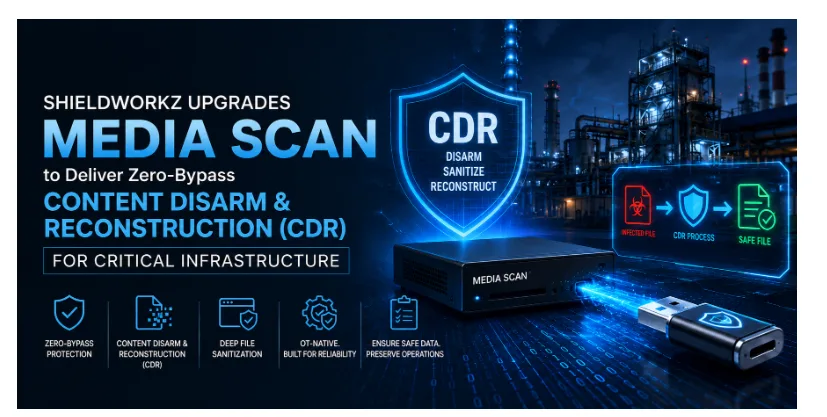
The latest enhancements significantly strengthen Media Scan’s Content Disarm & Reconstruction (CDR) capabilities, enabling organizations to move beyond detection-based security toward deterministic enforcement that actively removes malicious content before files are permitted into critical environments.
Detection Does Not Equal Control
Most enterprise security products answer a single question:
“Does this file appear malicious?”
Industrial environments require a different question:
“Can this file be safely trusted inside a production environment?”
The distinction is critical.
A detection engine capable of identifying 99% of malware still allows unknown, obfuscated, or emerging threats to pass inspection. In enterprise IT, missed detections may be recoverable. In Operational Technology environments supporting manufacturing, energy, utilities, transportation, pharmaceuticals, mining, oil & gas, food production, and critical infrastructure, a single compromised engineering project or infected firmware package can result in extended operational downtime, production disruption, safety incidents, or regulatory consequences.
Media Scan was architected to remove uncertainty from this process.
Instead of assigning confidence scores or generating alerts requiring manual review, every transferred file undergoes a deterministic inspection sequence that always produces the same outcome for identical inputs.
No exceptions.
No trusted source bypass.
No policy exemptions.
No probabilistic decisions.
Zero-Bypass Content Disarm & Reconstruction
At the core of the enhanced platform is Shieldworkz’s upgraded implementation of Content Disarm & Reconstruction (CDR).
Rather than scanning files in place and attempting to determine whether they are malicious, Media Scan reconstructs supported file types by removing active content, embedded scripts, macros, exploit payloads, malicious objects, hidden executable components, and weaponized document structures while preserving legitimate business content.
The resulting file is reconstructed into a clean, functional version suitable for industrial use.
This architectural approach fundamentally changes the inspection model.
Instead of asking whether malware was detected, Media Scan ensures malicious content is removed before the file reaches an engineering workstation, HMI, historian, PLC programming station, or industrial asset.
By rebuilding files rather than simply scanning them, the platform substantially reduces the attack surface associated with zero-day exploits, weaponized documents, macro-based malware, embedded payloads, and sophisticated file-based attacks increasingly targeting industrial environments.
Deterministic Inspection Pipeline
Every file entering or leaving the OT environment follows the same immutable inspection workflow regardless of source, user, device, or deployment model.
The enhanced inspection pipeline consists of:
- Static file structure analysis
- Parallel inspection using more than 17 independent malware scanning engines
- Advanced Content Disarm & Reconstruction (CDR)
- Global reputation validation using threat intelligence and industrial malware repositories
- Deterministic policy enforcement with a single verdict: Clean, Hold, or Blocked
Because every file follows an identical inspection path, identical files always receive identical outcomes.
This deterministic architecture eliminates inconsistencies often introduced by engine updates, heuristic scoring variations, user overrides, or policy exceptions common within traditional endpoint security platforms.
Designed for Operational Technology, Not Adapted from IT
Media Scan was engineered specifically for industrial cybersecurity rather than repurposed from enterprise IT products.
The platform supports more than 500 file formats, including native industrial engineering files used across major automation vendors including Siemens, Rockwell Automation, Schneider Electric, ABB, and other industrial control system ecosystems.
Supported engineering artifacts include firmware images, controller projects, configuration files, engineering archives, automation project files, industrial data formats, and standard enterprise document types frequently exchanged between vendors, contractors, and plant operators.
Whether deployed within completely air-gapped facilities or highly connected industrial operations, the inspection process remains identical.
Organizations can deploy Media Scan using multiple operational models including:
- Portable inspection devices for field engineers and maintenance personnel
- Fixed inspection kiosks securing physical entry points
- Desktop inspection stations supporting engineering teams
- Fully virtual inline inspection securing bidirectional IT-OT file transfers
Each deployment operates using the same deterministic inspection engine, identical policy enforcement, and centralized audit architecture.
Fail-Closed by Design
One of the defining architectural principles behind Media Scan is its fail-closed operating model.
If inspection cannot be completed because of corrupted files, unsupported formats, inspection engine failures, unavailable services, or incomplete processing, the file is automatically placed into a Hold state.
It is never permitted into the operational environment.
This eliminates one of the most common weaknesses found in traditional scanning solutions, where operational continuity often takes precedence over inspection completeness.
Within Media Scan, inspection is mandatory-not advisory.
The 5-Stage Deterministic Pipeline: Deep-Dive
The upgraded Media Scan inspection pipeline applies a zero-trust model to all file formats, running processes in parallel to maintain an average inspection throughput time of under 5 seconds, even in high-volume environments processing more than 10,000 files per day.
- Static Analysis: Evaluates file headers, structural integrity, and metadata to intercept known signature patterns and obfuscated encoding prior to execution.
- Multi-Engine Scanning: Distributes files simultaneously across 17+ independent scanning engines to remove single-point-of-failure vulnerabilities inherent in single-vendor solutions.
- Content Disarm & Reconstruction (CDR): Rebuilds files from scratch. Active macro structures, embedded scripts, and malicious payloads are stripped out. The output is a clean, fully functional asset, destroying the underlying threat rather than quarantining it.
- Reputation Validation: Queries hashes against specialized global threat intelligence banks, industrial control system (ICS) attack repositories, and OT-specific threat libraries.
- Deterministic Verdict: Emits an unalterable execution status. Because the architecture is fail-closed, any system disruption, network latency, or unparseable format results in an automatic Hold, safeguarding the physical network from unvetted code.
[File Input] ➔ [1. Static] ➔ [2. Multi-Scan (17+)] ➔ [3. CDR Rebuild] ➔ [4. Rep. Check] ➔ [Verdict: Clean/Hold/Block]
Purpose-Built for Native Industrial Protocols
While typical CDR technologies struggle with non-standard proprietary code, Shieldworkz has optimized Media Scan to naturally parse more than 500 file formats. This includes native engineering, configuration, and project types from major automation vendors like Siemens, Rockwell Automation, Schneider Electric, and ABB (such as .bin, .s7p, .acd, .rsp, .prj, .dat, and .cfg).
Unified Pipeline Across Four Ruggedized Form Factors
The upgraded Media Scan pipeline is deployment-agnostic, operating with absolute functional parity across four operational profiles to fit diverse plant topologies:
- Field (Portable USB): A completely offline, self-contained unit carried by field engineers for remote validation. Verdicts are secured at the device before the media ever touches network infrastructure.
- Gate (Kiosk): A ruggedized, physical boundary interface deployed at plant entrances or control room access checkpoints to enforce vendor compliance workflows.
- Desk (Station): A compact form factor for engineering bays and terminal workstations.
- Inline (Fully Virtual): A software-driven deployment inspecting bidirectional traffic flowing across the IT/OT boundary or inside segmented DMZs, operating invisibly without adding operator workflow steps.
Compliance Through Evidence
Modern industrial cybersecurity regulations increasingly require organizations to demonstrate-not merely claim-control over file movement into Operational Technology environments.
Media Scan automatically generates immutable per-file audit records documenting:
- File origin
- Timestamp
- Inspection stages completed
- Inspection verdict
- Enforcement action
- Chain of custody
These audit records support compliance initiatives aligned with IEC 62443, NIST SP 800-82, ISO 27001, NIS2, and other industrial cybersecurity frameworks requiring demonstrable control over removable media and OT boundary protection.
Rather than assembling evidence after an audit request, organizations maintain continuous, exportable compliance records for every inspected file.
Built for High-Availability Industrial Operations
Media Scan supports inspection volumes exceeding 10,000 files per day while maintaining average inspection times below five seconds through highly parallelized processing across multiple inspection engines.
The platform integrates with enterprise identity systems, SIEM platforms, ITSM workflows, secure file transfer infrastructure, and custom operational workflows through comprehensive API support while continuing to operate fully offline within isolated environments where required.
Its architecture is designed to preserve operational continuity without compromising deterministic security enforcement.
Executive Perspective
“Industrial organizations don’t lose sleep over malware alerts-they lose sleep over the one file that bypasses inspection,” said a Shieldworkz spokesperson.
“Critical infrastructure requires certainty, not probability. With the enhanced Media Scan platform, we’re strengthening our deterministic approach by advancing Content Disarm & Reconstruction, ensuring that every file entering an OT environment is inspected, reconstructed where required, and subjected to a single enforceable verdict. Security should not depend on confidence scores. It should depend on policy enforcement.”
About Shieldworkz Media Scan
Shieldworkz Media Scan is a deterministic removable media security platform purpose-built for Operational Technology and critical infrastructure environments. Combining multi-engine malware inspection, Zero-Bypass Content Disarm & Reconstruction (CDR), fail-closed enforcement, native industrial file support, and immutable audit logging, Media Scan provides organizations with a policy-driven approach to controlling file movement across OT boundaries. Available in portable, kiosk, desktop, and fully virtual inline deployment models, Media Scan helps industrial organizations strengthen cyber resilience while supporting compliance with leading OT cybersecurity standards.
