
Thursday, September 3, 2026



News and Views from the Global South
SRI LANKA: Gov't Celebrates Battle Gains in Tamil Areas
IPS Correspondents
- Sri Lankan national flags hoisted at important locations and posters depicting army offensives against the Tamil rebels are part of week-long celebrations ordered by the government of President Mahinda Rajapakse to mark its latest battlefield victories in the north of the island.
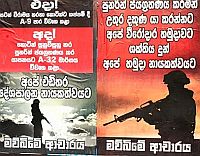
Posters celebrate the valour of the Sri Lankan army in fighting Tamil rebels. Credit: IPS Correspondents
"We join all peace-loving people of this country in saluting the security forces and the police for the brave and patriotic roles they have played in regaining the strategically and political important Pooneryn," the ‘Daily Mirror’ said in a Nov. 17 editorial titled ‘Heroic Achievement’.
"The political leadership led by President Mahinda Rajapakse that pursued the aim of ridding the country of the curse of terrorism undoubtedly deserves the people’s encomiums," the editorial said.
The upbeat mood was even reflected in cyberspace where enthusiastic Facebook users changed their profile pictures to the national flag or a graphic honouring the armed forces.
"Dear Sri Lankans! Please use national flag as your profile picture during this week as it has been named as a ‘Ranaviru (battle valour) Week’ to honour the brave soldiers who liberated Pooneryn," one post read.
Morning radio shows are inundated by listeners calling in with congratulatory messages.
The public felicitations came as weekend fighting witnessed government troops, buoyed by the latest successes, upping the tempo in the northern battle theatre.
Troops gained control of Pooneryn, a strategic town located on the northern Jaffna peninsula, after a lapse of 15 years on Nov. 15. The success prompted Rajapakse to call for the surrender of the Liberation Tigers of Tamil Eelam (LTTE) for the second time in as many weeks.
"At this moment, I very clearly call (Velupillai) Prabhakaran of LTTE to immediately lay down arms and come to the negotiation table. It is the greatest service that you can do to the people," he said in an impromptu national address that broke into usual TV programmes on Nov. 15 morning, announcing government troops moving into Pooneryn.
The battlefield victories have prompted speculation that Rajapakse’s nationalist coalition may take advantage of the euphoria generated to call early elections and try to win a second term in office.
The latest military successes allow government troops to open a supply route to Jaffna and other areas in the north for the first time in almost a decade. "Now, we can open a land route to the Jaffna peninsula after many years," the President said.
The weekend success also saw the Sri Lankan army stepping up attacks on LTTE positions along the lines of control in areas held by the rebels in Sri Lanka’s north, known as the Vanni.
"The loss of Pooneryn will weaken the offensive capability (of the LTTE) and present the troops as a bigger target," Sri Lankan terrorism expert Rohan Gunaratana told IPS. Gunaratana, who is attached to the Institute of Defence and Strategic Studies, Singapore, felt that the loss of Pooneryn would lead to more land areas coming under government control.
On Nov. 15 clashes were reported along the Muhamalai line of control that demarcates the northern border of areas held by the LTTE, and two days later the defence ministry said troops had closed in on Mankulam, an important town 30 km south of the Tiger political nerve centre of Kilinochchi.
"We will win the battle against terrorism. We will liberate the Northern masses from the Tigers and create a peaceful atmosphere for all communities to live together," the country’s powerful defence secretary Gotabaya Rajapakse, the president’s younger brother, told the state-owned ‘Daily News’ on Nov. 17.
The Tigers, who have remained largely silent in recent battles, said that in the two days since Nov. 15 they had thwarted three consecutive attempts by government forces to break out of the northern Vanni forward lines. They also said that at least 36 soldiers had been killed and scores injured in battles along the northern line of control.
There was anticipation that fighting would increase as government troops intensified their advances into the Tiger heartland.
"The Sri Lankan army was expected to step up the offensive operations and the LTTE to encapsulate its defensive region with stringent combat coordination of its Northern, Western and Southern defensive formations," the pro-Tiger TamilNet portal said.
Coincidentally, fighting intensified in the north as the first shipment of relief supplies from the Indian government arrived in Colombo on the evening of Nov. 15.
The relief, the first of its kind from India since the disastrous induction and removal of the Indian Peace Keeping Force to the island in the late 1980s, will be distributed among over 230,000 internally displaced persons (IDPs) remaining in Tiger-held areas by the International Committee of the Red Cross (ICRC).
"We will hand over supplies to the ICRC once the customs formalities are concluded. It is quite a large consignment and will take a couple days," Dinker Asthana, spokesman for the Indian High Commission in Colombo, told IPS. The handover is scheduled for Nov. 20.
The ICRC remains the only agency with a permanent presence in the Vanni after the United Nations and other international agencies relocated out following a government directive in mid-September.
The Sri Lankan government said that 1,700 MT of supplies in 100 containers had arrived in a ship operated by the Indian Shipping Corporation.
An official from the ICRC Colombo office had visited Tamil Nadu state in southern India and inspected the supplies before they were shipped, ICRC communications officer Sarasi Wijeratne told IPS. "The supplies are up to international standards," she said.
"This is the first time that India has provided humanitarian aid to conflict-affected people in Sri Lanka through the ICRC. We have seen the relief items and they do indeed correspond to the needs of the displaced people we see in the Vanni," Paul Castella, the ICRC's new head of delegation in Sri Lanka, said.
The Indian supplies include food, clothes, hygiene and sanitary goods. The ICRC and U.N. meanwhile said that the onset of the rains in the Vanni had increased the risk of water-borne diseases.
"Thousands of IDPs are without adequate shelter and open defecation is widespread due to the lack of toilet facilities," the Inter-Agency Standing Committee (ISAC), an umbrella body of U.N. and other agencies, said in its latest situation report.
"The ICRC and health authorities remain on the alert for further outbreaks of malaria and other mosquito-transmitted diseases which could become more prevalent as the rainy season arrives in the Vanni," the ICRC said in its monthly bulletin for October.
ICRC’s head of operations in areas under Tiger control, Hicham Mandoudi, said that IDPs were looking for stability after being forced to move several times.
"Security and stability are pressing concerns for displaced people in the Vanni. Many of them have had to flee several times since hostilities escalated in July," Mandoudi said. "They're exhausted after moving from one place to another, each time leaving behind more of their belongings."
 Print
|
Print
|


Pictures for this story
This story includes downloadable print-quality images -- Copyright IPS, to be used exclusively with this story.


