Wednesday, September 2, 2026



News and Views from the Global South
POLITICS-US: Obama Rode the Crest of a New Coalition
Ali Gharib
- Ahead of Tuesday’s presidential election in the U.S., many critics were questioning the Democratic strategy. Spending money outside of the usual battleground states and relying heavily on new voters whose appearance at polling places is usually unreliable were bold ideas with unproven results, much like the Democratic candidate himself.
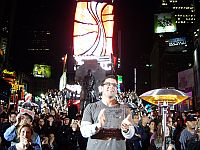
Thousands of people gathered in New York City's Times Square to celebrate Obama's victory Tuesday night. Credit: Ulrich Knapp/IPS
Obama’s victory at the polls was marked by a seismic shift in both voting demographics and regional voting patterns, with the former often feeding the latter.
For lack of a better term, the old political cliché of changing geographic and demographic trends applied to this election in spades: Obama redrew the electoral map.
Aggressive campaigning – his celebrated “ground game” leading to massive numbers of new registrations and a seemingly unlimited advertising budget to spread his message – yielded Obama’s demographic shift. The Democratic coalition of old remained strong, but it was expanded to segments that came out in force for Obama.
“The three main groups in the new Democratic majority are professionals (college-educated workers who produce ideas and services), minorities (including African-Americans, Latinos, and Asian-Americans), and women (particularly working, single and college-educated women),” wrote John Judis in The New Republic on Wednesday.
“These groups, which overlap in membership, are also the key components of the new post-industrial economy,” he wrote. The post-industrial world “has brought in its wake a new political worldview.”
The centres of the post-industrial economy allowed Obama, according to Judis, to expand the Democratic electoral map into places like Virginia (in suburban Northern Virginia), North Carolina (with Charlotte and the “research triangle” of three college towns), Colorado (with the Denver/Boulder area) and Orlando and gain ground in traditional battlegrounds like the southern end of all-important Florida.
Florida and Colorado, in particular, benefited from Democratic outreach to Latino voters, which, with their expanding proportion of the populace and electorate, signals a troubling development to Republicans.
Obama carried Latino voters by more than a two-to-one margin – 66 to 32 percent -according to a Pew Hispanic Centre publication based on exit polls.
Generally considered a swing demographic, and courted strongly and effectively by George W. Bush, Latinos went overwhelming for Obama, making him competitive especially in Florida, the Southwest, and (in a slight overlap) the Rocky Mountain West.
The Republican anti-immigration platform of draconian enforcement and strict limitations, used by the party as a wedge issue, has alienated the mostly recent immigrant Latino population, the immigration reform group America’s Voice said in a statement.
“Republican hostility towards Latinos in general and Latino immigrants in particular is driving this fast growing group of new voters…into the hands of Democrats,” said America’s Voice Executive Director Frank Sharry. “If Republicans expect to emerge from the political wilderness, they will have to separate themselves from the anti-immigrant extremists that have hijacked most of the party.”
Former Republican presidential candidate Sen. John McCain, despite having once been a moderate voice for immigration reform, appeased hard-liners in the Republican base by largely staying quiet about the issue.
In New Mexico, Latinos made up 41 percent of the electorate and voted for Obama by nearly a 40-point margin.
In Colorado, Latinos more than doubled their percentage of the electorate to about 17 percent. Obama won nearly three-quarters of the group, and carried the state with 53 percent of the vote.
In Nevada, Latinos supported Obama by a nearly four-to-one margin.
Latinos, a largely Catholic group, were among several groups of religious voters who seemed to take to Obama’s appeal to people of faith – a group that usually heavily favours Republican candidates.
The most modest of these gains came among evangelicals, where rumblings suggested that they may go more heavily for Obama. In the end, however, Obama’s five-point increase over 2004 Democratic candidate John Kerry’s totals among evangelicals only brought about 26 percent of their support.
Obama also only gained five and seven percentage points among Protestant and Catholic voters at-large, according to a Per Research Centre study based on MSNBC exit polls. But those gains were both enough to give Obama majority support among the two groups.
Another hotly contested religious constituency was Jewish voters, who were targeted by Republican smears distorting Obama’s support for Israel and whisper campaigns that he was a Muslim and a Manchurian candidate.
But Obama actually gained ground among Jewish voters when compared with Kerry’s run, garnering 78 percent of their vote.
Young voters, notably, also came out in force with big numbers in favour of Obama. While many expected the youth outpouring, Obama’s support was significantly greater than Kerry’s share of the demographic in his failed challenge to outgoing Pres. Bush.
But among older voters, those over 65, McCain won by a five-point margin.
While overwhelming black support for his historic candidacy and support from transplants from the North in places like Florida and North Carolina, bolstered Obama’s gains in new Southern battlegrounds, Southern whites remained elusive to the Democrat.
“Just 31 percent of Southern whites voted for Obama,” said a Pew Research Centre publication, “while he garnered the support of about half of white voters lying in other states.”
Indeed, one of the other regions where Obama benefited from white support was the industrial Midwest.
But the redrawn map, said Judis in The New Republic, may be more than an aberration.
“The rise of these voting groups within the new post-industrial economy has brought in its wake a new political worldview,” he wrote. “Call it ‘progressive’, ‘liberal’, or even ‘Naderite’ (for Ralph Nader the consumer advocate, not the egomaniacal presidential candidate).”
More and more people, wrote Judis, are identifying themselves as “liberal”, and the political realignment may be more lasting than with the elections of the last two Democratic presidents because Obama has caught the wave of this new coalition and “new political worldview” just as it has come of age, rather than when it breaks by the shore and then recedes.
“Unlike [former Democratic Presidents Jimmy] Carter [1977-1981] and [Bill] Clinton [1993-2001],” wrote Judis, “Obama will be taking office with the wind at his back rather than in his face.”
 Print
|
Print
|