
Saturday, October 10, 2026



News and Views from the Global South
DEVELOPMENT: Zimbabweans Worried About Aid With Strings Attached
Stanley Kwenda
- Aid with strings attached frequently does not translate into the improvement of the lives of the people for whom that money was ostensibly sourced in the first place. Most of the capital received in aid is used to pay back debt owed to Western donors.
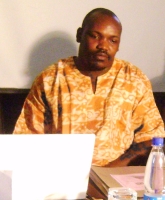
Vitalice Meja: Reparations, not aid. Credit: Stanley Kwenda/IPS
The conference was convened to discuss how the Zimbabwean economy can be kick-started once the Southern African Development Community’s (SADC) political settlement for the country is in place.
Already there has been talk of a plethora of donors lining up to offer aid to the new Zimbabwean government of unity. But the country is still struggling with debt repayments stretching as far back as 1980 when the country gained its independence from Britain.
Some of this aid was received during the 1990s through the disastrous Economic Structural Adjustment Programme (ESAP) and has resulted in Zimbabwe’s mounting external debt, said to be 4,9 billion dollars, according to Swedish solidarity organisation Africa Groups of Sweden (AGS) statistics.
Presenting a paper titled ‘‘Scenarios for Aid, Prospects for Zimbabwe’’, Vitalice Meja of the African Forum and Network on Debt and Development (AFRODAD) argued that because of the ties that comes with aid money, African governments end up using only a quarter of the money received while paying back four times more that what was received.
AFRODAD is a civil society organisation concerned about Africa’s debt burden.
‘‘Aid is still conditional and, as a result, African governments end up with only about 37 percent of the original amount, so what's the point?’’ Meja asked.
He said civil society has a significant role to play in future donor dealings with any new government of Zimbabwe. ‘‘We need to demystify aid as charity. It is not but it still has a role to play in this country. For example, more than 11,7 billion US dollars is needed to rehabilitate roads and ensure adequate water provision – which are some of the key components for a recovery.
‘‘But where will all that money come from?’’
Meja demanded a rethink: ‘‘It's time we say stop giving us your aid, we no longer want it. African countries are net exporters of capital. These donors should be seen for what they – thugs. Because 95 percent of capital from Africa goes to the West as debt repayments.’’
He emphasised that if African governments are to refuse aid, sound economic policies should be put in place first. He said other states in the South such as Chile and Argentina have confronted this unfair system but made sure they had did proper macro-economic policy frameworks in place.
He added that instead of trying to attract foreign direct investment from Western countries, Africans should lure African Diaspora investors.
Dennis Kellecioglu, an economist with Africa Groups of Sweden (AGS), differed from Meja, saying African countries such as Zimbabwe cannot afford to dump foreign aid because not all aid is bad.
‘‘We have to ask as Africans if we can afford to do this if we still have good aid. For example, this meeting is paid for with aid money. We are having good lunches, the venue is paid for and we are capacitating ourselves with aid money. Isn't that good aid?’’
Aid to Africa is often a talking point. Many think it is wasted by corrupt governments or spent on projects that fail. It is undeniable that over the years much foreign aid has not been used as effectively as it could have been. But aid can make a huge difference to the lives of women and men living in poverty.
A country such as Mozambique was at one time the poorest country in the world but has moved onto a sustainable growth path, thanks to aid.
Over the years aid has been used as both a political pawn on the Cold War chessboard and to peddle particular economic models. Through what is commonly known as the ‘‘Washington Consensus’’, donors, the World Bank and the International Monetary Fund have prescribed cuts in public spending.
At the same time they encouraged governments to liberalise trade and reduce the role of the state in economic affairs, primarily through privatisation of state-owned enterprises.
This has resulted into the privatisation of critical sectors of African countries which has left many developing countries struggling to address the current global food and financial crises. The same donors are likely to abandon these countries as they attempt to come to terms with the global financial crisis.
According to the Labour and Economic Development Research Institute of Zimbabwe (LEDRIZ), there is increasing evidence that solutions that come with aid money rarely work in the interests of the poor. Over the past five years, there has been a growing international consensus that economic policy conditionality does not work.
LEDRIZ is a policy and research think tank of the Zimbabwe Congress of Trade Unions (ZCTU).
The Paris Declaration on Aid Effectiveness, signed by donors and aid recipients a few years ago, set 12 targets to be reached by 2010. At its heart is the need to provide more aid on a long-term basis through recipient government systems in line with these governments' development priorities.
But Meja still insisted that ‘‘ideally, African countries should exit aid and stop behaving like 20 year olds still being weaned. We should demand reparations for what these same donor countries did to us but this must be done collectively.’’
 Print
|
Print
|




