
Monday, October 5, 2026



News and Views from the Global South
ENVIRONMENT-AUSTRALIA: Discoveries Highlight Danger to Reefs
Stephen de Tarczynski
- Efforts to create an inventory of life on Australia’s major coral reefs – to be used as part of a baseline to determine the impacts of global warming and overfishing upon reefs – have turned up hundreds of previously unknown and rare species.
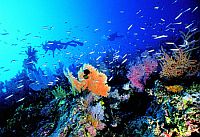
Previously unknown species have been discovered through coral reef conservation efforts. Credit: WWF
While the findings – which include around 300 soft coral species, of which 50 percent are believed to be new to science; dozens of new, small crustacean species; previously unknown shrimp-like animals with claws longer than their bodies; and scores of tiny amphipod crustaceans, known as the ‘insects of the marine world’ – demonstrate the rich biodiversity of coral reefs, they did not necessarily come as a surprise.
“I’m not surprised in the sense that, generally, our knowledge of the oceans is so poor compared to the land and even compared to the moon,” says Dr Ian Poiner, chief executive officer of the Australian Institute of Marine Science (AIMS), which led two expeditions to Lizard and Heron Islands on the Great Barrier Reef and one to Western Australia’s Ningaloo Reef, from which the information was garnered.
The Great Barrier Reef, which lies off the coast of the state of Queensland, is the world’s largest reef system. Made up of almost 3,000 individual reefs and 900 islands, the reef stretches for more than 2,500km.
“Although we know a fair bit about the coral biodiversity and the fish biodiversity, we know not a lot about the rest,” adds Poiner.
Among the more bizarre findings was an amphipod called Maxillipiidae – only a few species of which are recorded worldwide – whose whip-like back leg is three times the size of its body.
The study of the biodiversity of Australia’s reefs is part of the global Census of Marine Life (CoML) – Poiner is also chairman of the Scientific Steering Committee of the CoML – which will release its first set of data on the diversity, abundance, and distribution of ocean life in October 2010 following a decade of research.
Poiner told IPS that the census has historical, current, and future components.
“The historical [component] is about what the oceans looked like from just before the start of commercial fishing, through to what they currently look like, and using all that information to forecast what it will look like under different scenarios,” he says.
And with work around the world focusing on coral reefs – the so-called ‘rainforests of the ocean’, so-called due to their biodiversity, which occupy less than one percent of the ocean’s floor yet support an estimated 25 percent of all marine life – Poiner says that Australian reefs can play a vital role in increasing the understanding of marine life.
“The Australian work is particularly relevant because our reefs, comparatively, are in very good shape and are well managed. Hence, it’s an ideal place,” says the AIMS boss.
Yet while the tracking of changes in and around reefs, such as the Great Barrier Reef, will play a part in monitoring the health of the world’s oceans, the reefs themselves are at risk of disappearing.
According to the United States-based Coral Reef Alliance (CORAL) – an international organisation aiming to protect the health of coral reefs, with a focus on reefs in the Asia-Pacific and Caribbean-Central American regions – coral reefs face a range of threats, from pollution and sedimentation to tourism, fishing practises, and even coral mining.
But Brian Huse, CORAL’s executive director, says that climate change represents the biggest threat. He says that coral polyps – invertebrate animals whose skeletons, in the case of hard corals, build coral reefs – starve to death as ocean temperatures rise.
Coral polyps are also prevented from creating shells and skeletons when the ocean becomes more acidic, due to increasing levels of carbon dioxide being absorbed by the oceans, says Huse.
He told IPS that “the present situation is fairly dire.”
“We have already lost 25 percent of the planet’s coral reefs in the past 40 years,” says Huse, arguing that if measures to stop the destruction of reefs are not increased, 50 percent of the remaining reefs could be gone within 30 years.
While reefs are particularly sensitive to changes in the environment – “despite the fact that coral reefs have been on this planet for millions of years,” says Huse – and can therefore be used to rapidly measure the health of oceans, there are also significant economic and social benefits derived from their existence.
“From an economic standpoint, coral reefs contribute more than U.S.$400 billion to the annual global economy from fisheries, tourism and coastal protection,” declares Huse, adding that reef fisheries are the main source of protein for one billion people worldwide.
Reefs also provide natural storm protection to coastlines – CORAL says that in the Indian Ocean tsunami in Dec. 2004, “some coastlines were spared further damage as a result of healthy reefs” – while according to Huse, “toxins found in reef species are being researched and harnessed to create lifesaving drugs for the treatment of cancer, HIV-AIDS, and chronic pain.”
In order to turn the tide away from coral reef destruction and towards maintaining the world’s remaining reefs, Huse says that Marine Protected Areas (MPAs) – an umbrella term used to describe the gamut of protected areas, including coral reefs – are keys to address the loss of reefs.
“In areas with responsibly managed MPAs, supported by the communities that rely on reefs for food and income, local threats are reduced and reefs become more resilient to major stresses like climate change,” says the CORAL director.
But Huse argues that more needs to be done.
“Our current habits are taking us down a path of outright destruction for coral reefs, and given the importance they play in the overall health of the ocean and its creatures, we think it’s essential to forge a new path of protection and sustainability,” he says.
 Print
|
Print
|




