
Thursday, October 8, 2026



News and Views from the Global South
SRI LANKA: Help For Embattled Civilians Missing
IPS Correspondents
- An estimated 230,000 people are in dire need of assistance in the northern areas of Sri Lanka that remain under the control of Tamil separatist rebels, according to international humanitarian agencies.
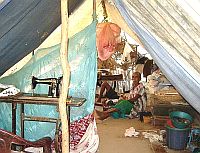
Inside a temporary shelter in Kilinochchi. Credit: IPS
Headed by its reclusive leader, Velupillai Prabhakaran, the LTTE has been fighting to carve out an independent homeland for the Tamil minority in the Sinhala-majority island nation since 1972. Close to 75,000 people are said to have died in the conflict since then.
The Inter Agency Standing Committee (IASC), an umbrella body of international aid agencies, including United Nations bodies, say that the number of internally displaced persons (IDPs) in the Vanni could be as high as 230,000. "An estimated 200,000 people are at risk in the Vanni and will need more assistance," the IASC said in its latest situation report.
Kilinochchi, the political headquarters of the LTTE, was being abandoned by civilians as fighting grew closer to the town. Civilian sources in Kilinochchi told IPS that the civilians were moving northeast of the town, deeper into the Vanni.
"They are setting up camp in the Darmapuram area, about 15 km from Kilinochchi, where there is water because of irrigation canals," sources at the Kilinochchi hospital said. "But toilet facilities will be a big problem because everyone is using the open grounds."
The IASC report indicated that fighting was drawing closer to Kilinochchi. "Aerial bombardments, shelling, and small arms fire in areas close to Kilinochchi town continue to be reported as the military campaign has intensified. As a result much of the population of Kilinochchi town has been displaced, and IDPs from other areas staying in and around Kilinochchi have moved," the report said.
International aid agencies, including U.N. bodies, relocated out of the Vanni on Sep. 16 following a government directive. Only the International Committee for the Red Cross (ICRC) continues to have presence in the area.
No agency has recommenced work since the relocation, but the U.N. said that it was keen to continue with its assistance to the civilians in the Vanni. "We want to keep playing that vital role," Gordon Weiss, U.N. spokesman in Colombo, said. "We are in the process of making arrangements with the government on the modalities of working in the Vanni."
The government has indicated that the logistical capacity of the World Food Programme (WFP) would be used to keep supplies moving into the Vanni. In fact, it had suggested that the WFP remain in the Vanni despite the relocation, but the suggestion was rejected by the U.N.
ICRC officials said that there were no shortages or crisis situations that had been reported from the Vanni, but there were areas of concern.
"The most pressing needs of these people are security, health, water, shelter, sanitation and food. Local health facilities have moved along with the civilian population and are continuing to provide health services under extremely difficult conditions. Kilinochchi District General Hospital has been receiving even more patients than usual. No large-scale health problems have yet been reported, but the approaching monsoon rains are cause for concern," Anthony Dalziel, ICRC deputy chief in Sri Lanka, said.
At least 14 medical institutions in the Vanni have been relocated since June due to the fighting, resulting in a loss of 200 beds.
Education has also been impacted badly in the Vanni. The U.N. reported that 45 percent of the applicants from the Vanni were unable to sit for the main university entrance exam held in August.
At least 30,000 schoolchildren have been affected by the fighting, according to non-government organisations (NGOs). "We want to continue with the work we did with schools like setting up temporary learning centres," said Menaca Calyaneratne, spokeswoman for the Britain-based Save the Children.
The Sri Lankan government has given assurances that it will look after the civilian population in the Vanni despite continuing with operations against the Tigers.
"Our government considers the supply of humanitarian relief to its people as its prime responsibility," President Mahinda Rajapakse told the U.N. General Assembly on Sep. 24. "The government of Sri Lanka continues this humanitarian policy even today although we know that the terrorists seize a good proportion of these humanitarian supplies. Our supplies are not confined to food; they extend to medicines and all other essentials as well as schools and hospitals, with teachers, doctors, nurses, and all other essential staff."
Rajapakse also noted that U.N. agencies and the ICRC have pledged to support the government’s humanitarian efforts. "Our government has also sought and received the cooperation of the U.N., ICRC and other agencies to help us in providing humanitarian assistance."
On the sidelines of the General Assembly sessions in New York, the co-chairs of the Tokyo Donor Conference, a collective of major donors to Sri Lanka comprising the European Union, Norway, Japan and the United States, met for an informal discussion of the current situation in Sri Lanka.
"We're placing a lot of emphasis right now on the protection of human rights for civilians who are caught in the fighting and the democratic government's responsibility for respecting and extending human rights protections to the people in the areas they take over," Richard Boucher, U.S. assistant secretary for South Asian affairs, told reporters after the meeting.
There was no Sri Lankan government representation at the meeting, but Boucher was quoted as saying that diplomats were meeting with Sri Lankan officials separately and that some were in contact with the LTTE as well.
 Print
|
Print
|



Pictures for this story
This story includes downloadable print-quality images -- Copyright IPS, to be used exclusively with this story.


