
Tuesday, October 27, 2026



News and Views from the Global South
POLITICS: Sudan Genocide Charges Split Global Community
Thalif Deen
- A move to indict Sudanese President Omar Hassan Ahmad Al-Bashir for genocide and war crimes in Darfur – the first against a sitting head of state – is threatening to split the international community.
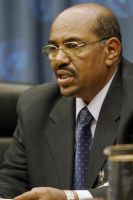
Sudanese President Omar Hassan Ahmad Al-Bashir Credit: UN Photo/Erin Siegal
The prosecutor of the International Criminal Court (ICC) in The Hague, Luis Moreno-Ocampo, Monday presented evidence showing that Al Bashir committed crimes of genocide in Darfur. The evidence came three years after the Security Council asked him to investigate the charges.
The 18 ICC judges, representing the various geographical regions, will have to weigh the evidence and decide whether or not to issue a warrant for Al-Bashir’s arrest.
This process could take several months – and will be played out against the backdrop of a rousing political controversy over the timing of the indictment and the merits of a possible arrest of an African head of state.
Under Article 16 of the Rome Statute that created the ICC, the 15-member Security Council has the power to suspend any indictment of Al-Bashir – under “deferral of investigation and prosecution.”
A Third World diplomat told IPS that both Russia and China, which jointly vetoed a Western-sponsored resolution to impose sanctions on Zimbabwe last week, apparently indicated they were willing to abstain on the vote provided the United States, France and Britain would give an “up-front assurance” that the Security Council would hold back the indictment against Al-Bashir.
But the three veto-wielding Western states presumably were unwilling to give that assurance, primarily during discussions in the various capitals, precipitating the vetoes.
If the ICC decides to issue an arrest warrant against the Sudanese president, there are fears of a political and military backlash against the ongoing peace process, which may also endanger the 9,000 peacekeepers in the African Union-U.N. Hybrid Operation in Darfur (UNAMID) in that troubled province.
Bill Pace, executive director of the Institute for Global Policy, and who has been closely monitoring the ICC since its creation, said: “Basically, it is incorrect to accuse the ICC of jeopardising peace or UNAMID.”
He said peacekeeping forces, sanctions, and international justice are only a few tools for peace that the Security Council has, under its extraordinary chapter seven authority in the U.N. Charter, invoked since 2005 to address the threat to international peace and security posed by the war-making actions of the Sudanese government and rebel groups.
“The Sudanese government and rebel groups have not cooperated with the deployment of any of these tools by the Security Council,” Pace told IPS.
Secretary-General Ban Ki-moon, who has been heavily involved in bringing peace to Sudan, diplomatically distanced himself from the decisions of ICC and its prosecutor.
“The secretary-general emphasises that the Court is an independent institution and that the United Nations must respect the independence of the judicial process,” Ban’s spokesperson said Monday.
The Brussels-based International Crisis Group (ICG) says the move “creates both big opportunities and big risks for peace in Sudan.”
“The problem for international policymakers is that the prosecutor’s legal strategy also poses major risks for the fragile peace and security environment in Sudan, with a real chance of greatly increasing the suffering of very large numbers of its people,” the group said.
ICG President Gareth Evans says the judgment call the Security Council now has to make is whether Khartoum can be most effectively pressured to stop the violence and build a new Sudan.
“This could be done by simply letting the Court process proceed, or after assessing the regimes initial response, and continuing to monitor it thereafter, by suspending that process in the larger interests of peace,” he said.
Bill Fletcher, Jr., executive editor, BlackCommentator.com, said the ICC’s indictment of Al-Bashir is, at best, “poorly timed”.
“There is little question that he is ultimately responsible for the horror being experienced by the people of Darfur,” he said.
“Nevertheless, the indictments do not help the peace process, and this is what we should be most concerned with,” Fletcher told IPS.
If anything, the indictments will more than likely make room for a compromise that much more difficult to achieve.
“While Al-Bashir, and his clique, must ultimately be held accountable for Darfur, what must be primary is working through a long-term peaceful solution to that political crisis,” Fletcher added.
In a statement issued Friday, the Peace and Security Council of the 53-member African Union, which represents African states, said “the search for justice should be pursued in a way that does not impede or jeopardise efforts aimed at promoting lasting peace.”
The statement, which was implicitly supportive of Al-Bashir, said the AU was “concerned” with the “misuse of indictments against African leaders”.
The Sudanese government has also called for an emergency meeting of the League of Arab States, of which Sudan is a member. The League is most likely to support Al-Bashir.
Pace said if the use of one peace tool presents problems for other tools, such as jeopardising peace operations, it is for the user of the tool, namely the Security Council, to address this issue, not the ICC prosecutor and judges.
“They are simply doing the job the international community asked them to do,” Pace pointed out.
He said the Rome statute has three ways that cases can come before the ICC: one, by states referring situations to it, and two, by the prosecutor acting independently seeking judicial support bringing a case forward.
The third route for ICC jurisdiction is that the various governments drafting the ICC Statute agreed to allow the Security Council to refer matters to the ICC under chapter seven of the U.N. charter. This route would allow for jurisdiction over nationals and territories of all U.N. member states whether they have ratified the ICC treaty or not.
This, the governments believed, was consistent with the U.N. Charter authority granted the Security Council as it has been exercised many times, such as in setting up ad hoc and special courts.
“Thus, Sudan’s argument against the jurisdiction of the ICC is without merit,” Pace told IPS.
One could argue that three of the permanent members – Russia, China and the United States – are using a court they have not agreed to, which means they enjoy a special exemption in international law.
China and the United States voted ‘No’ in Rome during the creation of the treaty. Russia voted ‘Yes’, and signed the treaty, but has not yet ratified.
The big powers in the Security Council, he said, must have understood that the ICC would file charges against the Sudanese government and rebel leaders most responsible for the current state of affairs, so this indictment should not be a surprise.
Pace added that Russia and China are reportedly major weapons traders with Sudan, and China a major oil purchaser.
“The big powers must take responsibility – unless they allow a catastrophic situation to get even worse. Blaming one band-aid [the ICC] for making a wound worse is ridiculous,” Pace declared.
 Print
|
Print
|




