
Monday, October 26, 2026



News and Views from the Global South
POLITICS: Iranian Envoy Calls New Offer “Constructive”
Omid Memarian
- Iran’s Foreign Minister Manouchehr Mottaki said Wednesday that Tehran is finalising its response to the European Union’s latest offer to suspend uranium enrichment, as European officials called for more pressure by the U.N. Security Council if Iran rejects the incentives package.
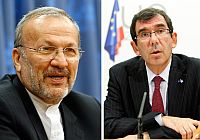
Iran's Foreign Minister Manouchehr Mottaki (left) and French Ambassador Jean-Maurice Ripert. Credit: UN Photo
“For the moment, we still offer a chance to dialogue,” he said, adding that, “The last time that [Javier] Solana, who is responsible for political security policy, went to Tehran… his discussions did not yield the results we hoped for.”
“The Iranians recalled their own proposals and at that time refused to support the incentive cooperation package that the West offered,” Ripert said at a press conference Tuesday. “This document is still on the table and we are waiting to hear the official response of the Iranian authorities.”
Amid rumours that Tehran planned to accept the proposal, Mottaki told reporters at the United Nations Wednesday that Iran would respond “in a short time” to the offer from the P5+1 – the United States, Britain, France, China, Russia and Germany – and “hope[s] to enter into a comprehensive process and approach.”
“Mr. Solana’s and the [European] delegation’s approach were different, constructive and respectful in terms of form and content this time and we have considered this point in our review of the package,” said Mottaki. “We have also considered the possibility of finding a solution to solve the problems that have been emphasised in talks and interviews.”
“Our reviews about the offered package and our negotiations with the 5+1 have created a new environment, that’s why we will look precisely and seriously pay attention to these discussions,” he added.
On Jun. 12, the EU’s foreign policy chief Javier Solana offered a modified package of economic, technological and political incentives to Iran to suspend its uranium enrichment, which Iran has refused to do despite a series of resolutions adopted by the Security Council since 2007.
In response to a question from IPS about recent reports that Iranian officials were looking favourably on the EU offer, Mottaki said that, “We also see the possibility for a comprehensive understanding and this is a path diplomats are going through.”
The government’s spokesman, Gholam Hossein Elham, had initially said that Iran would not accept the package if included a demand to suspend uranium enrichment, a process that can produce nuclear fuel to generate electricity or build a bomb. Tehran has repeatedly said that its nuclear programme is solely for peaceful purposes.
President Mahmoud Ahmadinejad has also clearly indicated that economic sanctions will not alter the country’s intention to pursue nuclear power. “If they want to continue with that path of sanctions, we will not be harmed. They can issue resolutions for 100 years,” he said in a television interview last February.
In response to a question from IPS about the EU’s position on a possible preemptive military strike against Iran’s nuclear facilities by the United States or Israel, Ambassador Ripert said that the EU is waiting for Iran’s response to the offer. “If the final answer is not satisfactory, then we will go back to pressure. It means confirmative legality in the Security Council of the United Nations.”
Pressed on whether this could include a military attack against Iran, he responded, “It means all means that are decided by the Security Council.”
However, in another sign that a breakthrough may be near, Dr. Ali Akbar Velayati, a top advisor to Iran’s Supreme Leader Ayatollah Ali Khamenei, recently said that it would be in Iran’s interests to continue negotiations with the EU.
“At the present time, the United States and the others that act against Iran’s good want us not to accept the offer, which makes it clear that accepting the EU offer is to Iran’s benefit,” he told Jomhuri Eslami, a conservative newspaper in Tehran that usually reflects the supreme leader’s positions on domestic and international affairs.
Velayati, who served as Iran’s foreign minister for 16 years in the 1980s and early 1990s, said that Iran should also pursue parallel diplomacy tracks.
“First is collaborating with the International Atomic Energy Agency, and second, collaboration with effective countries in the international community which are mainly among the 5+1 countries,” he said.
Kambiz Tavana, a prominent journalist and political analyst, told IPS, “It’s a kind of deadlock for Iran. Accepting the incentives will diminish Ahmadinejad’s room to manoeuvre, so probably they would resist that.”
“In the meantime, Iran’s security is at stake as the U.S. sends clear signals and Israel is echoing them as well,” he said in an interview from Tehran. “The wise decision, in the Iranian religious leaders’ point of view, would be finding a way to mix the Iranian package and EU package, and say to the people, ‘we found a mutual agreement’, and so save face.”
Tavana emphasised that Iran’s political elite has repeatedly asked the government to act responsibly. “Meaning cooperate with the international community, suspend enriching uranium – at least temporarily – and build confidence,” he said.
 Print
|
Print
|




