Saturday, October 3, 2026



News and Views from the Global South
CLIMATE CHANGE: Indians Speak Out Against Carbon Markets
Haider Rizvi* - Tierramérica
- International policymakers are facing fierce criticism from leaders of the world's 370 million indigenous peoples over plans to use carbon markets as one of the tools to mitigate climate change.
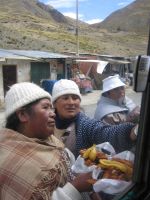
Indigenous women outside of La Paz, Bolivia. Credit: Diana Cariboni/IPS
Gearon and many others delegates to the Apr. 21-May 2 seventh annual meeting of the United Nations Permanent Forum on Indigenous Issues fear that carbon markets will not only violate their rights, but also further aggravate the threat of pollution and climate change.
The so-called carbon markets reflect the commercial aspects of environmental responsibility, which allows companies to reduce emissions of climate changing greenhouse gases, like carbon, or buy the right to keep polluting.
Under the Clean Development Mechanism (CDM) of the U.N. Convention on Climate Change, the idea is that carbon markets offer an efficient system that will guide investments towards the emissions cuts that are the cheapest.
But like indigenous leaders, many independent experts dispute the notion that the market-driven approach can produce better and more desirable results on greenhouse gas mitigation efforts.
A new study by the U.S.-based Institute for Policy Studies, published just a few days before the Forum meeting started, described the World Bank's role in the carbon markets as "dangerously counterproductive" to international efforts to tackle climate change.
"It is making money off of causing the climate crisis and then turning around and claiming to solve it," charged Janet Redman, principal author of the report and an Institute researcher.
The 79-page report, titled "World Bank: Climate Profiteer", argues that instead of encouraging clean energy investors, the bank is lending much of its financial support to the fossil fuel industry.
"It's playing both sides of the climate crisis," said Redman, noting that in just over two years the bank loaned no less than 1.5 billion dollars to companies investing in fossil fuels.
Out of its two-billion-dollar carbon finance portfolio, the Bank has directed nearly 80 percent to projects that involve polluting industries.
In her research, Redman also explains how the Bank's policy on carbon credits is affecting indigenous communities who have no voice or vote in reforestation projects where they live.
World Bank officials have officially acknowledged that indigenous peoples, who manage 11 percent of the world's forests and lands covering 80 percent of the world's territory, have "a small carbon footprint and that their contribution to global warming is minimal."
Yet, a World Bank document leaked in January suggests that it seeks to further expand its role in the carbon market with multi-billion-dollar plans for investment in so-called "climate adaptation" and forestry.
In their critique of the World Bank's push for carbon markets, some indigenous leaders offer a different perspective.
"The concept of carbon markets is driven by an economic vision," Marcos Terena, an indigenous organiser from the Amazon region in Brazil, told Tierramérica.
"The indigenous vision of environmental issues is based upon spiritual thinking. Indigenous peoples respect Mother Earth. It's the governments and corporations that are responsible for environmental destruction," he added.
Egberto Tabo, coordinator general of COICA, an umbrella group representing hundreds of indigenous groups in South America's Amazon Basin, echoed that view in an interview with Tierramérica.
"The World Bank and corporations are exploiting our rainforests. The Bank and governmental frameworks on climate change are not taking into account our concerns," he said.
The U.N. Forum faces huge obstacles because states do not want to implement the Universal Declaration on the Rights of Indigenous Peoples, adopted in 2007, Tabo added.
Despite drawing more than 3,000 delegates from nearly 500 indigenous groups, the Forum does not have the power to adopt binding resolutions.
Indigenous leaders say they want both governments and private corporations to implement the Declaration in its letter and spirit.
The 1992 U.N. Convention on Biological Diversity promotes and protects indigenous peoples' right to ownership of their traditional knowledge, but the principle of "informed consent" for the use of indigenous lands is not part of its provisions.
In supporting indigenous peoples' demand, the Convention's executive secretary, Ahmed Djoghlaf, said he would like to see the treaty translated into "national laws and national actions."
Forum chairperson Victoria Tauli-Corpuz, however, acknowledged that it would not be an easy task because some powerful nations, such as the United States and Canada, are reluctant to embrace it.
Some countries with large indigenous populations, such as Bolivia and Ecuador, on the other hand, seem willing to adopt the Declaration as part of their national laws.
Both Tabo and Terena describe such initiatives as early achievements of the global indigenous movement.
"It is time for the U.N. to learn from the cosmic vision of the indigenous peoples," said Terena. "It should know that life is not a commodity. It's not just humans. It's much more than that."
(*Originally published by Latin American newspapers that are part of the Tierramérica network. Tierramérica is a specialised news service produced by IPS with the backing of the United Nations Development Programme and the United Nations Environment Programme.)
 Print
|
Print
|