
Thursday, October 15, 2026



News and Views from the Global South
LEBANON: Fleeing a Refugee Camp for Refuge
Mona Alami
- Music resonates down the rundown streets of Beddawi, an overpopulated suburb of Tripoli. People have moved into garages and covered the entrance with bed sheets in a feeble attempt at privacy.
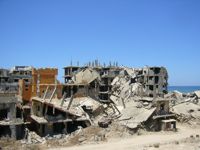
Remains of the Nahr el-Bared camp. Credit: Mona Alami
The camp was the scene of fighting that broke out between members of the Islamist group Fatah al-Islam and the Lebanese Armed Forces in May last year that continued into September. Fatah forces were beaten back, but no one lost more than the people living in the camp.
Most residents fled their homes at night or under bombs and gunfire. In the midst of the deadly battles between the Lebanese army and Fatah al-Islam – a group of terrorists who held the Palestinian enclave under siege – the refugees were displaced again after the first lot fled their Palestinian homeland some 60 years ago.
The fighting at the camp, that had become one of the most affluent in Lebanon, reduced many of the tall buildings to piles of rubble.
"Most of the Nahr el-Bared refugees have since been living in dreadful conditions, many in garages with no running water or access to latrines," a Nahr el-Bared volunteer said.
The war-torn camp lies a few kilometres to the north of the refugee suburbs, closer to the Syrian border. Streets have been cleared of dust and rubble, piles of bombshells have been removed, and buildings awkwardly plastered back over damage caused by rocket explosions. Children's screams and laughter break the silence of this surreal scene, as the waves of the Mediterranean gently lap the golden shores.
Close by, the smaller, nearly flattened constructions of the older camp, located a short distance away, appear dark and menacing in the afternoon light, as if still frozen in battle.
Seham Abedel Aad advances slowly, limping along the concrete floor of the room she shares with her family. She lives in one of the camp's unfinished buildings allotted to refugees by the United Nations Relief and Works Agency (UNRWA). Her two sons, who worked earlier as volunteers, have been waiting for months for their last compensation cheque to be cleared by Lebanon's High Relief Commission.
"We need the money. As you can see, my injured foot is aggravated by my diabetes. My medication is either bought on credit or offered by people who take pity on me," she says.
Seham says she was given the choice of accepting either a lump sum of 1,000 dollars for housing or the room she is living in now. "I chose the latter; I was afraid the money would run out and I'd find myself homeless if the housing problem persisted. I don't regret my decision, I've been here for over six months." She asks, "Do you think you could obtain medicine for me?"
Her neighbour, Fatma Mohamad Ghanoum, was also injured during the conflict. She lives in a tiny room with her husband and two children. "I need 5,000 dollars for my back surgery. With his two broken legs, my husband is not much help to me." Some six families live on the ground floor of the building, sharing two bathrooms and a kitchen, with no warm water.
Barely a few feet away, a row of prefabricated tiny rooms are lined up. Laundry hangs from the walls on the outside, and a pervasive stench hovers in the dark alleys. Groups mostly of children and older women roam around.
A group of women, two of the women in dilapidated wheelchairs, sit close together. An older woman, her grey hair floating around her distraught face, implores passers-by for a cigarette. Sitting with her is Hayat Joundi, a mother of six, who has been sharing two rooms with her children and husband.
"I used to own a large apartment with three bedrooms, a fridge and a washing machine. Now, I only have this," she says pointing to the tiny space. The room is empty, with bed sheets and mattresses piled up at one end. "At night we sleep on top of the thin mattress and bedcovers."
Joundi says she has removed her daughter from school to help with the household chores. "My sister had a stroke after our brother died during the war," she says, nodding towards the younger woman in a wheelchair. "She needs to be regularly changed and fed, and I can't cope on my own."
Seven months after the end of the catastrophic events at Nahr el-Bared, about 4,500 Palestinian families around Lebanon are left homeless, and some 2,500 remain at what is left of the camp.
 Print
|
Print
|



Pictures for this story
This story includes downloadable print-quality images -- Copyright IPS, to be used exclusively with this story.


