
Monday, October 19, 2026



News and Views from the Global South
TRADE-MAURITIUS: Clothing Sector Not Hanging by a Thread Anymore
Nasseem Ackbarally*
- Mauritius had almost lost hope for its textile and clothing industry after the closure of several big factories over the past few years. The sector dropped to a negative growth rate of -12.5 percent in 2006 but has since been revamped to manufacture upmarket goods.
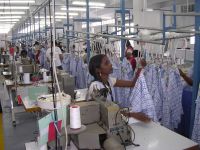
Mauritian clothing workers are back at work after a slump. Credit: Nasseem Ackbarally/IPS
Plenty of jobs are now available in the textiles and clothing sector but there are not enough local takers. Hence the island is importing more foreign labour from India, China and Bangladesh who already number more than 33,000. Almost 7,000 arrived last year.
‘‘I am very confident about 2008 as our order books are full. We are refusing orders for the coming months,’’ Ali Parkar, head of the company Star Knitwear, said at the general assembly meeting of the Mauritius Export Association (MEXA).
Danielle Wong, director of the MEXA, is confident that ‘‘our clients and our markets trust us. We should now build upon that’’.
The textile and clothing industry works on small orders of between 10,000 to 20,000 items delivered with very short turnaround times of less than two weeks. ‘‘This system is successful and is allowing for the expansion of the existing industries. They now lack space for operating,’’ said an official at the ministry for industry and commerce.
Some large enterprises have opened warehouses in Europe and South Africa where they stock their products. As soon as an order is received, the goods are shipped directly from there.
Apart from traditional markets, the industry is also seeking to conquer emerging markets in India and Pakistan, thanks to preferential trade agreements with these two countries. Foreign textile enterprises are again showing a keen interest in Mauritius.
The Chinese company Tianli invested 600 million dollars in a significant new project at Riche-Terre near the capital where 500 acres of land have been made available. It is an industrial park that will accommodate high-end, value-adding industries .
Prime Minister Navin Ramgoolam has indicated that this development project will provide employment to 42,000 people in five years’ time, starting from April 2009.
Forty Chinese factories will be engaged in operations ranging from clothing manufacturing to hardware assembly and food processing in the industrial park, generating an income of about 200 million dollars annually.
Mauritius is also fast consolidating its tourism industry, another pillar of the island’s economy. New hotels, holiday resorts and villas are being built, the airways have been liberalized and the number of flights from Europe to the island has increased three-fold.
This has worked well as arrivals almost reached the million mark in 2007. The island plans to welcome two million tourists by the year 2015. The growth rate of 15 percent between 2006 and 2007 has confirmed the trend. Income from tourism has reached 1.36 million dollars, about 27 percent higher than a year earlier.
Another sector that is booming is business process outsourcing such as call centres. This sector jumped by another 10 percent in 2007. Several thousand jobs have also been created in the seafood sector.
Unemployment is now less than nine percent, with many people in the informal sector looking for better positions and job security in the formal sector. ‘‘We have reached a situation where people are not going out looking for jobs but jobs are coming to them,’’ Ramgoolam quipped during a recent public address.
Maintaining Mauritian trade with the EU has been important. Some have argued that the economic partnership agreements (EPAs) enable Mauritius to continue benefiting from preferential access for its products to the EU.
‘‘Signing the EPA is a guarantee for not disrupting our trade links with Europe,’’ François de Grivel, chairperson of MEXA said at the association’s recent general assembly meeting.
*This is the second article in a two-part series
 Print
|
Print
|



Pictures for this story
This story includes downloadable print-quality images -- Copyright IPS, to be used exclusively with this story.


