
Wednesday, July 22, 2026



News and Views from the Global South
POLITICS-ZIMBABWE: "The Election Will Not Be Free and Fair"
Ephraim Nsingo and Tonderai Kwidini
- Where to begin with listing the concerns that surround Saturday's general elections in Zimbabwe?
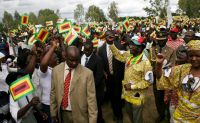
Zimbabwean President Robert Mugabe (centre right) attends a ZANU-PF rally. Credit: Ephraim Nsingo/IPS
Or, with complaints that the voters' roll includes thousands of ghost voters who can be drafted into service for President Robert Mugabe and the ruling Zimbabwe African National Union-Patriotic Front (ZANU-PF), and about a registration process for actual voters that many have described as flawed?
The alleged manipulation of food aid to ensure support for the ruling party, at a time when the United Nations World Food Programme estimates that some four million Zimbabweans are in need of assistance (about a quarter of the population, which is in the region of 13 million)?
Or, with the bias towards Mugabe and ZANU-PF on the part of the state broadcasting services, of critical importance in the absence of independent local radio and television stations – and given restrictions on the independent print media?
The reported shortage of polling stations in urban areas known as opposition strongholds, alongside a redrawing of constituencies in favour of the rural areas said to support ZANU-PF?
Or, with the exclusion of election observers from countries which have criticised the Mugabe government, and of journalists from foreign media organisations who have done the same – even as "repression and surveillance" of local journalists continues, according to a Mar. 21 press release from the Paris-based Reporters Without Borders?
Then there is the disenfranchisement of millions of Zimbabweans who have fled the political and economic disarray in their country, and who might vote for the opposition if allowed to cast ballots abroad. Also: Statements by various branches of the country's security services indicating that they would not tolerate an opposition victory Mar. 29, allegations that the Zimbabwe Electoral Commission (ZEC) is not impartial – and a presidential ruling that allows police into polling stations.
While officials claim this move is for the assistance of illiterate and disabled voters, others view it as another thinly veiled attempt to rig the vote in favour of Mugabe and ZANU-PF. Independent monitors have questioned recent national polls held in this Southern African country.
In the midst of these and other difficulties, the prospects for a just election appear dim, says Takura Zhangazha, an advocacy officer at the Zimbabwean chapter of the Media Institute of Southern Africa.
"The election will not be free and fair. A lot of people make sweeping statements that this election has been without incident, but it's only true in comparison to previous elections. People are still being intimidated, parties cannot campaign freely, and because of the tough laws journalists are being banned from covering the elections. All this diminishes the chance of a free and fair election."
In another worrying development, "many in rural regions (are) fearful that there will be retribution after the elections" against those seen as supporting the opposition, says Simeon Mawanza, Zimbabwe researcher at Amnesty International. He was quoted in a Mar. 26 press release from the rights watchdog.
Saturday's polls come after nearly a decade of increasingly authoritarian rule in Zimbabwe. Since being confronted some eight years ago with its first credible electoral challenge from an opposition party – the Movement for Democratic Change (MDC) – government has engaged in a variety of human rights abuses, and embarked on a controversial land redistribution programme that saw farms taken from minority whites for resettlement by landless blacks. This move was interpreted by certain analysts as a bid to shore up support among voters.
A number of confiscated farms are now said to be in the hands of high-ranking officials, rather than those of Zimbabwe's poor, while agricultural output has declined substantially. Hyper-inflation, unemployment of about 80 percent, shortages of basic goods and foreign currency, frequent power cuts and a decline in service provision routinely prompt questions about how the country remains afloat, even with the help of remittances sent from the vast diaspora.
Efforts by the Southern African Development Community (SADC) to resolve tensions in Zimbabwe have not been successful, and the poll will take place in violation of several aspects of the SADC Principles and Guidelines Governing Democratic Elections, adopted by the regional body in 2004.
Mugabe, in power since independence in 1980 and now standing for a sixth term in office, accuses Western nations of engineering the crisis in Zimbabwe in response to the eviction of white farmers. The country is under sanctions from the European Union (this in response to irregularities in the 2002 presidential elections) and the United States; however, these are targeted more at senior officials than ordinary Zimbabweans.
Mugabe's main rivals in Saturday's poll are erstwhile union leader Morgan Tsvangirai, head of the larger faction of a now divided MDC, and Simba Makoni: a former finance minister and ZANU-PF member who announced his candidacy on Feb. 5, and who has since been expelled from the party.
Speculation on the extent of Makoni's support within ZANU-PF has been intense, this as party heavyweight Dumiso Dabengwa backed the candidate. Makoni has also been endorsed by the other faction of the MDC.
"As you can see, Makoni's campaign has been gathering momentum in Bulawayo after Dumiso Dabengwa publicly declared he was backing him," said political analyst John Makumbe, in reference to Zimbabwe's second largest city. "It is now a question of who is backing who."
Noted Eldred Masunungure, another analyst, "Makoni's candidature lies in between the MDC and ZANU-PF regarding the re-engagement with the West, the World Bank and the International Monetary Fund…ZANU-PF has decided to look East, although nothing much will come from that end."
If one of the candidates in the presidential poll fails to win 50 percent of the vote, a run-off ballot will he held to determine Zimbabwe's new head of state.
Thanks to a 2007 constitutional amendment, Zimbabwe will for the first time also hold National Assembly, Senate and local government polls alongside the presidential election, subjecting citizens to a complex balloting process for which far too little preparation and voter education have taken place, say civic groups.
"Right now there are many fundamental issues that have not been addressed, yet we are just a few days before the elections," observed Zimbabwe Election Support Network chairman Noel Kututwa recently.
"ZEC has shown very little by way of readiness…Just the time that it will take to go through four ballot papers will unduly lengthen the voting process, and it would have been preferable to increase the number of polling stations."
Last week, ZEC chairperson George Chiweshe told journalists, observers and diplomats that there would be 8,998 polling stations across the country. He said the polling stations were set up after consultations with political parties and their candidates.
According to latest figures from the ZEC, 779 candidates are contesting 210 seats in the National Assembly, and 197 the 59 Senate seats that are available. A 60th senatorial seat has already been won by a ZANU-PF candidate who was elected unopposed at the nomination court, while an additional 21 Senate places will be filled in part with presidential nominees. Figures for aspirants contesting the approximately 2,000 local government seats remain elusive.
The ZEC puts the number of registered voters at 5.9 million. Voters will choose between 17 political parties, of which the most prominent are ZANU-PF and the MDC faction led by Tsvangirai, and 116 independent candidates. The latter are mostly grouped under Makoni's Mavambo/Kusile banner. ("Mavambo" is a Shona word that means "beginning"; "kusile" is Ndebele for "dawn".)
Despite the litany of problems surrounding Saturday's ballot, ZEC spokesperson Shupikai Mashereni insists voting preparations are on track.
"Most of the claims people are making about the elections in the press and elsewhere are unfounded…Everything is in order and we are all ready for the elections."
For its part, the International Crisis Group – a Brussels-based think tank – notes that "Zimbabweans desperately want change but have little faith that the elections will produce it."
"Even after the 29 March elections, a negotiated compromise, including creation of a transitional government, will likely be the prerequisite to halting the crisis, but only the first step," the organisation states further, in a Mar. 20 report titled 'Zimbabwe: Prospects From a Flawed Election'.
 Print
|
Print
|



Pictures for this story
This story includes downloadable print-quality images -- Copyright IPS, to be used exclusively with this story.
- Zimbabwean President Robert Mugabe (centre right). Credit: Ephraim Nsingo/IPS
- Morgan Tsvangirai, leader of the larger faction of the opposition Movement for Democratic Change. Credit: Ephraim Nsingo/IPS
- Simba Makoni, presidential candidate for the Mavambo/Kusile group of independents. Credit: Ephraim Nsingo/IPS


