Wednesday, October 21, 2026



News and Views from the Global South
POLITICS: Security Council Passes New Sanctions on Iran
Erkan Kaptan
- After several weeks of closed door negotiations, the 15-member U.N. Security Council decided Monday to impose a third set of sanctions on Iran to pressure Tehran to halt its ongoing nuclear power programme.
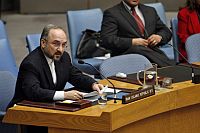
Iranian Ambassador Mohammad Khazee addresses the U.N. Security Council on Mar. 3, 2008. Credit: UN Photo/Evan Schneider
The vote on the resolution was 14 in favour, including the five permanent members – the United States, Britain, France, Russia and China – with one abstention from a non-permanent member, Indonesia.
For the first time, the Council imposed a ban on trade with Iran, specifically on goods relating to both military and civilian uses. The last two resolutions against Iran were imposed in December 2006 and in March 2007, mostly relating to trade in nuclear-sensitive materials and technology.
The new resolution listed further sanctions on Iran, including a travel ban on some individuals listed in previous resolutions; additional names of persons and entities subject to assets; a call to “exercise vigilance” in granting export credits to Iran and over the activities of Iranian banks; an embargo on nuclear-related dual-use items, with the exception of items for exclusive use in light water reactors; and technical cooperation with the International Atomic Energy Agency (IAEA).
The resolution also calls upon states to inspect cargo to and from Iran if there are reasonable grounds to believe that they may contain prohibited items.
Iranian Ambassador Mohammad Khazee responded Monday that, “The international community once again witnessed that the credibility of the Security Council, whose primary responsibility is to maintain international peace and security, is readily downgraded to a mere tool of the national foreign policy of just a few countries.”
He said the action would undermine the credibility of the IAEA, which is the world community’s nuclear watchdog.
“If a country which has been working closely with the agency is going to be punished, this may create a problem for the cooperation of other countries with the agency,” Khazee told IPS last week. “According to the work plan, we were supposed to answer these outstanding issues within 18 months, [and] we did them much earlier.”
The National Intelligence Estimate issued by all the U.S. intelligence agencies last December concluded that Iran had halted its nuclear weapons research programme in 2003.
The IAEA’s latest report in February said that Iran was cooperating with investigators, but also cited new information indicating Tehran was involved in military research, including uranium conversion and a missile re-entry vehicle modified to hold what could be a nuclear warhead.
Khazee called much of this intelligence “fabricated”. “Whatever documents are delivered to Iran through the agency, of course we will look into them and will answer. These things are not a reason to…take it to the Security Council,” he told IPS. “Any question that the agency has we will respond [to]. But the point is that anybody, every day can make allegations against Iran.”
Libya, which ceded to pressure to dismantle its own nuclear programme in 2003, stated that while it did not agree with the Security Council resolution, it voted affirmatively in the interests of consensus.
Speaking at the Council Monday, Ambassador Le Luong Minh of Vietnam said, “Deciding to vote in favour of the draft resolution… we are strongly convinced that favourable conditions must be created for the peaceful solution if the Iran nuclear issue, including cessation of hostile policies against Iran, assurance of Iran’s legitimate security interests and respect for the right of Iran to use nuclear energy for peaceful purposes.”
However, Indonesian ambassador Marty Natalegava, who abstained, said that he was not convinced that more sanctions were the most sensible approach. He added that he expected Iran would continue to engage actively with the IAEA to build confidence about the scope and nature of its nuclear programme.
British Ambassador John Sawers stated that: “Iran’s leaders should listen to what the international community is saying rather than misleading their people by misrepresenting our actions and the IAEA’s reports on their nuclear programme.”
”I commend the efforts of the director general and the officials of the IAEA, but Iran’s failure to do what is required of them, as clearly stated by the IAEA, left us no option but to seek further measures in the Security Council,” he said.
China, which along with Russia has previously defended Tehran in the Security Council, said that the new resolution did not aim to punish Iran. Rather, it urged Tehran to return to the negotiating table and reactivate a new round of diplomatic efforts.
 Print
|
Print
|