Tuesday, September 22, 2026



News and Views from the Global South
DEATH PENALTY-PAKISTAN: Condemned Indian 'Discovered' After 35 Years
Zofeen Ebrahim
- "I am convinced I became a minister just for him," Ansar Burney, Pakistan’s recently-appointed minister of human rights, said in a telephone interview from Islamabad with IPS.
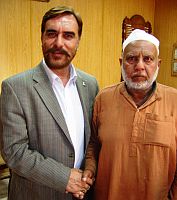
Pakistan human rights minister Ansar Burney with Kashmir Singh, the man he rescued from death row. Credit: Fahad Burney
Singh – who was granted a presidential pardon last week -will return home to Hoshirapur, India, in the next few days. There he will be reunited with his wife, whom he married at 16, and the two sons and a daughter they had together. He is eagerly waiting to resume his life from where it was broken off more than three decades ago.
Singh was sentenced to death under the Official Secrets Act in Lahore in 1973. He had been a police constable in Amritsar, India, but lost his job on disciplinary grounds. Together with a friend, he entered the contraband trade between Pakistan and India before they were both caught in Pakistan. It was a time of paranoia and tension between India and Pakistan after the hostilities of 1971 which led to the imprisonment of hundreds of servicemen and civilians.
Singh’s friend was sentenced to 10 years in prison. But Singh was condemned to die after being found guilty of espionage.
The execution was set for 1978, after Singh’s mercy petition was rejected by the then president Fazal Ilahi Chaudhry. But the evening before he was due to die, he was told that for some unexplained reason his hanging had been delayed. Over the next decade Singh became lost in the vast Pakistani prison system as he was transferred from one death row to another, expecting to be led away to the gallows any day.
Two months ago, he was moved to Kot Lakhpat jail in Lahore where Burney, his first visitor ever, discovered him.
It was seven years ago when Burney, a prominent human rights lawyer, was participating in a radio phone-in, in London, when a caller asked him to help locate Singh.
"I tried even then, but was not successful. Now I know why," Burney, who for quarter of a century has headed the Ansar Burney Welfare Trust (ABWT), said. Singh was now known in prison as Ibrahim, after converting to Islam. "I cannot say whether this conversion of faith was forced, or of his volition. But because of his new name, locating his original papers was very difficult," Burney explained.
As soon as Burney was appointed minister of human rights by Pakistan’s interim government in November 2007, he began investigating conditions in some 40 Pakistani prisons – everywhere also enquiring about the lost Singh.
The search ended in Kot Lakhpat, it was reported on Feb 11. "Call it providence, I met him (Singh) like I did other prisoners in a death cell, then moved on. But something told me I should go back and talk to him some more, which I did – and I am so glad for that," an elated Burney said.
The minister added he was appalled at what he saw behind the bars. "It’s hell on earth," he said, referring particularly to the conditions on death row where some inmates were both physically and mentally ill.
"They have not only served a life term, but many have served it twice over. I even found a couple who were centenarians. I found men whose legs had been chopped off because they had developed gangrene, quite a few were suffering from tuberculosis and many have developed various mental problems."
According to the minister, death cells, made to hold three people, had "sixteen prisoners stuffed in like animals". They took turns sleeping and were only allowed out 30 minutes a day "to straighten their limbs before they are locked up again.’’
He added: "They urinate and defecate in the same place and it’s smelly and filthy."
Burney said he had met scores of death row prisoners who had been waiting between 10 and 30 years for an answer to their clemency appeals. "I can say this with certainty that 60 percent of those on death row are innocent," he said. Some had told him that they did not know the person they were accused of murdering or were not in the city at the time of the alleged crime. Some said they had been falsely charged out of "enmity".
"The system is flawed and many innocent, usually poor, are incarcerated," the minister said.
Last year, the independent Human Rights Commission of Pakistan (HRCP) expressed similar concerns in its report ‘Slow March to the Gallows.’ There were serious defects in Pakistan's criminal, police and justice system, it said, calling for an immediate moratorium on death penalties.
Nearly a third of the world’s estimated 24,000 death row prisoners (more than 7,400) are in Pakistan, the largest number in any single country. Some of these have been there for decades. In 2006, according to Amnesty International, the number of people executed in Pakistan trebled from 31 (in 2005) to 82.
Of concern to rights groups is also the steady increase in the number of crimes carrying the ultimate penalty.
At the time of independence from British colonial rule in 1947 only murder and treason carried the death sentence. Today, there are 27 capital crimes, including blasphemy, stripping a woman of her clothes in public and sabotage of the railway system. Many of these were introduced during the 1977-88 military dictatorship of Gen. Zia-ul-Haq.
Pakistani officials are currently preparing release papers for Singh.
"It will be my greatest honour to serve a man who has had to serve such a harsh punishment," said Burney who plans to accompany Singh to India and personally hand him back to his family. "The trust will open a bank account for him and he will get an honorarium from us for a while until he is able to get back on his feet."
Ahead of his homecoming, Singh has expressed a wish for a pair of trousers and shirt rather than the Pakistani shalwar kameez that he wore in prison. "We will acquiesce to all his wishes," the minister said.
The pardoning of Singh may bring hope for the family of Sarabjit Singh, another Indian on death row in Pakistan, also sentenced also for alleged spying.
Arrested by the Pakistani army on Aug. 25, 1990, he was found guilty of plotting bomb blasts in Lahore and Multan in 1989. His family has maintained that he is innocent, saying he strayed across the border in a drunken stupor.
 Print
|
Print
|