
Thursday, October 8, 2026



News and Views from the Global South
ENVIRONMENT-AUSTRALIA: Activists Split Over Policy on Japanese Whaling
Stephen de Tarczynski
- As Australia continues to call on Japan to abandon its whaling program, leading environmental groups are divided in their response to the government’s plan to stop Japanese whaling.
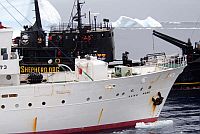
A Sea Shepherd vessel closes in on the Japanese whaler Kaiko Maru Credit: Sea Shepherd
Japan’s whaling fleet arrived in the Southern Ocean earlier this month to begin its annual whale hunt. The fleet is expected to slaughter some 935 minke whales and 50 fin whales, which Australia says are endangered.
This season’s hunt was also expected to include the killing of 50 humpback whales for the first time in decades, but Japan has bowed to international pressure and deferred the targeting of the threatened species for “one year or two”, according to a Japanese Government spokesman.
Japan argues that its whaling is done for scientific purposes, a claim which enables it to continue whaling despite the moratorium on commercial whaling implemented by the International Whaling Commission (IWC) in 1986. Critics argue that the scientific program – which began in 1987, the same year that Japan abandoned commercial whaling – is a sham.
“Australia strongly believes that there is no credible scientific justification for the hunting of whales and is opposed to all commercial and ‘scientific’ whaling,” said foreign affairs minister, Stephen Smith in a joint statement issued last week with environment minister, Peter Garrett.
The ministers’ statement outlined the government’s plan to apply pressure to Japan in an attempt to stop the whaling in the Southern Ocean.
Under the plan, diplomatic efforts will be stepped up. Australia has already led a coalition of more than 30 nations in a protest at Japan’s foreign ministry in Tokyo and will appoint a special envoy on whale conservation to “increase and strengthen dialogue at senior levels”.
Australia will also upgrade its efforts at the IWC as well as consider legal options against Japan. Additionally, Australia will monitor the Japanese fleet with an aircraft from the Australian Antarctic Division and with a customs patrol ship, the Oceanic Viking, which will be disarmed for the mission.
“With the announcement this week, Australia has really stepped forward as the lead government in opposing whaling in the Southern Ocean,” says Shallhorn.
While Greenpeace – which Shallhorn says will use “inflatable boats to get as close as we can to the whales so that the harpoon gunner doesn’t have a clear shot to kill whales” – has welcomed the moves by the Rudd government to lobby for an end to the hunt, the more militant Sea Shepherd Conservation Society says that the monitoring of the Japanese fleet is not enough.
“These whales are being killed now and collecting evidence for some ‘down the road’ international court case that the Japanese will simply ignore is not going to stop the killing,” says Sea Shepherd founder, Captain Paul Watson, via email from aboard one of the society’s ships, the Steve Irwin.
Since its formal founding in 1981, Sea Shepherd has used tactics such as ramming and scuttling of whaling vessels in its efforts to stop whaling, which it regards as a brutal slaughter. Sea Shepherd says that these efforts are guided by the United Nations World Charter for Nature.
Earlier this year, a Sea Shepherd vessel collided with a ship from the Japanese whaling fleet in the Southern Ocean, with both crews blaming the other for the “ramming”. Activists reportedly threw smoke bombs onto the Japanese ship as well as attempted to entangle its propeller.
Captain Watson says that while the Rudd government’s plan is an improvement on the efforts to stop whaling taken by the previous government under John Howard, the government should still do more.
“Anything is an improvement on the ‘talk but do nothing’ policies of the previous Howard Government. Now we have the ‘take pictures and do nothing’ policy,” Watson told IPS.
He says that this is “an opportunity for the Rudd Government to make a stand on whaling but they have to make a stand, not just the same old posturing. Diplomacy has failed for 21 years. Every year Japan gets bolder and more greedy and the kill figures steadily escalate.”
In 2005, Japan dramatically increased the number of whales killed for its scientific programme and added fin whales to its catch.
Greenpeace boss, Steve Shallhorn, says that the government’s response will send “a very strong message to Tokyo that Australia and Australians are fed up with this illegal whaling in the Southern Ocean.” He argues that it is not necessary for the Oceanic Viking to be armed.
“I think it’s appropriate that the Australian government restrict itself to observation and surveillance rather than interdiction. These are international waters and Australia doesn’t have the jurisdiction,” says Shallhorn.
But part of the hunt will take place in waters that Australia claims is in its ‘exclusive economic zone’ – which extends 200 miles from the coast of the country’s Antarctic Territory – as well as in the Southern Ocean Whale Sanctuary.
Captain Watson argues that Australia should bring the full force of the law against Japan’s whalers.
“The Australian government should go in armed and they should order the Japanese whaling fleet out of Australian Antarctic territorial waters,” he says.
The Sea Shepherd leader argues that Australia is willing to use armed interventions against Patagonia Toothfish poachers from Uruguay “in these very same waters”. The crews are arrested and their ships are seized, says Watson.
But Australia’s attitude towards Japanese whalers is much more benign.
“The only difference is that Uruguay is a poor nation and Japan is a large economic bully,” he argues.
Watson says that “Australia gets real tough with poor Indonesian fisherman (caught fishing in Australia’s northern waters) yet they allowed the Japanese to grossly exceed their Bluefin tuna quotas in Australian waters.”
He views Australia’s “discriminatory application of the law” as an injustice. “You don’t negotiate with criminals, you intervene and end their criminal activity,” argues Watson.
 Print
|
Print
|




