Friday, September 4, 2026



News and Views from the Global South
THEATRE: In the Creeks of the Niger Delta
Ogaga Ifowodo*
- Twelve years ago, over the protests of human rights groups worldwide, Ken Saro-Wiwa and eight Ogoni minority and environmental rights activists in Nigeria’s oil-rich Delta region were murdered by the military regime of the late General Sani Abacha.
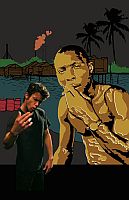
Dan Hoyle performs in "Tings Dey Happen". Credit: Lyra Harris
The commemoration came three days earlier than the Nov. 10 date of the judicial murder – as the former British prime minister, John Major, among many others, described the tragedy. The activists were hanged even while an appeal against the decision of the kangaroo tribunal that “tried” them was pending.
“Tings Dey Happen” is at once grim political theatre and dramatised travelogue. It is an acerbic satire of oil mercenaries and the shenanigans of the international community which colludes in the rape and pillage of the Niger Delta.
“It is easier to manage war than work for peace,” an U.S. oil mercenary specialising in security for Chevron-Texaco tells Hoyle.
“Tings Dey Happen” is also a gripping portrayal of the pathos of the intolerably abject circumstances of the inhabitants of the Niger Delta, driven to militancy, prostitution and whatever other desperate act of survival.
The play’s emotional power lies in Hoyle’s reflection on the oneness of our being, on an uninhibited expression of his humanism. And it obviously served him well not only in the creative process of writing the play or in his superb performance – how his incredibly fluid facial and bodily movements make it possible for him to so effortlessly become each of his motley characters.
Certainly, it informs his reflections long after he was done with the Fulbright fellowship that took him to Nigeria and he had returned to his country.
In his author’s note to the performance, Hoyle says: “Events continue to unfold in Nigeria. Of the people I got to know there, one has died, one has been jailed for two years and then released, some have been kidnapped, others have helped with the kidnappings. For tonight, I honour them all with this play, and hope that their stories stay with you after you leave the theatre, as they continue to haunt and delight me.”
Deserving of special mention, however, is Hoyle’s uncanny ability to translate the creek version of Nigerian pidgin English and give it living breath through his performance. This viewer came away thinking about “Things Dey Happen” in a post-Achebean appreciation of Joseph Conrad’s “Heart of Darkness” – that Euro-America, and not Africa (read Nigeria), is cast in the darker light in Hoyle’s play. Indeed, the amazing beauty of Hoyle’s achievement is rather in shattering stereotypes.
Those who have seen Hoyle become each of his characters – prostitute, mercenary oil prospector, representative of foreign charitable organisation, Serbian arms dealer, U.S. ambassador, local mediator between oil-ravaged community and giant oil corporations, destitute old man, repentant sniper, warlord, etc. – will testify that if there are any doubts about his agenda, they can only be resolved in his favour.
Which is to say that by electing to stay faithful to the appalling human dimensions of the Niger Delta tragedy, and by extension the Nigerian horror story, Hoyle could only end up winning sympathy for the downtrodden but resilient and fighting ordinary people of his play.
If you do not feel genuinely sad for the real life human being after whom Hoyle’s Okosi, the sniper with a heart and a dream, is modeled, then you would be even more of a dangerous reptile than the Nigerian soldiers who daily rain terror on poor villagers in a bid to pacify the Delta for continued oil extraction. Or, for that matter, the U.S. ambassador, whose disembodied diplomatese is as deadly as the fumes from gas flares by the oil companies.
Hoyle’s humanism can be felt in the impassioned ranting of the Community Relations Officer who, just before urging Hoyle to “try harder” at understanding the fate of the black man, especially the one trapped in the Niger Delta creeks, remarks that in the beginning, everyone was black, till some went away to Europe and became white only to return and not want to acknowledge their brothers whom they left behind.
But if that claim is too large, you could trace that humanism – which is no more than saying that as humans we have a joint destiny on planet earth – in the direct accusation of the ordinary U.S. citizen by the security expert: when you fill your Cadillac with petrol, you are helping to fund war in the Niger Delta.
At a panel discussion which followed a recent performance of the play, Jackson Ogbonna, publisher of Pointblanknews.com, now living in the United States, recalled his experiences as a journalist when he was part of a fact-finding mission to the Niger Delta communities and how that changed his perspective on the Nigerian question. The hanging of Saro-Wiwa and the Ogoni Eight only confirmed his fear that Nigeria would know no peace until the Niger Delta question was solved.
Given the strategic role of oil in the world, he enjoined the international community to actively support the cause. Sowore Omoyele, publisher of Saharareporters.com, for his part, wished to take the U.S. security expert’s accusation further. What, he wanted to know, were U.S. citizens doing to prevent blood oil from underwriting their comfort? Did they not know that their love affair with the automobile made it possible for the people of the Niger Delta to be further repressed?
He hoped for a relentless escalation of the turmoil in the creeks so that the gallon price of petrol would continue to soar, until average people would be shocked out of their complacency.
Hoyle’s play, which has created quite a stir as an Off-Broadway show in New York, is currently having an extended run from August through December.
*Ogaga Ifowodo is a lawyer and activist, and the author of three volumes of poetry: “Homeland and Other Poems”, “Madiba”, and “The Oil Lamp”. He worked for eight years at the Civil Liberties Organisation which introduced environmental rights issues into the mainly civil rights-centred work of the Nigerian NGO community and was a member of the Association of Nigerian Authors of which Saro-Wiwa was a president.
 Print
|
Print
|