Tuesday, June 16, 2026



News and Views from the Global South
POLITICS-PAKISTAN: Civil Society Mounts Pressure on Musharraf
Beena Sarwar
- With his army losing ground to insurgents on the western border, his potential political partner Benazir Bhutto joining protests against the emergency and unrest spreading in Pakistan’s urban centres, pressure is mounting on President Gen. Pervez Musharraf to step down.
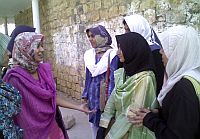
Karachi University students stood by their teachers in demanding restoration of the Constitution, the judiciary and human rights Credit: Beena Sarwar/IPS
There has been widespread condemnation of the emergency imposed on Nov. 3 that critics term as ‘martial law’, since Musharraf enacted it in his capacity as army chief rather than as President.
Denunciations have come in from all quarters. Bar associations including the powerful American Bar Association, Nelson Mandela and the Group of Elders, the European Union and the Commonwealth Ministerial Action Group (CMAG), which has threatened to suspend Pakistan if it failed to implement certain measures by Nov 22 when the CMAG next meets. These measures include lifting of the emergency and curbs on the media, and restoring the judiciary.
Such pressures are believed to be behind Musharraf’s announcement that general elections will be held by Jan. 9, 2008 (rather than mid-February as he had proclaimed earlier). “Such elections would not be credible unless the state of emergency is removed and constitutional rights of the people, political parties and independence of the judiciary are restored,” said CMAG in its statement of Nov. 12.
The Fair and Free Elections Network (FAFEN), an independent Islamabad-based coalition of 30 leading Pakistani civil society organisations, expressed similar concerns in its position paper of Nov. 12. All the major civil society organisations in Pakistan support this position and demand the immediate lifting of the emergency and restoration of the constitution, judiciary and fundamental rights.
Musharraf has asked western powers not to judge Pakistan by their standards, and appears as scornful of local civil society organisations as of continuing protests by students, lawyers and judiciary. He appeared unapologetic, even belligerent, on Sunday during his first press conference, eight days after promulgating the Provisional Constitutional Order (PCO) that suspended the Constitution and required the judiciary to take fresh oath.
An emergency Supreme Court bench headed by Chief Justice Iftikhar Ahmed Choudhry declared the PCO order null and void and ruled that no judge of the Supreme Court or High Courts could take oath under it. Armed security forces escorted the dissenting judges out. Their services have been ‘terminated’ but they remain defiant under house arrest, supported by an unprecedented number of fellow judges, including the chief justices of all four provincial High Courts.
Hundreds of lawyers, including retired judges of the High Courts, have been arrested in the crackdown following the Bar Associations’ call to protest and boycott courts headed by ‘PCO judges’. The government has admitted that over 500 lawyers were arrested in the two largest cities of Pakistan alone. The BBC estimates the country-wide number to be closer to 3,000. Since then, many more have been arrested, including former Human Rights Commission of Pakistan (HRCP) chairperson Afrasiab Khattak in Peshawar on Nov. 13.
“The Proclamation of Emergency contravenes the Constitution,” wrote prominent constitutional lawyer Qazi Faez Isa in an op-ed piece on Nov. 10, the day newspapers reported that the government had amended the Army Act of 1952 to allow the army to court-martial civilians. An underlying reason for this amendment, say analysts, is the apparent inability of the existing anti-terrorist courts to hold proper or speedy trials of those involved in acts of terrorism or militancy.
Meanwhile, ordinary citizens around the country are visiting the ‘non-PCO’ judges with flowers, garlands, and thank you notes, and spontaneously naming popular cross-roads after them. “They are paying a heavy price for their defiance,” said Kausar S.K of the Women’s Peace Commission, who has made several such visits under the umbrella organisation ‘People’s Resistance’, a civil society coalition against the martial law.
These judges were made to empty their chambers and the phones of some were disconnected. They are not allowed to visit the High Courts, and the government has said they will not be allowed to practice law, says the People’s Resistance.
“It is alright for us younger lawyers,” said Faisal Siddiqi, who is helping colleagues in Karachi Central Jail. “But for these older judges and lawyers, who have spent their lives building up their practices, it will be very difficult to start from scratch. We salute them.”
After groups in Islamabad and Lahore were prevented from meeting the judges, some 500 people gathered at a public spot in Islamabad on Monday to light candles in solidarity with Rana Bhagwandas, the only Hindu judge in Pakistan’s Supreme Court.
Bhagwandas was on the anti-PCO bench of Nov. 3 and, like his fellow judges, has been under house arrest at his official residence in Islamabad. One group also visited his family in Karachi with sweets to show solidarity on the occasion of Diwali, the Hindu festival of lights last weekend, as Bhagwandas was not allowed to visit his family.
Since civil society organisations can drum up only limited numbers for street protests, they hardly post a threat to the regime. But the ban on public gatherings under the emergency means that those attending protests and rallies risk being beaten and arrested by the police. Even so, citizens’ groups around the country are engaging in vigils, ‘flash protests’ and other symbolic actions like wearing black arm-bands. They have been joined by students from private institutions, including high-school students from Islamabad’s elite, traditionally apolitical schools.
Police baton-charged and then detained 48 such students engaged in a silent protest in Islamabad on Monday. The students, aged 12-18, some in school uniform, were charged with violating laws that prohibit the gathering of more than four persons in a public place. They were released after their parents signed ‘good behaviour’ bonds on their behalf.
“The students’ resolve has only been strengthened as a result of this incident – we will continue to voice our opinions, as is our right, in a peaceful and non-violent manner,” wrote ‘Z.H.’ in the widely circulated student-run online ‘The Emergency Times’ launched on Nov 5 (online version: pakistanmartiallaw.blogspot.com).
After students registered their silent protest with black bands on their arms and foreheads, the administration said that “any student found even wearing a black ribbon as protest against emergency will be expelled without a hearing before the disciplinary committee,” wrote one student. “Students in Karachi want to be part of the students’ movement but the administrations are not letting this happen” .
With independent television news still blocked, such protestors get their messages across to the world via the Internet and cell phone. There is currently no restriction on such communication or on the English language newspapers, although activists believe they are being closely monitored.
Analysts say that it seems Musharraf is more concerned about keeping news from members of the non-English speaking public to prevent them from joining the protests.
Students at non-elite institutions like Karachi University were unaware of the arrests and detentions taking place around the country but endorsed a small protest by the University Teachers Forum (UTF) on Tuesday. A dozen or so teachers from various departments stood silently behind a black banner calling for the restoration of the Constitution, the judiciary and human rights.
“The emergency has given a bad name to Pakistan around the world,” said Saira Sheikh a student of the Economics Department who was passing by. “But we don’t know what’s going on around the country because there are no news channels, no information,” added her friend Hira.
The students left as police rangers from a parked van nearby started coming towards them. The rangers did not engage with the demonstrators. “They were probably told to leave us alone,” said one teacher. UTF convenor, Abdul Qadeer of the Applied Physics department, attributed the low turnout to the fear of arrest and to de-politicisation of the campuses.
“This darkness at high noon cannot last. The judges by not taking oath, the lawyers and the civil society by resisting have already shown the way. The media is standing by them shoulder to shoulder. This is one battle the General is sure to lose,” predicted former senator Shafqat Mahmood.
However, with Washington determined to back Musharraf unconditionally, this darkness, may be rather more long-drawn out than most Pakistanis would like, some analysts say.
 Print
|
Print
|