Wednesday, July 22, 2026



News and Views from the Global South
KENYA: Legislation to Get More Women in Parliament – the Next Chapter…
Joyce Mulama
- Activists in Kenya have resumed efforts to legislate an increase in the number of women occupying seats in the East African country’s parliament, this after a constitutional amendment bill that would have created 50 special seats for women was thrown out by the governing body.
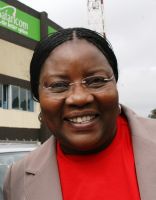
Ida Odinga: co-convenor of the National Women Leaders Negotiating Committee. Credit: African Woman and Child Feature Service
“But we want the men MPs to know that Kenyan women are disappointed with them. They have failed to seize the opportunity to make Kenya be counted when it comes to the issue of affirmative action,” she added, in reference to the fact that men occupy about 90 percent of seats in the legislature, and thus determine whether bills are passed or not.
Ahead of the vote on the bill, efforts were made to gather a million signatures in support of the amendment; women activists and politicians also marched in the capital, Nairobi, and surrounding areas to throw their weight behind the law.
Nonetheless, the bill was thrown out Aug. 15 when the number of MPs in the legislature proved too few for a vote on the law to go ahead. While at least 145 of the 222 parliamentarians were needed for a quorum, only 95 were in the house. Certain MPs had walked out of parliament before the vote; others simply failed to present themselves for the event.
Lack of support for the amendment appears to have been less a result of opposition to affirmative action, however, than of concern about a clause in the legislation that provided for 40 new constituencies. Kenya currently has 210 constituencies.
Opponents of government claim that it would use new constituencies to its advantage in the December general elections, and certain MPs accused officials of acting in bad faith by including the provision for new constituencies in the amendment bill alongside the stipulation for women’s seats.
Legislators have advised that a bill dealing only with women’s representation in parliament be put forward when the amendment is allowed to be re-tabled, in six months time.
Kenya has some way to go before catching up with its neighbours concerning women’s presence in parliament. Its current legislature boasts the highest number of female MPs in the country’s history: 18. However, this amounts to just 8.1 percent of legislators, compared to a female representation of 30.4 percent in Tanzania, and 29.8 percent in Uganda (this according to figures from the Inter-Parliamentary Union).
Rwanda, also in the East African region, has women in no less than 48.8 percent of seats in the lower house of parliament, and in 34.6 percent of seats in the upper house.
Both Rwanda and Uganda have constitutional measures to guarantee women’s representation in the legislature.
“A country like Rwanda, which is just emerging from a serious war, has been able to enact an affirmative action law that has almost seen an equal number of women and men in parliament. There is nothing stopping Kenya, which is a regional hub, from making such progress,” Elizabeth Lwanga, the United Nations Resident Co-ordinator in Kenya, remarked recently. Rwanda experienced a genocide in 1994 that saw upwards of 800,000 minority Tutsis and moderate Hutus killed by Hutu militants.
It is widely accepted that women need to occupy about 30 percent of seats in national legislatures for them to begin exercising influence over parliamentary affairs.
The constitutional amendment bill would have ensured that a minimum of about 17 percent of parliamentary seats in Kenya were occupied by women at all times; women were to have been nominated to the 50 new seats.
Kenya first attempted to introduce affirmative action legislation in 2000, in a bill that was subsequently rejected by Daniel Arap Moi, president between 1978 and 2002. The proposed law was then shelved.
Affirmative action measures were also included in a draft constitution drawn up by the National Constitutional Conference, which met during 2003 and 2004 to review the country’s independence era constitution. However, this draft was rejected in a 2005 referendum.
Certain female MPs and activists have emphasised that creating special seats for women in parliament only goes part of the way to ensuring political equality between the sexes, and that women must strive to win more elective positions.
However, female candidates attempting this in Kenya face a host of obstacles, not least a lack of campaign resources, and traditional views of women that make little allowance for activities outside of the domestic sphere.
 Print
|
Print
|