Tuesday, October 20, 2026



News and Views from the Global South
Q&A: Caribbean Alliance to Protect Humpback Whales
Interview with marine biologist Nathalie Ward
- In December 2006, marine mammal sanctuaries in the Dominican Republic and the United States set up an alliance to protect some 900 humpback whales. Behind that initiative was the tenacity of Nathalie Ward, director of the Eastern Caribbean Cetacean Network (ECCN).
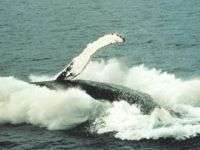
Credit: NOAA Photo Library
Ward, who holds a doctorate in environmental studies and conservation biology, will publish her book "Whales and Dolphins of the Caribbean" in 2008. IPS's Havana correspondent Patricia Grogg recently interviewed her.
IPS: One of the principal threats to sea mammals is fishing nets, in which they are caught by accident and drown. What is the incidence of this phenomenon in the Eastern Caribbean?
NATHALIE WARD: By-catch has been identified as the greatest immediate and well-documented threat to cetacean populations (whales, dolphins and porpoises) globally.
Published information on by-catch (accidental capture) of marine mammals in the Wider Caribbean Region is scarce, and no data exists in the Eastern Caribbean region, to date. While the United States and Mexico have devoted efforts to the Gulf of Mexico, there is generally a lack of systematic monitoring in the Wider Caribbean, which extends from the Gulf of Mexico, across the Caribbean, to the adjacent Atlantic.
Relevant data for a sound assessment of the problem are also missing, such as abundance estimates, mortality levels, impact on reproductive rates. Further, by-catch problems are complex to solve as they involve economic and cultural dimensions, particularly in smaller developing nations.
IPS: What strategies have been adopted in the Caribbean to face this threat?
NW: Reducing by-catch and discard of unwanted catch as a non-sustainable practice is presently the policy of many states and for an increasing number of regional and sub-regional fisheries management organisations, including Wider Caribbean states.
A potential strategy could be to strengthen relationships and forge partnerships with fisheries bodies and existing observer programmes, taking advantage of on-going initiatives and expertise.
IPS: Most of the principal cities of the Caribbean states are located in coastal areas. How does the development of human settlements on the coasts affect cetacean habitat?
NW: Marine and coastal environments in the Wider Caribbean contain diverse habitats, including estuaries and lagoons, mangroves, beaches, coral reefs and sea grass beds, which are increasingly exposed to stress from coastal development as well as increased fishing, pollution from land-based sources (agriculture increases sediment, nutrient, and pesticide runoff) and marine sources (oil discharge and spills, sewage, ballast and bilge discharge, and garbage dumping from ships), and climate change (sea level rise, and increased likelihood of hurricanes).
All such habitats are of relevance to the life cycle of marine mammals, especially for inshore and coastal species of small cetaceans in the Wider Caribbean, and also for their prey as spawning and feeding grounds and nurseries.
The primary causes of habitat loss are land development for settlements, tourism, and agriculture, as well as deforestation and pollution.
IPS: What can be done to prevent such damage to habitat?
NW: Most of the countries in the Wider Caribbean Region have adopted legal instruments to control various aspects of pollution to coastal and marine waters, with varying degrees of practical management and control. Several comprehensive regional projects are under way in support of pollution control and the implementation of the regional protocols concerning pollution from land-based sources and activities and cooperation in combating oil spills, under the Cartagena Convention and Caribbean Environment Programme's Assessment and Management of Environmental Pollution.
Conservation actions like the recent establishment of the sister sanctuary between the Marine Mammal Sanctuary of the Dominican Republic (SMMRD) and U.S. Stellwagen Bank National Marine Sanctuary (SBNMS) provides a promising management solution for transboundary marine species. This action is the world's first sister sanctuary linkage protecting an endangered migratory marine mammal species on both ends of its range.
These are two areas, some 1,500 miles apart, that provide critical support for the same humpback whale population of around 900 whales. They are resident at SBNMS and adjacent feeding grounds from April through December, and migrate to low latitudes in winter months, including the waters off the Dominican Republic, to mate and calve.
IPS: The area nations are greatly dependent on tourism. What could be the impact of increased tourism that involves aquatic activities?
NW: Over the past few decades, marine mammal watching (whale, dolphin and manatee) in the wild has been promoted as non-consumptive use that promises monetary rewards to people and benefits to local communities and governments. Successful tourism must benefit local populations, both economically and culturally, while giving incentive to protect the natural resources that are "tourist destinations".
This is particularly important in sensitive, dynamic areas such as coastal zones. Increased development from tourism can destroy or marginalise habitats for marine mammals and their prey, such as through increased unregulated vessel activity, inadequate wastewater treatment and increased fishing.
The challenge is effectively managing tourism to prevent it from compromising conservation goals. National experiences in developing and adopting management measures for whale and dolphin watching should be used along with other existing guidelines (International Whales Commission's "General Principles for Whalewatching") towards improvement of specific regulations, particularly in the case of activity growth and expansion into potential new areas or cetacean populations.
It is important to mobilise and engage the private sector and tourism regional bodies in the Wider Caribbean as partners in the implementation of SPAW's Regional Marine Mammal Action Plan, not only to promote best business practices on interactions with cetaceans, but also to support research efforts towards obtaining basic biology knowledge of species.
While the close approach of any boat has the potential to disturb marine mammals, the use of commercial whale watching vessels provide an inexpensive platform to conduct long-term photo-identification studies on local marine mammal populations.
 Print
|
Print
|