
Thursday, October 15, 2026



News and Views from the Global South
FILM: U.S. Military’s ‘Don’t Ask’ Policy and One Gay Marine
Aaron Glantz
- Jeff Key grew up in a small, conservative community in rural Alabama in the south-east United States. A large man standing well over six feet tall, he had already come out as gay to his friends and family, graduated with a degree in theatre, and moved to Los Angeles when, at age 34, he decided to join the Marine Corps.
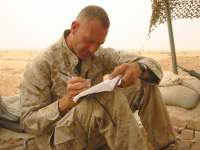
Jeff Key writes in his journal in Iraq. Credit: semperfithemovie.com
Under the “don’t ask, don’t tell” policy, openly gay men and lesbians are not allowed to serve in the U.S. military. Some 11,000 gay and lesbian service members have been expelled from the armed services since former President Bill Clinton implemented the policy 14 years ago, among them 59 Arabic linguists.
But Jeff Key didn’t care: “I wasn’t going to let a stupid policy get in my way.”
His friends were shocked. They describe their reactions in a new documentary film called “Semper Fi: One Marine’s Journey,” which is set to premier Saturday at San Francisco’s Frameline LBGT Film Festival before being shown nationally on Showtime cable television Monday night.
“There’s so many political thoughts that I have about it,” Key’s friend, Orlando Ashley, says in the film. “If they don’t want us, screw ’em! Great! One benefit [of discrimination is] we don’t have to go. And I just thought, why?”
“He needed to explain it to me,” another friend, Paul Jacek, tells the camera. “I finally said to him: ‘Jeff, I’m not so much worried about some enemy on a foreign shore. I’m worried about the guy in the next rack who’s going to find out that you’re gay and catch you alone and bash your head in.'”
But Jeff Key was determined. He wanted to protect his country and told IPS that by the time the military ordered him to Iraq, he had already told most members of his unit that he was gay.
“It was never a problem,” he said. “People look at us to see how we feel about our homosexuality a lot of the time. There are people who are flat out Nazis. [But] for most people, if it’s no big deal to you, it’s no big deal to them.”
Key says because of “don’t ask, don’t tell” his homosexuality brought his unit closer together.
“Because I had trusted them on that level when we got to Iraq, when guys would see something that would be particularly upsetting to them, or if a woman left their man as they went off at war, they would come to me with the most intimate details of their lives in a way that they said was particular to our friendship,” he said.
After a few months in Iraq, Key was medically evacuated because of a non-combat related, life-threatening intestinal problem. His service there did not change the way he thought about the Marine Corps, but it did change the way he thought about the Iraq war. He was outraged that so many people had been killed or injured in a war based on fictitious claims of weapons of mass destruction.
He developed a one-man show about his service called “The Eyes of Babylon,” excerpts of which form the basis of the new documentary film, “Semper Fi.”
In one segment, Key explains his feelings, being stationed at a fort outside ancient Babylon, which was formerly controlled by Saddam Hussein.
“As I stroll through the holding cells in the bowels of the building, there are grates in the floor for the draining blood and I listen across time to screams of horror and anguish of those once held prisoner here,” he says, his photos of the fort tinged in red.
“With each blink the dark inside of my lids give stark glimpses of the life once lived here. The odd shots of boots, uniforms, black mustaches, skinny prisoners, food a dog, blood.”
On Mar. 31, 2004, Key came out as gay on CNN’s Paula Zahn’s Now programme and the Marine Corps expelled him for violating the “don’t ask, don’t tell” policy.
“People who are conscientious objectors are now being told they’re going to go fight,” he noted. “Even people who are coming out of the closet as gay are being deployed. I came out in front of five million people (on CNN) so they couldn’t sweep it under the rug. I used this discriminating policy for once in my life.”
Because of “don’t ask, don’t tell,” he said, he “will never have to take another human life for corporate gain.”
 Print
|
Print
|




