
Sunday, October 18, 2026



News and Views from the Global South
BULGARIA: A Capital That Can’t Handle Its Mess
Claudia Ciobanu* - IPS/IFEJ
- On several occasions over the past two years, the streets of the Bulgarian capital Sofia have been literally covered with trash. The city of one million is one of the few European capitals without a waste processing system.
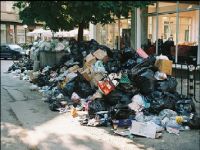
Rubbish piles up on a Sofia street. Credit: Kakanien Revisited Sofia
Previously, trash produced by the capital was deposited in a landfill at Sudohul, an outlying neighbourhood of the capital. But protests by local residents against the dump in their backyard forced then Mayor Stefan Sofianski to promise to close down the disposal site in late 2004.
By October the following year, pressure began to mount on the mayor. Trucks bringing waste to the landfill were stopped. As a result, the Sudohul dump was finally shut down.
Since then, the municipality has been collecting waste in plastic bales, and storing these at various sites around Sofia. The City Council has not sought environmental approval.
According to an evaluation conducted by the European Commission in 2005, “baling mixed household waste threatens the people and the environment with possible explosions and odours and is not in conformity with environmental legislation.”
“The municipality did not carry out an environmental impact assessment (EIA) and the sites where the bales were placed were not accompanied with all the relevant documentation, so they are illegal,” Hlebarov explained. “Nevertheless, Parliament changed the waste legislation as regards EIA in order to ease the establishing of new storage places without the need of EIA, which also means without public consultations.”
Among the sites chosen by the Sofia municipality are Gorni Bogrov, close to the capital, and Tsalapitsa, situated in the vicinity of another important town, Plovdiv, 135 kilometres east of Sofia.
Tsalapitsa was a dumpsite for Plovdiv. The municipality of Sofia paid Plovdiv 47 million leva (23 million euro) for permission to use the location as well.
But its residents did not want to be seen as a garbage bin for Sofia. Protests were organised in March. “This is a real ecological disaster for our village,” one local from Tsalapitsa was quoted in the Bulgarian press. “We grow our own crops here, and the quality of the garbage from the capital is overwhelming, it’s just too much.”
Protests in Tsalapitsa stopped after the village was granted 2.5 million leva (just over one million euro) for infrastructure development.
Asked how the Sofia municipality could solve the waste disposal problem, Hlebarov mentioned developing new refuse dumps, improving the separate collecting system and recycling facilities, and building a waste processing factory. He also said that environmental groups have made several presentations of schemes for waste management based on Bulgarian and European legislation and best practices around the world.
Sofia mayor, Boiko Borisov, wants waste disposal to be controlled by the state. In a public statement in February this year, he said: “Let me say it now loud and clear. City Hall is going to keep a tight control of waste disposal. No matter whether it is going to be a joint venture, or the money will come from a European bank or from an investor…”
Last month, Borisov met with experts from JASPERS (Joint Assistance to Support Projects in European Regions), which provides technical assistance to member states of the European Union, to discuss solid waste management in Sofia.
In 2006, the city municipality began the process of finding an international investor for a waste processing plant. Roughly 40 companies expressed their interest, but the authorities backed out saying that they had only announced the procedure to assess the market environment.
The Bulgarian media reported that the nature of the call for investors made by the authorities, as well as the profile of the companies that responded, shows that the municipality was intending to build an incinerator, not a recycling plant.
Although environmental groups have warned that funds from the European Union are more likely to be granted for the building of a waste recycling plant rather than an incinerator, the municipality seems to prefer the latter because it would also solve the problem of the accumulated bales. The mixed garbage in the bales cannot be recycled any more.
However, there are many arguments against incineration of waste. Concerns about heavy metals, dioxin and furan emissions into the atmosphere, apart from the huge costs of building and operating an incinerator, among many others.
In Sofia, the authorities may be indifferent to the risks. Health and environment concerns did not prevent them from baling the mixed garbage. Neither will it prevent them from building an incinerator to quickly get rid of the trash piling up on the streets of Sofia.
“The common political understanding is that technology will save us all, therefore Sofia does not need a good waste plan, but a plant,” Hlebarov said.
(*This story is part of a series of features on sustainable development by IPS and IFEJ – the International Federation of Environmental Journalists.)
 Print
|
Print
|




