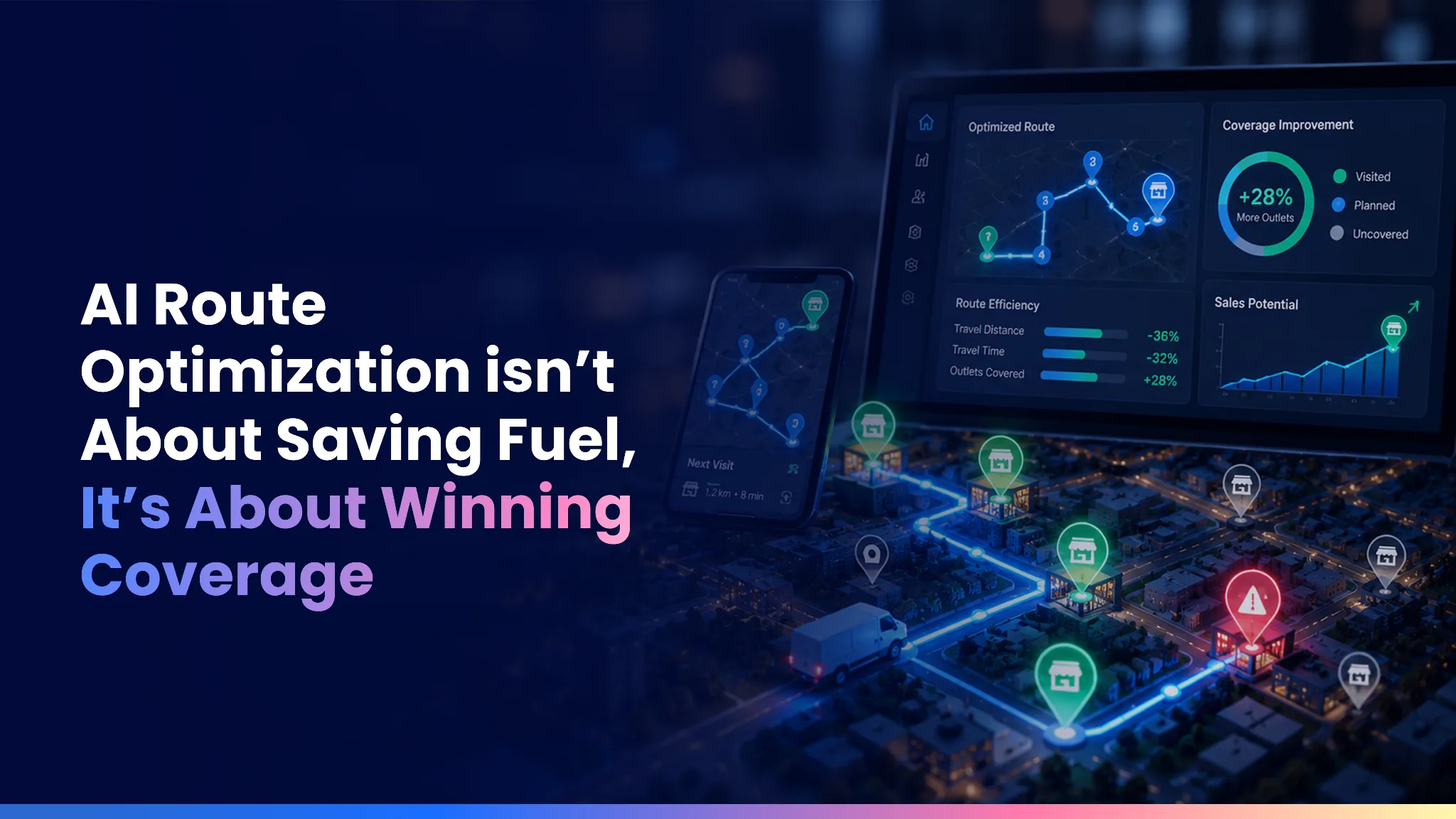

If your AI route optimization business case starts and ends with fuel savings, you may be measuring the cheapest outcome and missing the most valuable one.
A route can be shorter, cheaper, and perfectly executed while a competitor wins the outlets your sales team never reaches. Every planned visit can be completed, every kilometre accounted for, and the territory can still be underpenetrated.
The uncomfortable truth is that an efficient route does not necessarily create an effective sales territory.
For FMCG and CPG brands, the real question is not how efficiently field representatives move between outlets. It is whether the business is directing its limited field-sales capacity towards the outlets and markets where it can generate incremental growth.
That changes the purpose of AI route optimization. It stops being primarily a travel-efficiency exercise and becomes a decision about market coverage.
- Your route plan may be creating coverage debt
A route plan can meet every productivity target and still leave a business with a growing distribution gap. When inherited beat plans continue to prioritize established outlets, emerging markets and underpenetrated retailers may never receive enough attention to develop.
This creates what we can call coverage debt: the commercial opportunity lost because route plans fail to keep pace with changes in the market. The cost is not limited to missed visits. It can include slower outlet activation, weaker distribution, and competitors establishing retailer relationships before your brand does.
What you should do instead
- Reassess beat plans against current outlet potential, not just historical assignments.
- Identify territories where low visit frequency may be restricting growth.
- Treat new outlets and emerging retail clusters as explicit coverage priorities.
Where AI Route Optimization can make a difference
- Combine outlet intelligence, location data, and sales history to uncover coverage gaps.
- Identify where existing routes are consuming time without addressing priority markets.
- Recommend route changes that bring underserved, high-potential outlets into the coverage plan.
- AI can make an old coverage problem run faster
AI can optimize the decisions it is given. It cannot automatically distinguish a market with low potential from a market that has never received enough attention. If low historical sales are interpreted as low future opportunity, a model may repeatedly direct resources towards familiar outlets and overlook emerging ones.
The outcome is a self-reinforcing coverage gap: neglected outlets generate little sales data, and that limited performance becomes the reason they remain neglected. Greater algorithmic precision does not solve this problem. It can make the original bias harder to notice.
What you should do instead
- Separate an outlet’s current sales from its estimated growth potential.
- Review whether visit frequency is influencing the performance data used in planning.
- Include reliable signals such as category trends, distribution gaps, and outlet development.
Where AI Route Optimization can make a difference
- Combine historical performance with relevant outlet and territory intelligence.
- Flag promising outlets that receive limited visits or remain commercially underdeveloped.
- Recalculate priorities as new sales, visit, and market data becomes available.
- The most important routing decision may be the next visit
Maximizing daily calls is not the same as maximizing commercial value. A representative might complete several routine visits while an underpenetrated group of outlets receives no attention. Both approaches consume field time, but their potential contribution to growth can differ substantially.
The real question is what the business gains from the next available field hour. Answering it requires a shift from simply sequencing destinations to evaluating the commercial value of competing visit opportunities.
What you should do instead
- Distinguish mandatory service visits from growth-oriented opportunities.
- Evaluate additional visits against expected value, travel time, and account requirements.
- Give sales teams clear priorities instead of treating every outlet as equally important.
Where AI Route Optimization can make a difference
- Rank feasible visit options using outlet priorities and relevant business rules.
- Balance high-potential opportunities against service commitments and route constraints.
- Help planners allocate limited field time where it can contribute most to coverage and growth.
- A completed visit does not always mean effective coverage
A retailer visit can count towards a target without achieving its intended outcome. The required product may be unavailable, the retailer may be unable to place an order, or the outlet may already receive more attention than its commercial potential warrants.
When every completed call is treated as equally valuable, sales leaders risk confusing physical presence with productive coverage. The business may report strong execution while distribution gaps and missed sales opportunities remain unresolved.
What you should do instead
- Define the intended outcome for different types of outlet visits.
- Identify recurring reasons why visits fail to achieve their commercial purpose.
- Evaluate coverage alongside relevant outcomes such as orders, SKU distribution, and retailer engagement.
Where AI Route Optimization can make a difference
- Incorporate outlet priorities, service requirements, and known operational constraints into visit planning.
- Where reliable inventory and order signals are available, help coordinate visits with product availability and replenishment needs.
- Use visit and execution data to improve future routing decisions, rather than counting completed calls alone.
- Route deviations are not always a discipline problem
Repeated deviations from a planned route can indicate more than poor adherence. They may reveal unrealistic service-time assumptions, difficult territory design, changing traffic conditions, or retailer availability that the original plan failed to account for.
If every deviation is treated as a compliance issue, the business may keep enforcing routes that do not reflect field reality. The result is recurring missed coverage, frustrated representatives, and planning decisions that never improve because the same execution problems remain unexplained.
What you should do instead
- Compare planned routes with actual field execution to identify recurring gaps.
- Separate avoidable deviations from problems caused by unrealistic planning assumptions.
- Use repeated execution issues to revise beats, visit windows, and service-time estimates.
Where AI Route Optimization can make a difference
- Incorporate relevant traffic, location, and scheduling constraints into feasible routes.
- Recalculate routes when changing conditions make the original plan impractical.
- Feed actual execution patterns back into future route planning to improve recommendations over time.
The value of AI route optimization is not confined to the journey between two outlets. It lies in the decisions that determine which outlets receive attention, how frequently they are served, and how field capacity responds as the market changes.
For FMCG and CPG businesses, growth depends not only on selling more to established retailers but also on developing distribution, reaching the right outlets, and responding to shifts in local demand.
A shorter route can improve efficiency. A better allocation of field time can change the market a brand is able to serve.
That is the more useful way to evaluate AI route optimization: not simply by how many kilometres it removes, but by how much more effectively it helps a business compete for coverage.
Because the ultimate measure of an optimized route is not how efficiently a representative travels. It is what the business can achieve with the outlets that representative reaches.