Author Name: Kamal Naghili
Department, Nakhchivan State University, Nakhchivan, Azerbaijan
Purpose: Digital transformation is usually discussed as a technology project, yet studies repeatedly find that leadership, not technology, separates firms that adapt from firms that stall. This paper explains how digital leadership translates into organizational agility, and under which conditions the link is stronger or weaker.
Design/methodology/approach: Conceptual paper. Research on leadership, dynamic capabilities, information systems and strategic agility is systematically reviewed and applied to the development of a theoretical framework and a set of propositions.
Findings: Digital leadership should be understood not as a leadership style with a digital label but as a pattern of behavior that strengthens three dynamic capabilities: sensing, seizing and transforming. Agility results from the above-mentioned capabilities, not directly from leadership. This relation depends on three factors: digital maturity, psychological safety, and organizational size.
Originality/value: The paper locates digital leadership within the framework of dynamic capabilities theory, explains its difference from transformational and e-leadership, and proposes six testable propositions and their applications for executive management.
Keywords: digital leadership; organizational agility; dynamic capabilities; digital transformation; e-leadership; strategic renewal
1. Introduction
It is not true that Polaroid lacked digital technology. By the beginning of the 1990s, Polaroid had already made heavy investments in the study of digital photography and possessed strong technical capabilities in the field. What prevented the company from making further progress, according to Tripsas and Gavetti (2000), was how its senior managers understood the business: they believed profits came from selling film, not cameras. The technology was there. The leadership cognition needed to use it was not.
The Polaroid story is old, but its lesson has become more pressing. Digital technologies now change markets faster than most strategic planning cycles can follow, and firms are told constantly to become agile. Yet there appears to be a consistent trend within the body of knowledge regarding digital transformation. As noted by Kane et al. (2015) in their survey of managers worldwide, what set apart digitally maturing organizations from the rest was not their technology but their strategy and leadership. This is also evident in the findings of Westerman et al. (2014). Vial (2019), reviewing the digital transformation literature, describes it as a process in which organizations change their structures, capabilities and value creation, not simply their systems.
If leadership matters this much, we should be able to say how it matters. Here the literature is less helpful than one would hope. Studies of “digital leadership” have multiplied, but the concept is often loosely defined, sometimes little more than transformational leadership applied to technology projects (Cortellazzo et al., 2019). The mechanism linking leader behavior to organizational agility is usually assumed rather than explained. Meanwhile, the strategy literature offers a well-developed account of how firms adapt, dynamic capabilities theory, which gives a central role to managers but rarely speaks the language of leadership research (Teece, 2007; Helfat & Peteraf, 2015).
This paper brings the two conversations together. It addresses three questions:
RQ1. What distinguishes digital leadership from earlier leadership concepts?
RQ2. Through which dynamic capabilities does digital leadership influence organizational agility?
RQ3. Which contextual factors strengthen or weaken that relationship?
The argument, in brief, is that digital leadership affects agility indirectly, by building the organization’s capacity to sense change, seize opportunities and transform itself. Section 2 reviews the relevant literatures. Section 3 explains the conceptual approach. Section 4 develops the model and six propositions. Sections 5 to 8 discuss contributions, implications, limitations and conclusions.
2. Theoretical Background
2.1 From transformational leadership to digital leadership
Burns (1978) identified transactional leaders as those exchanging rewards for performance and transformational leaders as those who increase followers’ commitment to shared goals. Bass (1985) extended this idea into transformational leadership, which includes the following dimensions: idealized influence, inspirational motivation, intellectual stimulation, and individualized consideration (see also Bass & Avolio, 1994). Transformational leadership is still the most researched leadership theory, and many aspects of digital leadership are based on it.
The first serious attempt to address technology came with e-leadership. Avolio et al. (2000) described it as a process of social influence carried out through advanced information technology, aimed at changing the attitudes, thinking and behavior of individuals and groups. Their focus was on leading through technology: leading virtual teams, communicating by email, building trust at a distance. Fourteen years later, Avolio et al. (2014) revisited the concept and noted how far technology had moved from being a channel for leadership to being a source of change in what leadership involves.
Digital leadership, as the term is used in this paper, goes one step further. The issue here is not so much leadership through technology as it is leading an organization whose strategy, processes and business model have been reshaped by technology. Bharadwaj et al. (2013) made it clear that digital business strategy can no longer be seen as a subset of business strategy, since the two have merged. This means that leaders will have to address technology as a strategic question. Table 1 compares the three concepts.
Table 1. Three leadership concepts compared
| Concept | Main focus | Role of technology | Key sources |
| Transformational leadership | Motivating followers toward shared goals beyond self-interest | Not central | Burns (1978); Bass (1985); Bass & Avolio (1994) |
| E-leadership | Exercising influence through information technology, often at a distance | Channel through which leadership operates | Avolio et al. (2000); Avolio et al. (2014) |
| Digital leadership | Directing strategic renewal of an organization reshaped by digital technology | Source of strategic opportunity and threat | Bharadwaj et al. (2013); Westerman et al. (2014); Kane et al. (2019) |
Source: compiled by the author.
Using the above sources, digital leadership can be characterized by four clusters of behavior: scanning and interpreting changes in technology; developing a vision that ties digital possibilities with organizational purpose; encouraging experimentation and embracing intelligent failure; and reallocation of resources and structural reconfiguration as the vision takes shape. None of these is entirely new. The unique aspect lies in their combination and their orientation towards technology-driven change.
2.2 Organizational agility
Agility has been defined in many ways, but most definitions share two elements. Overby et al. (2006) define enterprise agility as the ability to sense environmental change and respond to it readily. Sambamurthy et al. (2003) emphasize the capacity to detect and seize market opportunities with speed and surprise. Looking at strategic agility at the top of the firm, Doz and Kosonen (2010) identify three components: strategic sensitivity, leadership unity and resource fluidity. Weber and Tarba (2014) note that the concept has become popular faster than it has become precise.
For this paper, agility is the capacity of an organization to detect relevant change in its environment and to respond with timely, coordinated action. Two features of this definition matter. Agility is an outcome that can be observed in behavior, not a vague cultural aspiration. And it involves both sensing and responding; a firm that sees change but cannot act on it is not agile, and neither is a firm that acts quickly in the wrong direction.
The information systems literature has linked agility to technology. Lu and Ramamurthy (2011) found that IT capability was positively related to agility, but stressed that spending on IT does not produce agility on its own. Tallon and Pinsonneault (2011) found that alignment between IT and business strategy was associated with agility, which in turn was associated with performance. These studies suggest that how technology is managed matters more than how much of it a firm owns, which brings leadership back into view.
2.3 Dynamic capabilities
Dynamic capabilities theory explains how firms maintain advantage when their environment changes. Dynamic capabilities were described by Teece et al. (1997) as the capability of an organization to integrate, build and reconfigure internal and external competences in response to rapid change. According to Eisenhardt and Martin (2000), these capabilities represent identifiable routines, such as product development or alliances, which in a rapidly changing environment assume the form of simple and experience-based rules. Teece (2007) further categorized dynamic capabilities into three broad groups: sensing opportunities and threats, seizing them through investments and business models, and transformation through reconfiguration of resources and organizational structures.
Two developments in this theory are especially relevant. First, scholars have increasingly located the foundations of dynamic capabilities in managers. Adner and Helfat (2003) introduced the idea of dynamic managerial capabilities, and Helfat and Peteraf (2015) showed how managers’ cognitive capabilities, in perception, attention, reasoning and communication, underpin sensing, seizing and reconfiguring. Second, Teece et al. (2016) linked dynamic capabilities directly to agility, arguing that agility is valuable but costly, and that strong dynamic capabilities allow firms to apply it where it is needed. In their research on established firms that undergo digital transformation, Warner and Wäger (2019) explained how digital sensing, seizing, and transforming capabilities emerge.
These developments create an opening. If dynamic capabilities rest partly on managerial cognition and behavior, and if agility rests on dynamic capabilities, then leadership should influence agility by shaping those capabilities. The leadership literature has rarely made this connection explicit, and the dynamic capabilities literature tends to speak of “managers” in general rather than of specific leadership behaviors. The model developed below tries to close that gap.
3. Methodology
This is a conceptual study. While it does not add any new empirical findings to the literature, its intent is to contribute to theoretical development through integrating different bodies of knowledge, which Whetten (1989) considers to be a valid theoretical contribution in case it clarifies how and why the constructs are related to each other. Jaakkola (2020) identifies a few different types of conceptual papers. The current paper can be considered to be similar to what she refers to as a model paper.
The literature base was assembled through a structured review following the logic of Tranfield et al. (2003). I started from foundational works in three areas: leadership theory, dynamic capabilities and organizational agility. These were extended through backward and forward citation analysis and keyword searches on Scopus and Web of Science covering 2000 to 2025, combining keywords such as “digital leadership,” “e-leadership,” “organizational agility,” “strategic agility,” “dynamic capabilities,” and “digital transformation.” Preference was given to peer-reviewed articles from recognized management and information systems journals.
Propositions were developed through the identification of the leadership behaviors linked with each dynamic capability according to the existing literature, followed by the tracing of the theoretical connection between the dynamic capability and agility. The contextual variables were included wherever the literature provided clear grounds to assume the impact on the connection strength. Since this study is conceptual, propositions have to be interpreted as expectations requiring empirical verification.
4. Conceptual Model and Propositions
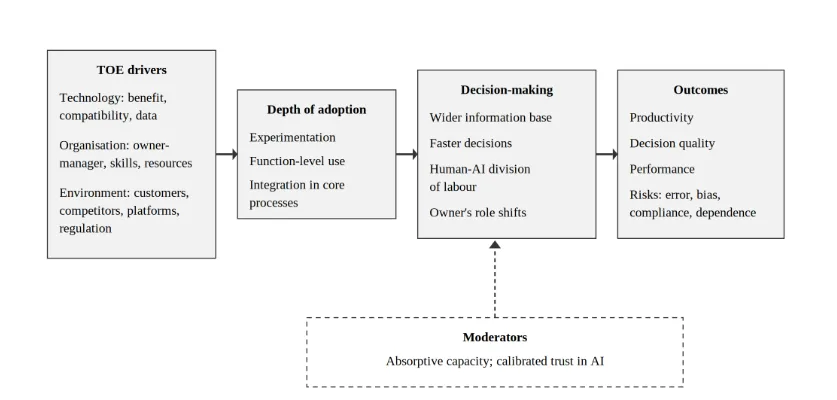
Figure 1 presents the model. Digital leadership actions influence three dynamic capabilities that lead to organizational agility. Three moderating variables influence these relationships: digital maturity, psychological safety, and organizational size.
Figure 1. Conceptual model

Source: developed by the author.
4.1 Digital leadership and sensing
For sensing to take place, it is important to scan the environment and interpret the findings in order to know what should receive attention (Teece, 2007). Sensing is a cognitive activity, and Helfat and Peteraf (2015) explain how the ability to sense is based on the perceptual and attentional skills of managers. Leaders influence the process of sensing through two main mechanisms. First, the reading that leaders give to technologies influences what information reaches the strategic agenda. The managers at Polaroid could see clearly the development of digital imaging but interpreted it through an outdated business model (Tripsas & Gavetti, 2000). Second, leaders influence how sensing is carried out across the firm by determining whether or not to bring in information from frontline employees, customers and external stakeholders.
Digital leaders, as defined in Section 2.1, actively scan technological change and encourage others to do the same. They also frame technology as a strategic question, which affects how signals are interpreted. Doz and Kosonen’s (2010) concept of strategic sensitivity captures this combination of sharp perception and open dialogue.
P1. Digital leadership is positively associated with the organization’s sensing capability.
4.2 Digital leadership and seizing
Sensing an opportunity is different from seizing it. Seizing involves making investment decisions and developing business models under conditions of uncertainty (Teece, 2007). This is another area where the role of the leader is important. In order to seize a digital opportunity, it is often necessary to conduct experiments where the outcome is impossible to predict. Traditional investment decision-making criteria tend to prefer what is known. Digital leaders who can clearly define the vision of digital development help the company see why it should invest, while leaders who encourage experimentation show how to invest without betting everything at once.
The fact that the dynamic capabilities of rapidly evolving markets are based on simple rules and fast prototyping, as pointed out by Eisenhardt and Martin (2000), supports this view. The same applies to the research by Warner and Wäger (2019), which revealed that digital seizing by incumbent companies was about balancing their digital portfolios and redesigning organizational structures for faster decision-making.
P2. Digital leadership is positively associated with the organization’s seizing capability, particularly through the articulation of digital direction and encouragement of experimentation.
4.3 Digital leadership and transforming
Transforming is the hardest capability to build and the one most clearly tied to leadership. It entails a process of redeployment of assets, structures, and processes, usually in the face of opposition from entrenched interests (Teece, 2007). Ambidexterity, which is the capacity to exploit existing businesses while exploring new ones, has been described by O’Reilly and Tushman (2008) as a dynamic capability that requires strong leadership that can balance the two. Gibson and Birkinshaw (2004) demonstrate how ambidexterity can also be embedded in the context of business units through supportive systems.
Digital transformation frequently requires precisely this kind of reconfiguration: new roles, new data flows, new ways of working across units. Kane et al. (2019) argue that the real barriers to digital transformation are people, culture and organization rather than technology. Leaders who reallocate resources and redesign structures directly enable transformation. Those who announce digital ambitions without changing structures leave the organization stuck between old routines and new rhetoric.
P3. Digital leadership is positively associated with the organization’s transforming capability, particularly through the reallocation of resources and redesign of structures.
4.4 From dynamic capabilities to agility
The model treats agility as an outcome of dynamic capabilities rather than a direct product of leadership. This is along the lines of Teece et al. (2016), who regard dynamic capabilities as the building blocks of agility. Each capability makes a different contribution. Sensing provides early warnings of changes to the firm. Seizing enables the firm to rapidly allocate its resources towards opportunities. Transforming ensures that the structures of the firm are not stuck in the past. All three capabilities need to work together to make the firm agile. A firm with good sensing capabilities but poor transforming capabilities might see the changes but still not respond to them.
The information systems evidence is consistent with this view. Lu and Ramamurthy (2011) and Tallon and Pinsonneault (2011) found that agility depended on how technology capabilities were integrated with business processes and strategy, not on technology investment alone, which points to the integrating role of dynamic capabilities.
P4. Sensing, seizing and transforming capabilities mediate the relationship between digital leadership and organizational agility.
4.5 Contextual conditions
The strength of these relationships is unlikely to be the same everywhere. Three conditions stand out.
The concept of digital maturity is about the level of integration of digital technology that the organization has achieved up until now (Kane et al., 2015). In digitally immature organizations, the impact of leadership would perhaps be the highest, due to the absence of any other driving force. The digital processes in mature organizations can perhaps become routine and less leader-driven. Thus, the leader impact might be lower in mature organizations; however, the connection might not necessarily be linear.
Psychological safety, the shared perception that there is a sense of safety in taking interpersonal risks (Edmondson, 1999), dictates whether employees feel secure enough to share bad news and voice dissenting views and novel ideas. Sensing is contingent upon the availability of such information to decision-makers, while seizing hinges on the willingness to try something that might not succeed. When psychological safety is low, the impact of digital leadership on sensing and seizing will be minimal, irrespective of good intentions.
Organizational size also matters. In smaller organizations, leaders are closer to operations and can change structures more directly, which should strengthen the effect of leadership on transforming. Leadership impacts have to move through many levels in big organizations and thus can get diluted, although big organizations also have more means of experimenting. According to complexity leadership theory (Uhl-Bien et al., 2007), in complex and big organizations, adaptive change depends less on individual leaders and more on conditions that enable emergence.
P5. Psychological safety strengthens the relationship between digital leadership and sensing and seizing capabilities.
P6. Organizational size and digital maturity weaken the relationship between digital leadership and transforming capability.
5. Discussion
The model makes three contributions to theory. First, it gives digital leadership a clearer identity. Rather than a new leadership style, digital leadership is presented as a set of behaviors oriented toward technology-driven strategic renewal and defined by their effects on specific organizational capabilities. This helps answer the criticism that the concept is simply transformational leadership with a new label (Cortellazzo et al., 2019).
Second, it outlines the process. There is an assertion in much of the literature that leadership leads to agility; this model identifies the process through sensing, seizing and transforming. This connects leadership research with the microfoundations of dynamic capabilities (Helfat & Peteraf, 2015) and fulfills the need to emphasize the role of managers in capability building.
Third, it recognizes that context changes the picture. The moderating role of psychological safety, maturity and size helps explain why digital leadership initiatives produce very different results in different organizations, and why the same leader may succeed in one setting and struggle in another.
The model also has boundaries. Leadership is viewed as behavior rather than leader attributes in this approach. Agility is treated as the outcome, while recognizing, as Teece et al. (2016) observe, that agility has costs and that not every firm needs the same level of it. Leadership is practiced at higher management levels in most cases, but this does not exclude other forms of leadership.
6. Managerial Implications
Executives, according to the framework, should focus on the impact of digital leadership on organizational capabilities rather than how many digital efforts they are making. Three questions that leaders should ask their own organizations include: Are we aware of technology changes that are relevant, and is information from the periphery reaching decision makers? Can we commit resources to promising opportunities quickly, through small experiments if necessary? Are we prepared to change structures and roles when the direction becomes clear?
The significance of psychological safety needs special mention. Leaders who want their organizations to identify and exploit opportunities need to encourage people who spot problems, voice them and propose solutions.
For human resource and leadership development, the model implies that the development of digital leaders should not only include technical skills but also include competencies in scanning and interpreting technological changes, setting direction, and managing experimentation and change.
7. Limitations and Future Research
This paper is conceptual and therefore the propositions have not been empirically tested, and the model may require modifications once more empirical evidence becomes available. The sources of the literature surveyed are all in English, and most come from studies conducted in North America and Europe. As such, there may be limitations to the applicability of the model in other cultures where expectations of leaders differ.
Potential directions for future research include testing the propositions using survey-based research designs that assess digital leadership behaviors, all three dynamic capabilities, and agility separately. Longitudinal studies tracking organizations throughout their digital transformation process would show how the relationships unfold over time. Cross-national and cross-sector comparative studies would help set boundaries for the proposed model. Validated measures of digital leadership behaviors also need to be developed independently of transformational leadership measures.
8. Conclusion
Firms that face difficulties in digital transformation do not have problems with access to technology. Like Polaroid, such organizations usually lack the leadership needed to understand the importance of technology and transform the organization accordingly. This paper has discussed the indirect impact of digital leadership on organizational agility, showing that it affects sensing, seizing and transforming capabilities, and that psychological safety, digital maturity and size determine the strength of this impact. Putting digital leadership into the framework of dynamic capabilities theory gives the concept a sharper definition and a clear path for empirical research. For managers and executives, the main lesson is that agility is developed, not proclaimed, and it is done by developing capabilities in others.
References
Teece, D. J. (2007). Explicating dynamic capabilities: The nature and microfoundations of (sustainable) enterprise performance. Strategic Management Journal, 28(13), 1319-1350. https://doi.org/10.1002/smj.640
Vial, G. (2019). Understanding digital transformation: A review and a research agenda. The Journal of Strategic Information Systems, 28(2), 118-144. https://doi.org/10.1016/j.jsis.2019.01.003