
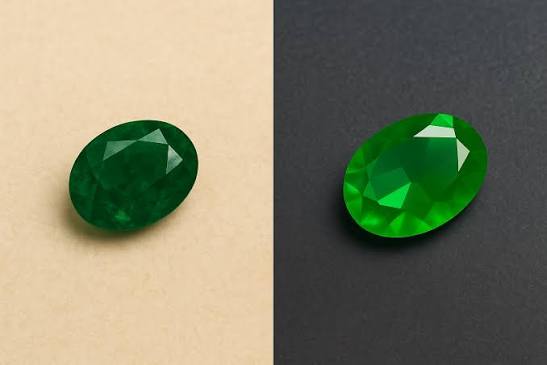
Colored gemstones are easy to replicate and hard to judge by eye. Glass has been sold as sapphire and emerald for centuries, and lab-grown stones have been around since 1902, when Auguste Verneuil announced his flame-fusion method. Many natural stones are also heated, oiled, or dyed before they reach a shop, so a simple yes or no on “is it real?” often isn’t possible.
Genuine stones follow physical rules that fakes can’t fully match. Hardness, the way light bends through the crystal, and the tiny features trapped inside can all be checked, some at home and the rest in a lab. Original Yellow Sapphire, original Blue Sapphire, and natural Emerald gemstones are among the most copied stones in the market.
Understanding the Terms: Natural, Synthetic, Imitation, Treated
Four words get mixed up a lot in this trade, and each one describes a different kind of stone:
- Natural: This stone formed deep inside the earth over millions of years, without human help. Humans only dug it out, cut it, and polished it. Natural gemstones are the rarest of the four, which is why they cost the most.
- Lab-grown (synthetic): This stone is made in a lab, but it is made of the same material as the natural one and has the same crystal structure. A synthetic blue sapphire is aluminum oxide colored by tiny amounts of iron and titanium, just like a mined one. It is a real sapphire in chemical terms, but it should always be sold as lab-grown and at a lower price.
- Imitation (simulant): This is a completely different material made to look like a gemstone, such as glass or dyed quartz. It only copies the look, so it has none of the hardness or value of the real stone.
- Treated: This is a natural stone that has been improved after it was mined, usually with heat, oil, or dye. The treatment deepens the color or makes the stone look clearer. Treated stones are real, but they are worth less than untreated ones of the same quality.
A stone can be genuine and still not be what the seller said. Heating is routine for sapphires, and the trade accepts it when it’s disclosed, so a heated original Blue Sapphire is a real sapphire. A lab-grown stone sold as natural is a mislabeled, and so is a dyed stone sold as untreated. For any stone, ask two questions: what it is and what has been done to it.
Simple At-Home Checks
- Visual inspection with a loupe (10x): A loupe is a small magnifying glass that costs very little. Look inside the stone for tiny lines, crystals, or cloudy patches, which most natural stones have. Perfectly clean stones, round air bubbles, or swirl marks usually point to glass or a lab-made stone.
- Fog test: Breathe on the stone like you would on a mirror and watch the fog. On a real gem, it usually disappears in a second or two. Glass tends to hold the fog a little longer, though this works better on diamonds than on colored stones.
- Light and sparkle test: Hold the stone under a bright light and turn it slowly. A real sapphire or emerald should give a steady, deep glow. If you see rainbow-colored flashes or a lifeless look, gemologists suggest being cautious, as it could be cubic zirconia or glass.
- Weight and feel: Hold the stone in your palm. Real gemstones feel cool and stay cool for a while, while glass and plastic warm up fast. A sapphire also feels heavier than glass or quartz of the same size, because it’s denser.
- Scratch and wear clues: Check the edges and corners of the facets, which are the flat cut surfaces. Sapphire is very hard, so its edges stay sharp, while glass edges round off and develop chips and scratches over time. Don’t scratch-test the stone yourself, since you can damage it.
Note on limits: Home checks give you hints and can’t prove a stone is real. A lab-made sapphire passes every one of these tests because it’s made of the same material as a natural one. For a stone you’re paying real money for, get a lab report.
Common Fakes and Treatments to Watch For
- Yellow look-alikes: Citrine is the stone most often sold in place of an original Yellow Sapphire. It looks close, costs a fraction of the price and is softer, at 7 on the Mohs scale. Yellow topaz, yellow beryl and yellow glass turn up too. Real yellow sapphires come mostly from Sri Lanka, Thailand, Australia and Madagascar, and many are heated to even out the color, which is fine when the seller says so.
- Blue look-alikes: Blue glass and lab-made sapphire are the usual copies. Natural stones like tanzanite, iolite and kyanite also get sold as sapphire, and they’re real gems that sell for far less. An original blue sapphire can also be diffusion-treated, where color is pushed only into the surface of a pale stone. Under a loupe, the color of a diffused stone sits along the facet edges and cracks. Natural blue sapphires come from Sri Lanka, Myanmar, Madagascar, and Kashmir, and origin can change the price a lot.
- Green look-alikes: Green glass is the simplest copy of a natural emerald gemstone, followed by flux-grown synthetic emeralds, which have been made since the 1930s. Doublets and triplets are common too. These are thin slices of real beryl glued to glass or colorless beryl with green cement in between, so a side view often shows a flat line near the edge or a sudden change in color. Nearly all natural emeralds are also filled with oil or resin to hide cracks. That’s standard as long as it’s disclosed. Real emeralds come mainly from Colombia, Zambia and Brazil.
Red flags: A price far below market, flawless clarity with very intense color, no information on origin or treatment, and a seller who won’t show a lab report.
Why Certification Matters
A gemstone certificate is a report written by an independent lab after testing the stone. It tells you what the stone actually is, whether it’s natural or lab-grown, and what treatments it has had. It also lists the weight and dimensions, and for emeralds it states how much clarity enhancement was done. Some labs add an opinion on where the stone was mined. This matters because you can’t see most of this with your eyes. The wording changes the price too: “heated” and “no indications of heating” describe the same kind of sapphire at very different prices.
Each report has a number you can look up on the lab’s website, and the weight and dimensions should match your stone. A certificate from the seller’s own shop isn’t independent, so it doesn’t count.
Some well-known gemological labs include:
- GIA: Gemological Institute of America (USA)
- IGI: International Gemological Institute (Belgium, with labs worldwide)
- SSEF: Swiss Gemmological Institute SSEF (Switzerland)
- GGL: Gübelin Gem Lab (Switzerland)
- GRS: GemResearch Swisslab (Switzerland)
- AGL: American Gemological Laboratories (USA)
- GII: Gemmological Institute of India (India)
How to Buy Natural Gemstone with Confidence
Even after you know how to spot a fake, the safest protection is how you buy. Most problems with gemstones come from missing information, such as an unclear treatment, a vague origin or a certificate that nobody can verify. Asking the right questions before you pay, and getting the answers in writing, clears up most of that. These are the things worth checking with any seller, whether you’re buying online, from a local jeweler, or at a gem market.
- Buy from sellers with clear authenticity and return policies. A return window gives you time to get the stone tested independently.
- Ask whether the stone is natural or lab-grown, whether it’s been treated, and where it’s from. A reliable seller answers all three in writing.
- Ask for the lab report and look up the number yourself.
- Get a full description with weight in carats, dimensions, color and treatment status.
- Compare prices. An unheated Original Blue Sapphire of fine color sells for far more than a heated one of similar size, so a bargain price on an “untreated” stone should make you look twice.
- Keep the invoice and certificate together. Insurers and future buyers will ask for both.
The Bottom Line
Checking a gemstone doesn’t have to be complicated, but it does take more than one step. Although the at-home checks won’t catch everything. Lab-grown sapphires, heat treatments, and oil-filled emeralds look the same to the eye as their natural counterparts, and only a gemologist’s instruments can tell them apart.
That’s why the paperwork matters as much as the stone. Prices between natural, treated, and lab-grown stones can differ by a wide margin, so it’s worth paying a little more to buy from a seller who is open about all three.
Before you buy, ask the questions, check the report number yourself, and keep every document. They take very little time and cover the most common mistakes buyers make. If you’d like to see certified gemstones with treatment and origin details listed clearly, you can browse the GemsRoot collection.