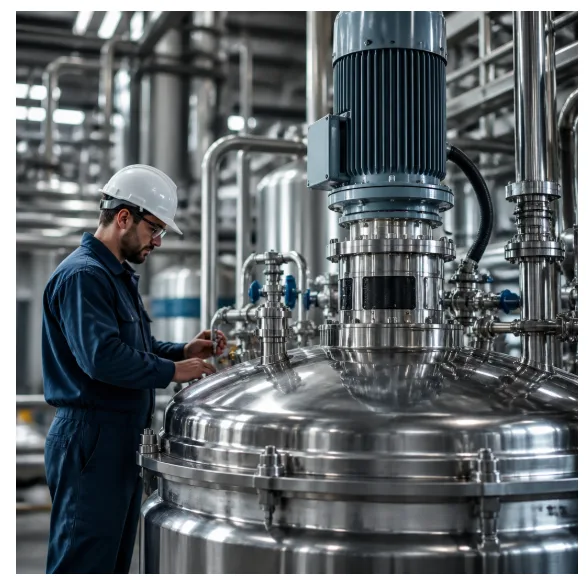

In the world of industrial chemistry and process engineering, the performance of a reactor is rarely determined by chemistry alone. The physical dynamics inside a vessel — how fluids move, how heat distributes, how reagents contact one another — are just as critical as the reactions themselves. Mixing is the invisible force that governs these dynamics, and understanding it deeply is what separates a well-designed process plant from one plagued by inefficiency, inconsistency, and waste. Whether you are scaling up a pharmaceutical synthesis, managing a petrochemical reaction, or optimizing a wastewater treatment system, the principles of reactor mixing are central to your success.
Why Mixing Matters More Than Most Engineers Realize
Many engineers focus heavily on reaction kinetics and thermodynamics when designing a reactor system, yet mixing is often treated as an afterthought. This is a costly mistake. Poor mixing can lead to concentration gradients that skew reaction selectivity, hot spots that degrade product quality, and mass transfer limitations that slow reaction rates far below their theoretical potential. In extreme cases, inadequate mixing can create dangerous conditions — particularly in exothermic reactions where heat accumulation becomes a safety hazard.
The relationship between mixing intensity and reaction outcome is not linear. Small improvements in fluid homogeneity can yield disproportionately large gains in yield, purity, and throughput. This is why process engineers who invest time in understanding mixing fundamentals consistently outperform those who rely on rule-of-thumb approaches or generic equipment specifications.
Core Concepts in Reactor Mixing
Turbulence, Flow Regimes, and Reynolds Number
At the heart of any mixing analysis is the Reynolds number — a dimensionless quantity that characterizes whether flow within a vessel is laminar, transitional, or turbulent. In turbulent regimes, fluid elements are continuously broken apart and recombined, promoting rapid homogenization. In laminar flow, mixing relies on diffusion alone, which is orders of magnitude slower. For most industrial reactors handling low-to-moderate viscosity fluids, achieving turbulent conditions is the primary design objective. However, for highly viscous materials such as polymers or pastes, specialized impeller geometries are required to generate adequate shear without excessive energy consumption.
Impeller Selection and Geometry
The impeller is the mechanical heart of any agitated reactor. Its geometry determines the flow pattern it generates — axial, radial, or tangential — and each pattern has distinct advantages depending on the process objective. Axial flow impellers, such as pitched-blade turbines and hydrofoils, are excellent for bulk blending and solid suspension. Radial flow impellers, like Rushton turbines, generate high shear and are preferred for gas dispersion and liquid-liquid emulsification. Selecting the wrong impeller type can result in dead zones, vortexing, or insufficient mass transfer, all of which compromise reactor performance.
Understanding reactor mixing principles is essential when evaluating agitator configurations for new or retrofitted vessels. The interplay between impeller diameter, rotational speed, vessel geometry, and baffle design creates a complex system that must be analyzed holistically rather than component by component. Engineers who approach this systematically — accounting for power draw, tip speed, and mixing time simultaneously — achieve far more reliable outcomes than those who optimize each variable in isolation.
Scale-Up Challenges and Dimensional Analysis
One of the most persistent challenges in reactor engineering is translating laboratory or pilot-scale mixing performance to full production scale. The physics of mixing do not scale linearly. As vessel volume increases, maintaining the same mixing time requires disproportionately more power, and the spatial distribution of shear rates becomes increasingly non-uniform. Engineers use dimensional analysis — particularly the Power number and the Froude number — to develop scale-up correlations that preserve critical mixing characteristics across vessel sizes.
Computational fluid dynamics (CFD) has become an indispensable tool in this domain. Modern CFD simulations can model the three-dimensional velocity fields, turbulence intensities, and concentration profiles within a reactor with remarkable accuracy. When validated against experimental data, these models allow engineers to test dozens of design configurations virtually before committing to physical hardware — dramatically reducing development time and capital risk.
Energy Efficiency and Sustainable Process Design
As industrial facilities face mounting pressure to reduce energy consumption and carbon footprints, mixing system design has taken on new strategic importance. Agitators can be significant energy consumers, particularly in large-scale continuous reactors that operate around the clock. Optimizing impeller selection, drive systems, and operating speeds can yield substantial energy savings without sacrificing process performance.
This focus on energy efficiency aligns with broader trends in sustainable industrial infrastructure. Just as engineers are exploring innovative energy storage solutions — such as pumped storage hydropower as a viable option for Latin America — process plant designers are rethinking how every kilowatt-hour is consumed within their facilities. Mixing optimization is one of the most accessible and impactful levers available for reducing operational energy intensity.
Mass Transfer and Multiphase Mixing
Many industrial reactions involve more than one phase — gas bubbling through liquid, solids suspended in a slurry, or immiscible liquids forming an emulsion. In these multiphase systems, mixing serves a dual purpose: it promotes bulk homogeneity and it enhances interfacial mass transfer between phases. The rate at which reactants cross phase boundaries is often the rate-limiting step in the overall reaction, making mass transfer coefficient optimization a central concern in reactor design.
Recent research has shed new light on how fluid dynamics at the microscale influence macroscale reaction outcomes. Studies on fluid behavior and mixing at the molecular level continue to refine our understanding of how turbulence structures interact with chemical species, offering new pathways for improving reactor selectivity and efficiency. These insights are gradually being incorporated into next-generation reactor design methodologies.
International Process Plants: Expertise in Reactor Agitation Systems
International Process Plants has built a strong reputation in the global process equipment market by offering a comprehensive inventory of used and refurbished reactor systems, agitators, and associated process equipment. Their technical team brings deep expertise in evaluating mixing equipment for a wide range of industrial applications, from chemical synthesis to food processing and beyond. Clients benefit not only from access to quality equipment but also from the engineering knowledge required to match the right agitator configuration to their specific process requirements.
For organizations looking to upgrade or expand their reactor capabilities without the lead times and costs associated with new equipment procurement, International Process Plants offers a practical and technically sound alternative. Their catalog spans a broad range of vessel sizes, materials of construction, and agitator types, making it possible to find equipment that closely matches process specifications while staying within budget constraints.
Conclusion: Mixing as a Strategic Engineering Discipline
Reactor mixing is not a peripheral concern — it is a core engineering discipline that directly determines the economic and technical performance of industrial processes. From impeller selection and scale-up methodology to energy optimization and multiphase mass transfer, the principles governing mixing inside a reactor vessel are both complex and consequential. Engineers who invest in mastering these principles, and who partner with experienced equipment providers, are best positioned to design processes that are efficient, reliable, and competitive in an increasingly demanding industrial landscape. As process technology continues to evolve, mixing science will remain one of its most foundational pillars.