Step into just about any corporate lobby on a rainy July day and you will see this picture repeated everywhere.
Umbrellas leaking beside the entrance. Footsteps soaking the floor tiles. A facilities person cleaning the exact same three metres of flooring for the fifth time in an hour, getting a bit exasperated each time.
This is precisely the time when the difference between polypropylene rubber mats designed for monsoon conditions becomes a matter of safety, cleaning budget, and perception of the environment.
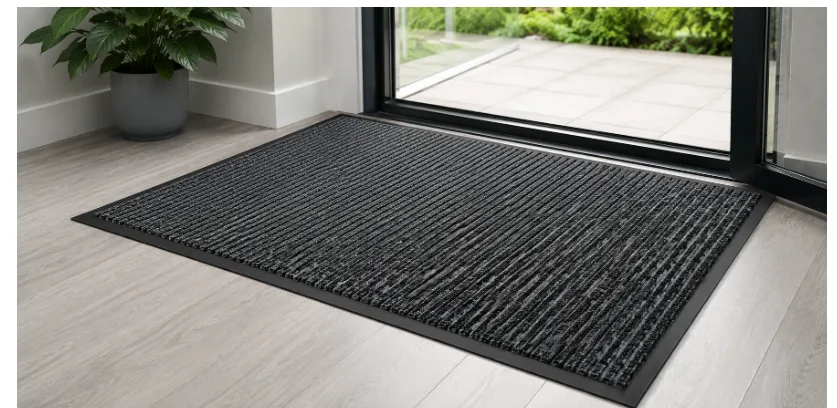

The Real Problem With Indian Monsoons and Flooring
Monsoon flooring trouble isn’t really about one wet patch near the door. It’s cumulative.
Water gets tracked in on shoes. Umbrellas drip along entire walkways, not just the entrance. Humidity keeps floors faintly damp long after the actual rain has stopped, sometimes for days. In coastal cities and anywhere with sustained heavy rainfall, this pattern repeats for weeks at a stretch, not just the odd afternoon.
According to ISSA, the global cleaning industry association, roughly 15 feet of entrance matting can prevent 80 to 90 percent of the dirt that gets tracked into a building by foot traffic. During monsoon, that “dirt” is usually mud, grit, and standing water all mixed together, which makes the matting zone matter even more than it does the rest of the year.
Here’s the part people miss, though: a mat that isn’t built for wet conditions doesn’t just look tired after a few weeks of rain. It can become an actual hazard. A soggy, saturated mat is sometimes more slippery than the bare floor it’s sitting on.
Why Material Choice Matters More Than You Think
Not all mats react similarly when water gets involved. That’s when polypropylene and rubber mats (alone or in combination) are likely to outshine both natural fibre and ordinary foam mats.
Reaction of Polypropylene to Moisture
Polypropylene is an artificial fibre that, differently from natural fibre mats (cotton, coir, or wool), does not absorb water; it allows moisture to stay on top or drain.
This feature alone is what makes a huge difference. Firstly, it means the mat will dry quicker. Secondly, it won’t get that moist odour common for natural fibre mats after several wet days. Thirdly, as there is no moisture in the actual fibres, it will be much harder for mould and mildew to grow.
The latter factor plays a larger role in India than in countries with a less humid climate. An always-moist natural-fibre mat in an entryway of a house in India can easily grow mould in a matter of days, not weeks.
Why Rubber Backing Changes Everything
A polypropylene surface is only half the story, though. What sits underneath the mat decides whether it actually stays put once the floor around it gets wet.
Rubber backing grips tile, marble, and stone noticeably better than PVC or vinyl backing does, and the gap widens once things get wet. This is also why rubber shows up as a standalone material at entrances, ramps, and loading docks, not just as a backing layer. It’s valued specifically for its durability, flexibility, and resilience in exactly these high-traffic, high-moisture spots.
Polypropylene vs Rubber: A Quick Comparison
| Factor | Polypropylene Mats | Rubber Mats |
| Water absorption | Very low, dries quickly | None, water sits or drains off |
| Best used for | Scraping and wiping zones just inside entrances | Outdoor entry points, ramps, loading areas |
| Slip resistance | Good, especially with rubber backing | Excellent, even when wet |
| Mould resistance | High | Very high |
| Typical monsoon role | Removing residual moisture from shoes | Stopping mud and water before it enters |
| Feel underfoot | Softer, carpet-like | Firmer, more rigid |
Neither can be considered “better” in every situation. They often function better when combined. Using a rubber scraper mat at the entrance followed by a polypropylene wiper mat right after that serves both purposes.
Monsoon Isn’t the Same Everywhere in India
It must be stated explicitly that the monsoon matting requirements are not uniform in the whole country, and approaching this requirement as a single concern will mean a wrong matting choice in many buildings.
In Mumbai and coastal Maharashtra, we have intense monsoon rains that may leave floors near the building entry points wet for hours. In such areas, the importance of the outdoor scraping section is as important, if not more, than the mat that goes inside the building.
Bangalore and most of the Deccan plateau areas receive less frequent rain but higher humidity between rainfalls. The need for mould resistance is more in such cases than simply water volume.
In Chennai and some areas of the eastern coast, we have heavy but short monsoon rains and high wind velocity that causes the rain to fall sideways under awnings and porches, requiring extended entrance areas.
None of this changes the core material logic. It just changes how much weight to put on drainage versus mould resistance versus scraping power when deciding on a mat.
Where These Mats Matter Most
The right wet-weather mat looks a little different depending on the kind of building it’s protecting.
- Offices: a rubber-backed polypropylene mat at the main entrance, paired with a smaller absorbent mat near the lift lobby, handles both jobs. The first scrape happens at the door. The final wipe happens right before employees step onto carpeted floors.
- Hotels: guests arrive with luggage, wet shoes, sometimes an umbrella still in hand, all at once, and they’re rarely looking down at the floor. A wider entrance mat with strong rubber backing reduces the odds of a distracted guest slipping while juggling bags at check-in.
- Retail stores: shoppers move fast and, again, aren’t watching where they step. An anti-slip entrance mat for wet floors placed across the full width of the doorway, not just centred in the middle, actually covers the paths people walk instead of the paths a designer imagined they’d walk.
- Hospitals: a wet floor near an entrance is a genuine risk for patients using walkers, wheelchairs, or crutches. Rubber matting with strong slip resistance usually gets prioritised here over how the mat looks, and that’s the right call.
- Homes: a single rubber-backed doormat at the main entrance, deep enough for two full steps rather than one, catches most of what would otherwise end up tracked across the living room floor.
Common Monsoon Matting Mistakes to Avoid
A few patterns show up again and again, across very different types of buildings.
- Using one small mat for the whole entrance. If the mat is too short, people are off it and onto bare floor before their shoes have had a real chance to dry.
- Choosing a mat based on colour or pattern alone. A striking mat that holds water or slides around on wet tile is arguably worse than having no mat there at all.
- Ignoring the backing material entirely. A PVC-backed mat sitting on polished stone can slide several inches once it’s wet, which defeats the whole point of putting it there.
- Not measuring the doorway properly. Off-the-shelf sizes frequently leave gaps at the edges of wider commercial entrances, and water simply finds its way around the mat instead of through it.
- Forgetting the outdoor section entirely. A mat placed only just inside the door misses the chance to remove mud and grit before it ever crosses the threshold in the first place.
Signs Your Mat Has Given Up
Mats don’t fail all at once. They wear down gradually, and by the time it’s obvious, they’ve usually already stopped doing much good.
Curling edges are an early sign, especially where a mat has been rolled up wet and stored damp between uses. Once the backing starts to crack or flake, grip drops noticeably, even on dry floors. A mat that stays visibly damp for more than a day after rain has likely lost whatever drainage capacity it started with. And if you can smell a mat before you see it, that’s usually mould, not just dust.
Replacing a worn mat before monsoon starts, rather than partway through it, is a small decision that avoids a lot of slip-and-fall risk later.
Choosing the Right Mat for Your Space
Entrance Zones
For the outermost zone, rubber or heavy-duty polypropylene mats with raised patterns that scrape shoes clean tend to work best. This is also where custom sizing matters most, since standard mat dimensions rarely match wider commercial doorways exactly. Trimming a standard-size mat down to fit an unusual entrance often exposes the backing along the cut edge, which quietly reduces grip right where it’s needed most. A mat measured to the actual doorway avoids that problem from the start.
High-Traffic Corridors
Once people are inside, a lower-pile polypropylene runner handles steady foot traffic without becoming a trip hazard, while still soaking up whatever moisture wasn’t caught at the door.
Home Use
A single well-placed rubber-backed mat at the main door, paired with a smaller absorbent mat just inside, is usually enough for most homes. The goal isn’t a bigger mat. It’s the right material sitting in the right spot.
Maintenance Tips for Wet-Weather Mats
- Shake out or vacuum entrance mats daily during heavy rain stretches, since trapped grit wears down fibres faster once it’s damp.
- Let mats dry flat instead of folded, so moisture doesn’t stay trapped inside the backing.
- Check rubber backing periodically for cracking, which quietly reduces both grip and lifespan.
- Rotate or replace mats at the busiest entrances more often during monsoon months than the rest of the year.
- Keep a spare mat on hand for particularly wet weeks, so a saturated mat can be swapped out to dry instead of staying underfoot while soaked.
Frequently Asked Questions
Are rubber mats better than polypropylene mats for monsoon?
Not strictly, no. Rubber tends to win outdoors and right at entry points because of its grip and durability, while polypropylene is better suited to absorbing residual moisture just inside the door. Most effective entrance setups end up using both rather than picking one.
Do polypropylene mats hold water or get soggy?
Not really. Polypropylene fibres don’t absorb water the way natural fibres do, which is why they dry faster and avoid the musty smell that cotton or coir mats often develop during monsoon.
How often should entrance mats be replaced during monsoon?
It depends on foot traffic, but high-traffic commercial entrances often need checking weekly during heavy rain, with cleaning or replacement if the backing shows wear or the surface stays damp for longer than a day.
Can a wet mat actually be more dangerous than no mat at all?
Yes, if the backing is poor or the mat has become fully saturated. A mat that slides on wet tile, or one holding so much water it’s essentially a puddle with fibres in it, can raise slip risk instead of lowering it.
What size mat is needed for a commercial entrance during monsoon?
Industry guidance generally points to enough matting length for at least two to three full walking steps, which works out to roughly 1.8 to 2.4 metres for most adults. Entrances that don’t match standard mat dimensions are usually better served by a custom-measured mat than a trimmed generic one.
Conclusion
Monsoon flooring problems are predictable every single year, yet plenty of buildings still get caught off guard because the mat at the door was chosen for looks rather than performance. Understanding how polypropylene and rubber behave differently once water enters the picture makes it a lot easier to put the right material in the right place, whether that’s a hospital corridor, a hotel lobby, or a home entryway. Getting the sizing and backing right ends up mattering just as much as the material itself, and for entrances that don’t fit standard dimensions, a properly measured mat will consistently outperform a trimmed-down generic one, monsoon after monsoon.