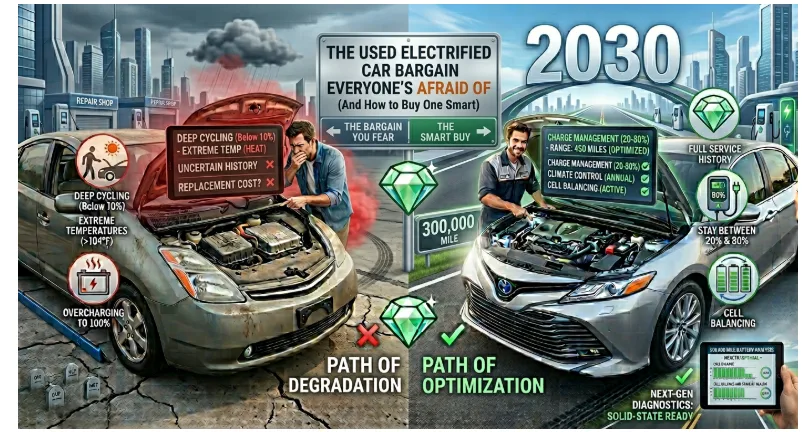

A three-year-old electric or hybrid car typically sells for 30–45% less than it cost new — a steeper drop than most gasoline cars — and the reason is almost entirely psychological. Buyers imagine a five-figure battery bill lurking under the floor, so they lowball or walk away. Meanwhile, real-world fleet data shows most of these packs will outlive the loan, the tires, and often the buyer’s interest in the car.
That fear gap is where the bargain lives. If you know how to actually verify battery health — not guess at it, verify it — you can buy someone else’s depreciation anxiety at a serious discount. This guide covers the checks that take twenty minutes at a test drive, the wear patterns that differ between hybrids and full EVs, and the numbers that turn a scary negotiation into a boring one.
Why the Battery Fear Is Priced In (But the Risk Mostly Isn’t Real)
Start with the data that should reframe everything. Studies tracking hundreds of thousands of electrified vehicles put average battery degradation at roughly 1.8–2.5% of capacity per year, front-loaded in year one and slowing after. Actual pack failures — the car-won’t-drive kind — run in the low single digits of a percent outside of specific recalled models, and nearly all of those happen inside warranty.
Now look at what warranties actually cover. Federal rules in the US require 8 years/100,000 miles of hybrid and EV battery coverage; California-standard states push that to 10 years/150,000 miles for many models, and several manufacturers guarantee a capacity floor (usually 70%) rather than just outright failure. A 2021 model bought used in 2026 often still carries three to five years of the most expensive component’s warranty.
So the market is pricing in a risk that warranty terms and fleet statistics have largely already absorbed. That mispricing is rare in used cars — usually the market is brutally efficient — and it exists here only because battery health is invisible to a casual buyer. Your job is to make it visible.
The Twenty-Minute Battery Health Check Anyone Can Do
You don’t need to be a technician. You need a phone, an OBD dongle, and a short checklist. Here’s the sequence experienced buyers run before talking price:
- Pull the battery health report. Most full EVs display state-of-health (SoH) somewhere — in a service menu, through the manufacturer’s app, or via an OBD-II Bluetooth adapter ($20–40) paired with an app suited to that brand. You’re looking for SoH as a percentage of original capacity. Above 90% on a 3–4 year old car is healthy; 85–90% is normal; below 80% deserves a hard conversation or a hard pass.
- Compare indicated range to the original rating — carefully. Charge to 100% (or ask the seller to), then compare the dash estimate to the original EPA/WLTP figure. It’s a crude check because range estimates adapt to the previous owner’s driving, but a gap larger than 15% in mild weather is a flag worth chasing with a proper SoH readout.
- Ask for charging history. Many brands log DC fast-charge counts in service records or apps. A car that lived on rapid chargers isn’t automatically bad — thermal management matters more — but a highway-fleet car with thousands of DC sessions should be priced differently than a garage-kept commuter.
- Check for battery-related recalls and completed campaigns. Run the VIN through the manufacturer and government recall databases. An outstanding battery recall is a negotiation lever; a completed one sometimes means the car has a newer pack than its age suggests — genuinely a bonus.
- Listen and look during the test drive. Cooling fans that scream at moderate temperatures, a 12V battery warning, dashboard hybrid-system lights that “just came on last week” — these small tells cost sellers thousands when buyers notice them.
- Get a specialist inspection for anything expensive. Independent EV/hybrid shops now offer pre-purchase battery diagnostics for $100–200, including cell-level voltage balance. On a $25,000 purchase, skipping this to save $150 is the falsest economy in the used market.
Hybrids, Plug-ins, and Full EVs Wear Out Differently
Here’s what most buyers miss: “electrified” covers three very different battery lives, and the inspection emphasis should shift with each.
Conventional hybrids: small pack, endless cycles
A regular hybrid carries a tiny buffer pack — often just 1–2 kWh — that cycles shallowly all day, every day. The chemistry is protected by software that never lets it run full or empty, which is why these packs routinely outlast everything around them. The known quantity here is remarkable: a Toyota hybrid battery has such a long documented service history that independent shops publish failure-age statistics by model year, and refurbished replacements with warranties run $1,500–2,500 installed rather than the $4,000+ dealer quote most buyers assume. For these cars, mileage matters less than climate history — packs from consistently hot regions age measurably faster — and a $150 hybrid-system health scan tells you nearly everything.
Plug-in hybrids: the hardest-working packs on the road
PHEVs are the sleeper risk category, and almost nobody prices them that way. Their packs (8–18 kWh) are small enough that daily driving cycles them deeply — often full-to-empty every single day — which is the most aging-intensive duty cycle in the industry. A high-mileage PHEV driven mostly on electric power may show more relative degradation than a full EV with triple the odometer reading. Check the electric-only range against the original rating with extra skepticism here.
Full EVs: big pack, gentle life — usually
A 60–80 kWh pack doing a 40-mile commute barely notices the work; that’s a 10–15% daily cycle, the gentlest possible duty. The variables that matter are heat exposure, fast-charging intensity, and whether the thermal management is liquid-based. This is also the category where SoH readouts are most accessible and most trustworthy, so there’s the least excuse for buying blind.
Decoding the Charging Story a Used EV Tells
Every used EV arrives with an invisible biography written by its charging habits, and learning to read it is worth real money.
The headline worry — rapid charging — deserves nuance rather than fear. A well-cooled fast charging battery tolerates years of DC sessions with only a few extra percentage points of degradation compared with an identical slow-charged pack; the studies that scared everyone years ago mostly involved early vehicles with passive cooling. What actually separates a tired pack from a healthy one is heat history: the same rapid session that’s harmless in a liquid-cooled car with preconditioning can be genuinely punishing in an air-cooled design baking through a desert summer.
So ask location questions, not just charger questions. Where did the car live? A Phoenix or Dubai car needs a bigger SoH discount than its odometer suggests; a Scandinavian car often ages beautifully despite hard winters, because cold slows chemical aging even as it temporarily dents range.
Two more biography chapters worth reading:
- The 100% habit. Some chemistries (iron-phosphate) are designed for daily full charges; high-nickel packs age faster when routinely parked full. If the seller says “I always kept it charged to 100% so it was ready,” that’s neutral for an LFP car and a mild negative for a long-range NMC one. Knowing which pack the specific trim carries — the same model often ships with both — is the kind of detail that separates informed buyers from hopeful ones.
- The abandonment chapter. A car that sat unplugged at low charge for months (estate sales, repos, dealer lots gone wrong) may have a damaged 12V system and, in worst cases, main-pack cells pulled below safe voltage. Long gaps in registration or service history deserve direct questions.
Mistakes and Myths That Cost Used Buyers Real Money
“High mileage means a dead battery soon.” Mileage correlates weakly with pack health. A 90,000-mile highway commuter with gentle cycles frequently out-tests a 40,000-mile city car that fast-charged in heat. Test SoH; don’t infer it from the odometer.
“The dash range estimate is the battery’s health.” It’s not — it’s a guess based on the last driver’s habits. An efficient hypermiler makes a tired pack look great; a lead-footed winter driver makes a healthy pack look terrible. Only a proper state-of-health reading settles it.
“A replaced pack means the car was a lemon.” Often the opposite. A pack replaced under warranty or recall means the most expensive component is years younger than the car. Some of the best used values are vehicles with documented recent pack replacements that the market still prices as if they carried original batteries.
“Aftermarket and refurbished packs are junk.” Quality varies, but the independent repair ecosystem has matured dramatically — module-level repairs, balanced refurbished packs with 1–3 year warranties, and specialist shops in most major cities. What matters is documentation: who did the work, what was replaced, what warranty transfers to you.
“Winter test drives don’t tell you anything.” They tell you plenty if you interpret them right. Expect 15–35% less indicated range in freezing weather — that’s physics, not damage. What is diagnostic in winter: how fast the cabin heats, whether preconditioning works, and whether range collapses far beyond that normal band.
“You can’t negotiate on battery condition without a failure.” SoH is quantifiable, and quantifiable things are negotiable. A pack at 85% versus a comparable listing at 93% is a concrete, dollar-per-percent conversation — typically worth $100–300 per point of SoH on mainstream models, more on long-range trims where capacity is the whole value proposition.
What the Numbers Look Like in an Actual Deal
Put the whole method together on a realistic example. Say you’re looking at a four-year-old mainstream EV listed at $22,000, originally $41,000.
Your dongle reads 88% SoH — right in the normal band. The VIN check shows a completed thermal-management recall (mild positive: dealer-inspected pack). Service records show mostly home charging with occasional road-trip DC sessions. The car spent its life in a temperate climate. Four years of battery warranty remain on the capacity-floor clause.
That profile is about as de-risked as a used purchase gets, and here’s the economics that most buyers never run: the remaining warranty alone insures the single most expensive failure mode into the 2030s. Compare total five-year costs against an equivalent gasoline car at the same price — roughly $1,200–2,000 per year saved on fuel for an average driver at home-charging rates, $300–600 saved annually on maintenance (no oil changes, minimal brake wear thanks to regeneration) — and the electrified car frequently comes out $7,000–12,000 ahead over the ownership period before counting any incentives your region offers on used electric purchases.
Against that, price the genuine risks honestly: a possible out-of-warranty pack issue late in your ownership (low probability, now increasingly repairable at module level for $1,500–4,000 rather than full-pack prices), and faster tire wear from the extra weight (~20% shorter tire life). The math still lands comfortably on one side for most drivers — which is exactly why the fear-driven discount is worth harvesting while it lasts.
The Buyer’s Edge, in One Idea
Every underpriced asset needs a reason to be underpriced, and in this market the reason is simply that battery health is invisible to people who don’t know where to look. You now do. A $30 dongle, a VIN check, a climate question, and a $150 specialist scan convert the scariest unknown in used-car buying into a number on a screen — and numbers, unlike fears, can be negotiated.
The window won’t stay open forever. As health reports become standardized on listings (regulators in several markets are already moving that way), the fear discount will shrink to match the real risk. Until then, the best used-car deals on the road belong to the buyers who check instead of guess.
Frequently Asked Questions
What’s a good state-of-health number for a used electric car? Above 90% is excellent for anything under five years old, 85–90% is normal wear, and 80–85% is acceptable with a matching discount. Below 80% means shorter range now and likely warranty-claim territory — verify the capacity-floor terms before buying.
How much does a professional battery inspection cost, and is it worth it? Independent EV and hybrid specialists typically charge $100–200 for a diagnostic including cell-balance data. On any purchase over $10,000 it’s the highest-value money in the entire transaction, routinely paying for itself many times over in negotiation or avoided mistakes.
Do battery warranties transfer to second owners? Almost universally yes for the federally mandated coverage, though a few brands trim extras like capacity guarantees for subsequent owners. Read the specific warranty document for the model year — terms changed frequently through the early 2020s.
Is a plug-in hybrid a safer used buy than a full EV? Counterintuitively, often not. Plug-in packs endure the deepest daily cycling in the industry relative to their size, while big EV packs live gently. Judge each car by measured health and usage history rather than assuming the smaller battery means smaller risk.
Should I avoid used electrified cars from hot climates? Not avoid — discount. Heat is the strongest aging accelerant, so a sunbelt car deserves a closer health check and a lower price than an identical northern car. If the SoH reading is strong despite the climate, the pack has already proven itself.
What happens if the pack fails right after my purchase? If you’re inside the transferred warranty period and capacity floor, the manufacturer covers it. Outside warranty, module-level repair has become the norm at independent shops, typically $1,500–4,000 depending on the fault — significant, but nothing like the full-replacement horror quotes that circulate online.
Can I trust the seller’s mobile app screenshot of battery health? Treat it as a starting claim, not proof. Screenshots can be outdated or from a different vehicle, and app figures are sometimes optimistic. Verify with your own OBD reading or an independent inspection before money moves.