Introduction
“Antioxidant” has become one of those words that shows up everywhere in wellness conversations on packaging, in marketing, and in casual health advice. But in scientific circles, it’s used with far more caution.
That gap is where Antioxidant Rich Tea quietly sits.
Tea itself is not new. What’s new is how often people try to explain it through the language of cellular biology oxidative stress, free radicals, and metabolic balance. Whether that interpretation is always accurate is another question entirely.
Still, the interest is real. And it keeps growing.
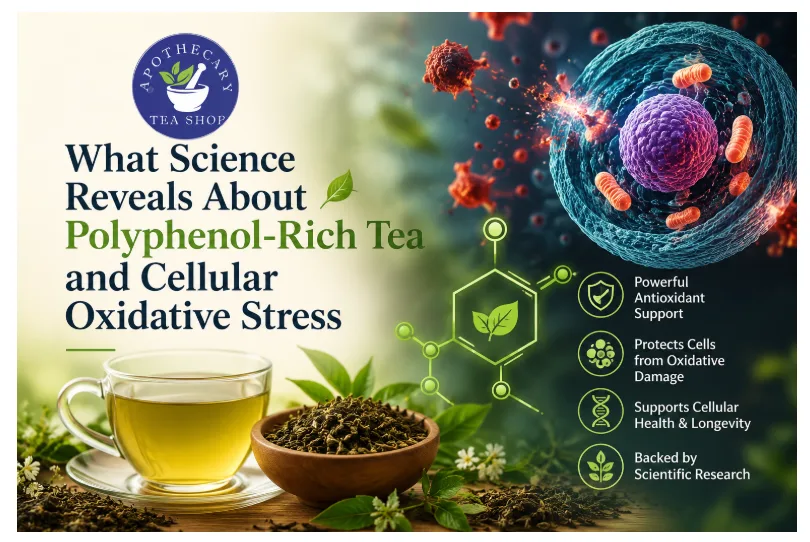

Polyphenols: What Actually Matters in Tea
Tea leaves contain naturally occurring compounds called polyphenols, a broad category that includes flavonoids and catechins. Among them, EGCG (epigallocatechin gallate), most commonly found in green tea, has been heavily studied.
In controlled lab environments, these compounds show antioxidant behavior meaning they interact with reactive oxygen species produced during normal metabolic activity.
That’s the scientific framing. But outside the lab, the conversation often stretches further than the data supports.
This is why researchers tend to describe tea as part of a broader dietary pattern rather than assigning it isolated effects. It’s also why natural herbal tea keeps appearing in nutrition discussions not as a cure, but as a consistent source of plant-based compounds.
Oxidative Stress: A Concept Often Oversimplified
Oxidative stress sounds like a modern health problem, but in biology, it’s simply balance or imbalance at the cellular level.
Reactive oxygen species are produced naturally. The body has its own systems to manage them. Problems arise only when that balance is disrupted over time.
And that disruption rarely comes from a single source.
Sleep, diet quality, environmental exposure, stress levels all of it interacts. Nutrition is only one layer in a much larger system.
So when cell health is discussed in research, it’s rarely about one food or one beverage. It’s about patterns that accumulate over time.
Why Tea Became a Functional Beverage Without Trying
Something subtle has shifted in the U.S. beverage landscape. Soda didn’t disappear overnight, but it lost cultural dominance. In its place, functional beverages slowly took hold — drinks that are chosen for what they represent, not just what they taste like.
Tea benefited from this shift without reinventing itself.
Some people drink it to cut sugar. Others to reduce caffeine. Some simply want a quieter daily rhythm.
That’s where categories like Wellness Tea and emerging supplement tea blends entered the conversation not as medical products, but as structured habits within modern routines.
Brands such as Apothecary Tea Shop sit in that space where tradition meets modern wellness language, without pushing the narrative too far in either direction.
What Science Supports and What It Doesn’t
There is a tendency in wellness culture to compress complex science into simple claims. Nutrition research does not really work that way.
What is broadly supported:
- Tea is a natural dietary source of polyphenols
- Polyphenols demonstrate antioxidant activity in laboratory conditions
- Dietary patterns matter more than isolated ingredients
- Cellular processes are influenced by multiple lifestyle factors
What is not supported:
- That tea directly “fixes” oxidative stress
- That antioxidants behave the same in the body as they do in a petri dish
- That any single beverage has standalone biological control over long-term health outcomes
This is where nuance matters and where most public discussions tend to drift away from the science.
Why Tea Keeps Showing Up in Research
Tea is one of the few dietary elements that remains both culturally constant and chemically complex.
It is consumed daily across populations. It varies widely by type. And it contains a naturally diverse mix of compounds that researchers can study in different contexts.
That combination makes it useful not as an exception, but as a reference point.
So even after decades of study, Antioxidant Rich Tea continues to appear in scientific literature. Not because it is mysterious, but because it is consistent.
What Actually Matters in Real Life
Most people are not thinking in terms of polyphenol pathways when they make tea. They are thinking in terms of routine.
What they replace matters more than what they add.
A sugary drink swapped for tea. A late-night stimulant replaced with something gentler. A pause in the day that didn’t exist before.
These small shifts are where dietary behavior actually changes.
Tea especially herbal blends fits into that space easily. It doesn’t require justification. It simply becomes part of the routine.
And over time, routines tend to matter more than intentions.
Conclusion
The science around Antioxidant Rich Tea and oxidative stress is still evolving, and it likely will be for a long time. That’s the nature of nutrition research slow, layered, and rarely absolute.
What remains consistent is simpler: tea is one of the most widely consumed plant-based beverages in the world, and polyphenols remain a serious area of scientific interest in how diet interacts with biology at a cellular level.
But the most grounded interpretation is also the least dramatic.
Tea is not a solution.
It is a habit and sometimes, habits are where long-term health narratives actually begin.