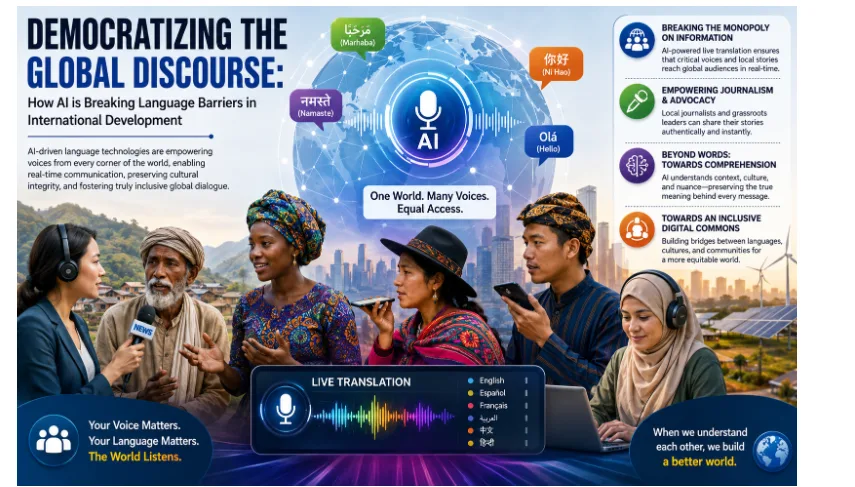

The promise of a globalized world has always been rooted in connectivity. In theory, modern digital networks allow ideas, news, and humanitarian efforts to cross borders instantaneously. Yet, for decades, a silent gatekeeper has restricted true global equity: the language barrier. While international platforms like Inter Press Service (IPS) work tirelessly to elevate voices from the Global South and marginalized communities, the systemic cost of translation has historically centralized geopolitical influence within a few dominant languages.
Today, we are witnessing a profound shift. Artificial intelligence is no longer just a tool for tech enthusiasts; it is evolving into an essential instrument for social justice, international diplomacy, and democratic inclusion. By decentralizing the power of speech, AI-driven language technologies are allowing grassroots movements, independent journalists, and localized NGOs to participate on the world stage on their own terms.
Breaking the Monopoly on Global Information
Historically, access to timely international news and global policy discussions was a privilege. Major international summits, scientific breakthroughs, and human rights reports are overwhelmingly published in English, French, or Spanish. For local communities facing the direct impacts of climate change, economic restructuring, or political upheaval, this linguistic divide creates an information vacuum. Conversely, their critical firsthand testimonies rarely reach global policy makers because translating them out of localized dialects requires significant financial resources.
The emergence of sophisticated AI audio processing is rapidly dismantling this hierarchy. The ability to deploy live translate audio tools means that a community leader in a remote region can speak at a global webinar or give an interview to an international journalist, and be understood in real-time across multiple continents.
This instant synchronization removes the financial and logistical friction that once sidelined grassroots advocates. Information equity is no longer dependent on a multi-million-dollar translation budget; it is becoming accessible to anyone with an internet connection, ensuring that those affected by global policies have a direct say in shaping them.
Empowering Independent Journalism and Grassroots Advocacy
In international reporting, speed and authenticity are paramount. When critical social or environmental crises unfold, the world relies on local journalists who understand the cultural and political nuances of the ground reality. However, when these journalists must wait for manual translation bureaus to adapt their footage, audio dispatches, or interviews, the momentum of the news cycle is often lost.
AI-driven voice technologies change the timeline of crisis response and investigative journalism. By automating the transcription, translation, and voice synthesis processes, local content can go global simultaneously with the event itself. Crucially, modern generative AI doesn’t just replace words; it preserves the original speaker’s vocal characteristics, emotional urgency, and dignity. This human element is vital for advocacy work, where empathy drives global solidarity and policy action.
Moving from Mechanical Translation to Genuine Comprehension
A common critique of early automated tools was their inability to handle cultural subtext, regional idioms, and the sensitive terminology inherent to human rights and international law. A literal, word-for-word translation can misrepresent a crisis or obscure a diplomatic nuance, sometimes with severe real-world consequences.
However, the current generation of large language models treats communication as an ecosystem rather than a dictionary code. The sophisticated algorithms powering modern language interpretation services are capable of analyzing context holistically. They recognize the social conditions behind phrases, adapt colloquialisms accurately, and respect the specialized vocabulary used in legal, medical, and environmental sectors.
This level of precision ensures that when a marginalized group shares its narrative, the structural integrity of their experience remains intact. AI has transitioned from a mere text converter into an intuitive partner in cross-cultural diplomacy, protecting the authenticity of local knowledge.
Towards an Inclusive Digital Commons
Linguistic diversity is one of humanity’s greatest assets, representing unique ways of thinking, problem-solving, and preserving history. Technology should never aim to homogenize this diversity; rather, its ultimate goal should be to build bridges that allow these diverse perspectives to coexist and collaborate.
As platforms like Palabra continue to refine these neural frameworks, the focus remains on democratization. True global progress cannot occur in a monologue. By providing accessible, high-fidelity, and immediate translation capabilities, we are moving closer to a balanced global dialogue one where the weight of an idea is no longer determined by the language in which it was spoken.