Hyperscayle, an Austin-based revenue operations firm, has released a new perspective on one of the most active debates in go-to-market operations: when to build internal software tools using AI and when to keep buying SaaS. The article, authored by co-founder Ben Mohlie, argues that the line between build and buy is moving faster than most ops leaders realize.

Hyperscayle, a revenue operations consulting and implementation firm based in Austin, Texas, has published a new build vs. buy analysis for RevOps tech stacks that challenges the conventional wisdom operations leaders have relied on for years. The article, authored by co-founder Ben Mohlie and published in April 2026, argues that natural language coding has fundamentally shifted which tools are worth building internally, and that most organizations are drawing the line in the wrong place.
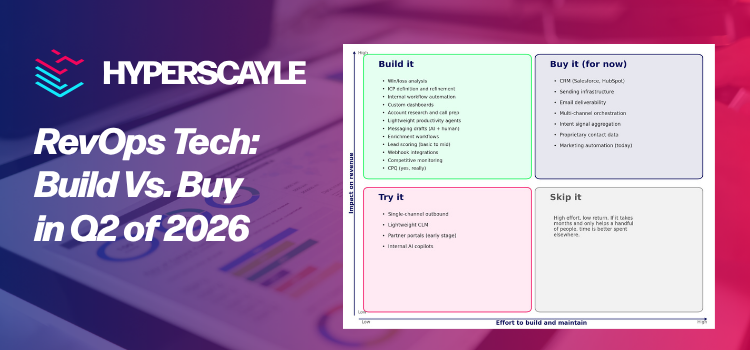
The article introduces a practical 2×2 framework organized around two axes: impact on revenue and effort to build and maintain. Mohlie places a wider range of tools in the “build” category than most operations leaders expect, including CPQ applications, deal desk approval routing, custom partner portals, win/loss analysis tools, account research workflows, and lead scoring. The reasoning is that natural language coding platforms have advanced to the point where a non-technical operator can ship enterprise-grade software with role-based access, audit logs, and complex workflow logic in days rather than months.
The article addresses the most common objections to building internal tools, including integration challenges, compounding maintenance, compliance exposure, and the risk that only one person understands what was built. Mohlie argues that each of these concerns has a credible answer in 2026 that it did not have in previous years. The model that builds the application can also debug it, document it, and onboard new team members to it, which changes the risk profile substantially.
The framework preserves a clear “buy” column for tools where the vendor’s value is proprietary data rather than configurable workflow: core CRM platforms, email deliverability infrastructure, intent signal aggregation, and proprietary contact data. However, Mohlie notes that this column is not permanent. As natural language coding capabilities continue to advance, the list of tools worth buying rather than building will shrink, and organizations that treat today’s categorization as final will fall behind those that revisit the question regularly.
The article also outlines eight diagnostic questions RevOps leaders can use before committing to any build or buy decision, covering revenue impact, audience size, build cost in calendar time, maintenance load, blast radius if the tool fails, fully loaded cost of buying, opportunity cost, and degree of required customization.
“The build-vs-buy question isn’t settled by where the tools are today. It’s settled by where they’re going. The teams that figure out what’s now worth building, and act on it, are going to ship faster, customize harder, and pay less than the teams that keep defaulting to buy out of habit,” said Ben Mohlie, Co-Founder, Hyperscayle.
The full article is available on the Hyperscayle Insights page. Operations leaders evaluating where AI fits in their RevOps roadmap can learn more about Hyperscayle’s structured approach through its RevOps AI Transformation program.
Contact Details
Business: Hyperscayle
Contact name: Ben Mohlie
Email: ben.mohlie@hyperscayle.com
Country: United States
Website: https://hyperscayle.com/insights/build-vs-buy-2026?utm_source=PR&utm_medium=PR&utm_campaign=Build-vs-Buy-PR