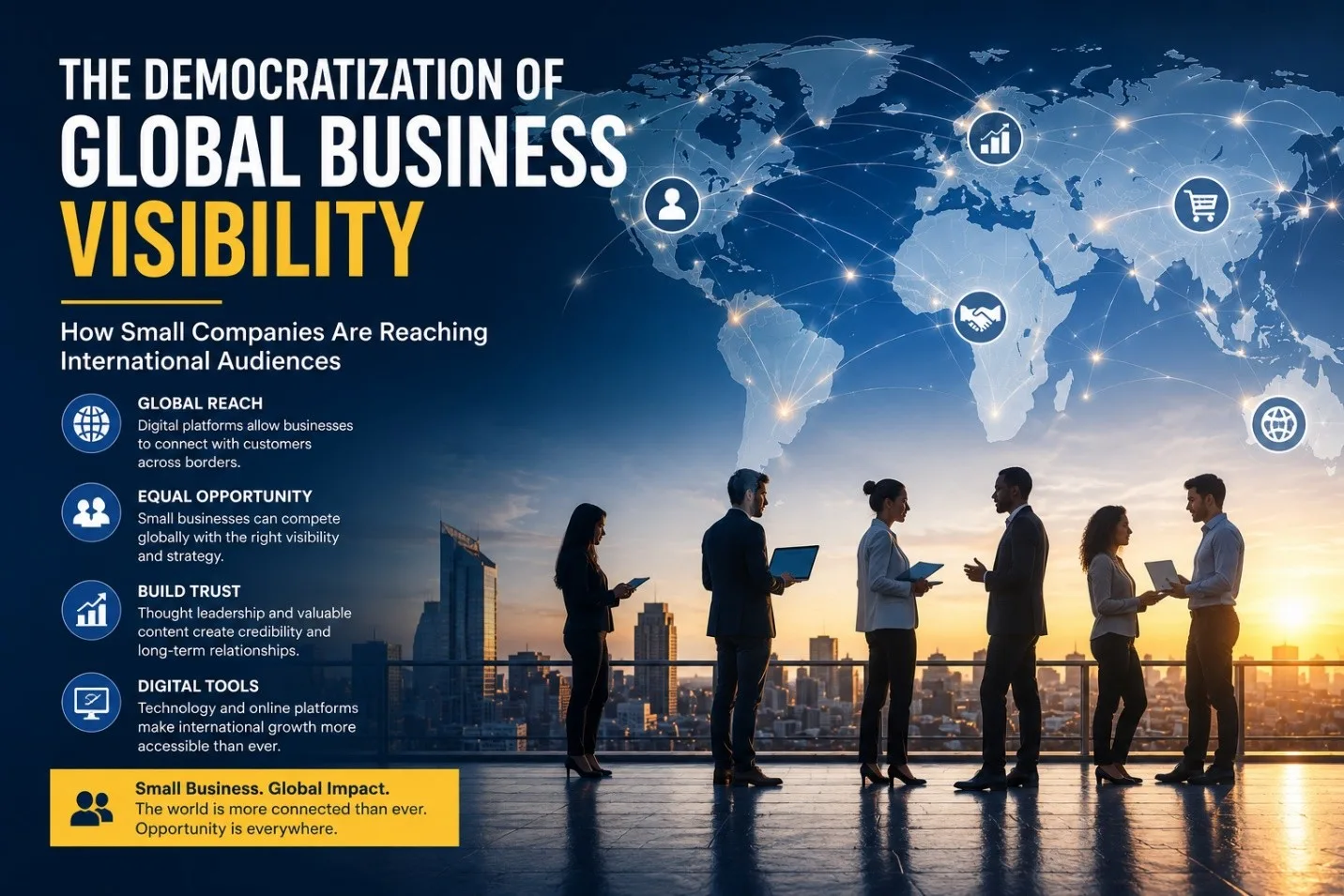

For decades, international visibility was a privilege largely reserved for multinational corporations.
Large businesses had the budgets to advertise across multiple markets, hire international public relations agencies, attend global trade events, and establish offices in strategic locations worldwide. Small businesses, regardless of how innovative their products or services might have been, often struggled to compete beyond their local or regional markets.
Today, that landscape is changing rapidly.
Digital technologies, online publishing platforms, artificial intelligence, and the growing accessibility of global communication channels have fundamentally transformed how businesses connect with customers, partners, and investors. A small company in Manchester, Madrid, Nairobi, or Jakarta can now reach audiences across continents without the financial resources traditionally required for international expansion.
The democratization of business visibility is creating new opportunities for entrepreneurs and small enterprises worldwide. It is reshaping competition, lowering barriers to entry, and enabling businesses of all sizes to participate in the global economy.
The End of Geographic Limitations
Historically, business growth was closely linked to geography.
A company’s ability to attract customers depended heavily on physical proximity, local advertising, and established regional networks. Expanding internationally often required significant investment, extensive planning, and considerable operational risk.
The internet disrupted these limitations.
Businesses can now showcase products, deliver services, communicate with customers, and build relationships across borders with unprecedented ease. E-commerce platforms, digital payment systems, cloud-based software, and virtual collaboration tools have created a business environment where location is increasingly less important than visibility and accessibility.
A software developer in Eastern Europe can serve clients in North America. A design agency in South Asia can collaborate with businesses across Europe. A consultant in Africa can provide expertise to organizations operating on multiple continents.
What matters is no longer where a business is located.
What matters is whether people can find it.
Visibility Has Become a Competitive Advantage
The growth of digital markets has created immense opportunities, but it has also intensified competition.
Consumers and businesses now have access to a global marketplace of products, services, and expertise. This abundance of choice means that visibility has become one of the most valuable assets a company can possess.
Research consistently shows that buyers conduct extensive online research before making purchasing decisions. They compare providers, read reviews, evaluate expertise, and seek evidence of credibility.
Businesses that appear in these discovery journeys gain a significant advantage.
Those that remain invisible often struggle despite offering excellent products or services.
As a result, many organizations are investing not only in operational excellence but also in strategies that improve discoverability and establish trust.
The Rise of Thought Leadership
One of the most notable developments in recent years has been the increasing importance of thought leadership.
Business leaders are recognizing that expertise itself can become a powerful asset when shared publicly.
Articles, industry commentary, research insights, case studies, and educational content allow organizations to demonstrate knowledge while contributing value to broader conversations.
This approach benefits both businesses and audiences.
Readers gain access to practical information and expert perspectives. Businesses gain visibility, credibility, and opportunities to engage with new markets.
Thought leadership has become particularly important for small and medium-sized enterprises that may not have the advertising budgets of larger competitors.
By sharing expertise, smaller organizations can compete on knowledge rather than financial resources.
Digital Publishing Levels the Playing Field
The growth of digital publishing has played a critical role in democratizing visibility.
In previous decades, gaining exposure through major media channels was often difficult and expensive. Today, businesses have access to a wide range of editorial platforms, industry publications, and publishing networks that enable them to reach targeted audiences.
Many organizations are using editorial publishing opportunities through platforms such as GuestPost.UK to share expertise, contribute industry insights, and strengthen their presence within relevant business communities.
This shift allows smaller companies to participate in conversations that were once dominated by larger corporations.
The result is a more diverse marketplace of ideas, perspectives, and innovation.
Artificial Intelligence and the New Discovery Economy
Artificial intelligence is accelerating this transformation.
Search engines, recommendation systems, and AI-powered assistants increasingly influence how people discover information, products, and services.
Rather than simply displaying lists of websites, modern platforms are becoming more focused on delivering direct answers and personalized recommendations.
This creates both opportunities and challenges for businesses.
Organizations that consistently produce valuable content and establish credibility across multiple channels are more likely to be recognized as trusted sources. Their expertise becomes part of the broader information ecosystem that powers digital discovery.
For smaller businesses, this represents an opportunity to compete through knowledge, specialization, and relevance.
AI does not necessarily favor the largest organization.
It often favors the most useful and authoritative information.
Emerging Markets and Global Opportunity
The democratization of visibility is particularly significant for businesses operating in emerging markets.
Entrepreneurs in developing economies frequently face obstacles related to infrastructure, investment, and market access. Digital technologies are helping reduce some of these barriers.
Access to international audiences allows businesses to diversify revenue streams, attract foreign customers, and establish partnerships beyond their domestic markets.
In many cases, digital visibility can serve as a catalyst for broader economic development.
Small enterprises that successfully connect with global audiences create jobs, generate income, and contribute to local growth.
As connectivity continues to expand worldwide, the economic impact of this trend is likely to increase.
Trust Remains Essential
While technology has made visibility more accessible, trust remains the foundation of sustainable business growth.
Consumers are increasingly selective about where they spend money and whom they choose to work with.
Businesses must do more than simply attract attention.
They must demonstrate credibility, consistency, and expertise.
Transparent communication, authentic engagement, customer reviews, educational content, and meaningful contributions to industry discussions all play important roles in building trust.
Visibility may create opportunities, but trust converts opportunities into lasting relationships.
A More Inclusive Global Business Environment
The ability to reach international audiences is no longer limited to organizations with substantial financial resources.
Today, entrepreneurs, startups, and small businesses have access to tools that allow them to compete on a global stage.
This shift is creating a more inclusive business environment in which innovation, expertise, and value can be recognised regardless of company size or geographic location.
Challenges remain, including digital inequality, market saturation, and evolving technological demands. However, the overall trajectory is clear.
The barriers that once restricted global visibility are continuing to fall.
For businesses willing to share knowledge, build trust, and engage with audiences beyond their immediate markets, the opportunities have never been greater.
The democratization of business visibility is not simply a technological development.
It is an economic transformation that is reshaping how organizations connect, compete, and grow in an increasingly interconnected world.