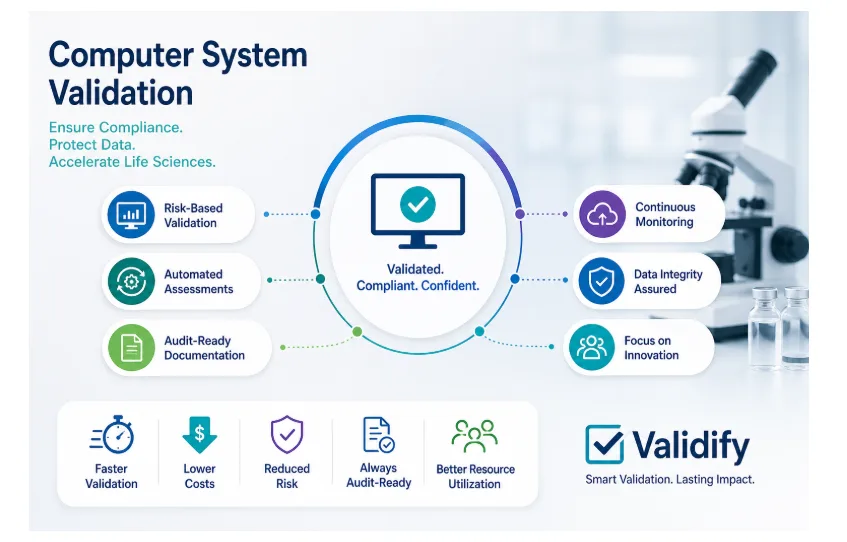

In today’s highly regulated life sciences industry, ensuring that every computerized system performs exactly as intended is no longer a back-office task. It is a strategic priority. Computer System Validation, often referred to as CSV, is the documented process that proves a software application consistently produces accurate, reliable and compliant results. Without it, pharmaceutical companies, medical device manufacturers and biotech firms cannot meet the strict expectations of regulators such as the FDA, EMA and MHRA.
As digital transformation accelerates across the industry, the demand for efficient computer software validation has grown sharply. Manual approaches that once worked are now too slow, too expensive and too risky for organizations operating under tight timelines and increasing regulatory scrutiny.
The Purpose of Computer System Validation
Computer System Validation exists to guarantee that software used in regulated environments behaves predictably and protects data integrity at every stage. Every application that touches GxP data must be validated and kept in a validated state throughout its lifecycle. This includes:
- Electronic Data Capture (EDC) systems used in clinical trials
- Randomization and Trial Supply Management (RTSM) platforms
- Electronic Clinical Outcome Assessment (eCOA) tools
- Laboratory Information Management Systems (LIMS)
- Quality Management Systems (QMS) and document management platforms
A proper validation process verifies that the system meets defined business requirements, complies with regulatory standards such as 21 CFR Part 11 and EU Annex 11, and continues to function correctly after every change, update or upgrade. The result is a transparent, auditable trail that demonstrates control over the software and the data it generates.
Why Manual Validation Is No Longer Sustainable?
Traditional computer software validation is time-consuming and resource-heavy. Quality assurance and IT teams often spend weeks producing test scripts, executing protocols, gathering screenshots and assembling documentation packages. Each new release of a vendor platform restarts the cycle, leading to several persistent challenges:
- Validation projects that drag on for weeks or even months
- Rising costs from repetitive manual work after every vendor update
- Constant overload on QA and IT teams who are already stretched thin
- Human error from missed steps, outdated documents or incomplete trace matrices
- Audit findings, warning letters and costly remediation projects
Regulators increasingly expect companies to adopt risk-based, technology-driven validation approaches that reduce these vulnerabilities and align with modern frameworks such as GAMP 5 and CSA.
The Shift from Reactive to Proactive Validation
Modern life sciences organizations are moving from reactive validation, where teams scramble before audits, to proactive validation, where systems are continuously monitored and maintained in a validated state. This shift is driven by automation, intelligent risk assessment and platform-based tools that replace fragmented spreadsheets and Word documents.
Proactive Computer System Validation means that every change, configuration update or new release is automatically assessed for risk, tested against the relevant requirements, and documented in real time. Audit readiness becomes a daily reality, not a quarterly fire drill.
Key Benefits of Automated Computer Software Validation
Organizations that adopt automated validation see measurable improvements across compliance, efficiency and team morale. The most important advantages include:
- Faster validation cycles with platform assessments completed in days rather than weeks
- Lower validation costs thanks to reusable assets and automated documentation
- Stronger data integrity since automation eliminates copy paste errors and missing evidence
- Continuous audit readiness with every change tracked and documented automatically
- Better resource allocation that frees QA and IT teams to focus on innovation rather than paperwork
- Reduced compliance risk through standardized, repeatable validation processes
What to Look for in a CSV Solution?
Choosing the right tool is critical to long-term success. A strong Computer System Validation platform should deliver on several key capabilities:
- Risk-based validation aligned with GAMP 5 principles
- Ongoing impact assessments after every system change
- Automated, audit-ready documentation generation
- Smooth integration with widely used life sciences platforms such as EDC, RTSM, eCOA and CSA tools
- Real-time visibility into validation status across all systems
- Support from a team with deep regulatory and industry expertise
Equally important is the team behind the technology. Combining deep regulatory expertise with smart automation ensures that the platform fits the realities of GxP environments and adapts as regulations evolve.
Move Forward with Confidence
Computer software validation does not have to be a burden. With the right strategy and the right partner, it becomes a competitive advantage that accelerates product launches, protects data integrity and keeps your organization fully compliant.
Validify offers a proactive risk management and validation platform built specifically for life sciences companies. Trusted by QA and IT teams to shorten validation cycle times, lower risk and stay audit-ready always, Validify combines advanced automation with hands-on industry expertise. Book a free demo today and discover how Validify can transform your approach to Computer System Validation.