The inverter is an essential component within any photovoltaic system. Its primary role involves transforming the DC output from solar panels into AC electricity, which is compatible with household appliances and the utility grid. The choice of inverter technology directly affects system energy yield, safety, and monitoring capabilities. This article examines the differences between two major inverter technologies: microinverters and string inverters.
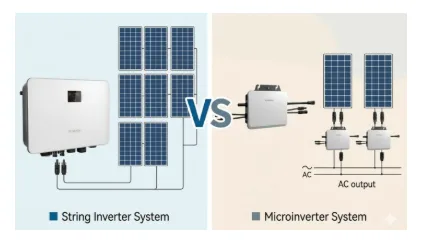

Key Differences
1. Circuit Topology and Efficiency
- String inverters operate on a centralized model. Multiple solar panels are connected in series to form a “string.” The combined DC electricity from one or more strings is channeled to a single, centrally located inverter. This inverter employs Maximum Power Point Tracking (MPPT) to optimize the voltage and current for the entire string.
A limitation of this architecture is its dependence on the performance of every panel in the series. Since the current is uniform across the entire string, if one panel’s output drops due to shading, soiling, or malfunction, the performance of the entire string is compromised.
- Microinverters utilize a distributed architecture. A dedicated microinverter is attached to the back of each individual solar panel. This configuration enables each panel to operate and be optimized independently.
Each unit has its own MPPT capability, meaning the performance of one panel has no bearing on the output of its neighbors. This design effectively mitigates the “weakest link” issue seen in series configurations.
2. Safety Considerations
- In a system built around a string inverter, the series-connected panels generate high-voltage DC electricity. In residential systems, DC voltage typically ranges between 300V and 600V, while commercial installations can reach 1000V or higher. This means the DC cabling running across the roof to the inverter carries a continuous high voltage.
In emergency situations, such as a fire, this high-voltage DC presents a significant hazard, as DC arcs are difficult to extinguish and pose a risk to both occupants and firefighters. Consequently, modern electrical codes in many regions mandate the installation of module-level rapid shutdown devices to mitigate this risk.
- Microinverter systems offer a different safety profile. The DC voltage between the panel and the microinverter is relatively low, typically below 60V, since it is limited to a single module. The output from the microinverter is standard AC electricity.
AC power has a natural zero-crossing point in its waveform, which makes any electrical arc much easier to quench. As a result, the roof space in a microinverter system is free of persistent high-voltage DC, offering a fundamental safety advantage.
3. Monitoring Capabilities
- String inverters generally provide monitoring at the system level. Users can access a portal to see the total power output of each string.
However, they cannot see the performance data for individual panels within that string. If the total output of a string drops, troubleshooting requires on-site inspection to identify the specific underperforming panel.
- Microinverters enable module-level monitoring. The power output, voltage, and status of every single panel can be viewed independently through a cloud-based platform. This granular data allows for precise system oversight.
If a panel underperforms, the system can pinpoint the exact unit, making diagnostics and any necessary maintenance far more efficient and targeted.
4. System Design and Expandability
- Designing a system with a string inverter requires careful planning. The voltage and current of the panel strings must be calculated to fall within the inverter’s operating window. Panels installed on different roof faces with varying orientations or tilts usually need to be connected to separate MPPT inputs to avoid efficiency losses.
Expanding the system later can be complex; it must be determined if the existing inverter has the capacity for additional panels, and if not, it may need to be replaced with a larger, more expensive unit.
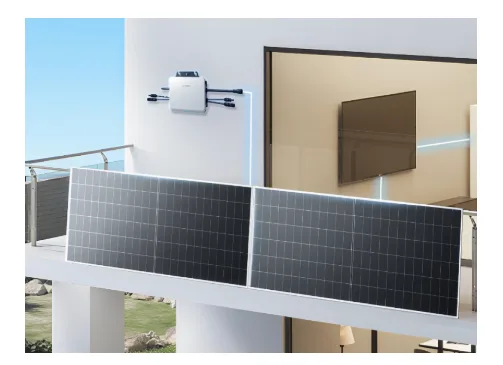
- Microinverters offer greater design flexibility. Because each panel functions autonomously, they can be installed on different roof planes with various orientations and angles without issue. This is particularly advantageous for complex roof geometries.
System expansion is straightforward: new panels with their accompanying microinverters can be added directly to the existing AC circuit without needing to modify or replace the core power conversion equipment.
5. Cost Analysis
- String inverters have a lower upfront hardware cost. A single unit handles the power conversion for numerous panels, which also simplifies installation labor.
This makes them an attractive option for projects where minimizing the initial capital outlay is the primary objective.
- Microinverters carry a higher initial hardware expense. The cost per watt of power conversion is generally higher due to the need for a device on every panel.
However, this higher initial cost can be balanced by potentially higher energy harvest in complex conditions, reduced maintenance costs over time, and the elimination of a single point of failure. A comprehensive long-term value assessment is necessary to evaluate the overall return on investment.
6. Reliability and Service Life
- The string inverter is a single, critical component in the system. If it fails, the entire PV array ceases to produce power. Their typical design life ranges from 10 to 15 years.
- Microinverters benefit from a distributed architecture. The failure of a single unit only affects the output of its associated panel; the rest of the system continues to operate normally. Many leading manufacturers back their products with warranties of 20 to 25 years, offering long-term performance assurance.
Typical Applications
1. Scenarios Favoring Microinverters
- Roofs with Partial Shading: Properties where trees, chimneys, or other structures cast shadows on part of the array. Microinverters prevent the output of the entire system from being dragged down by shaded panels.
- Complex or Multi-Faceted Roofs: Buildings with panels installed on multiple roof faces with different orientations (e.g., east, south, west). Independent operation allows each panel to maximize its own energy production based on its specific sun exposure.
- Projects with High Safety Requirements: In regions with strict electrical codes mandating module-level rapid shutdown, microinverters inherently meet these requirements with their low-voltage DC architecture.
- Planned System Expansion: For homeowners who anticipate adding more panels in the future, a microinverter system allows for easy and incremental growth without replacing existing core equipment.

2. Scenarios Favoring String Inverters
- Large, Unshaded Roofs: Ideal for expansive, south-facing roofs on warehouses, factories, or large homes with consistent, unobstructed sun exposure throughout the day.
- Budget-Conscious Projects: When the primary decision factor is minimizing the initial system cost, string inverters offer a clear price advantage.
- Easy-Access Installations: Suitable for ground-mounted systems or large commercial flat roofs where the inverter is readily accessible. If service is needed, the centralized location makes maintenance simple and cost-effective.

General Selection Guidance
When deciding between microinverters and string inverters, there is no universally good or bad choice—only the solution that is best suited to a specific situation. The user’s unique roof characteristics, safety requirements, budget considerations, and long-term plans will collectively determine the most appropriate technology path.
As a globally recognized inverter manufacturer, Sungrow has established a strong track record across residential, commercial, and utility-scale applications through years of market validation. Its string inverter product line is recognized for high reliability and a wide voltage range, making it well-suited for various standard roof installations.
Meanwhile, its microinverter solutions integrate advanced power electronics with intelligent monitoring systems, designed to optimize the performance of each individual panel throughout its 25-year operational life while enabling comprehensive safety management.
Conclusion
Whatever the project requires, Sungrow offers industry-leading solutions tailored to meet specific energy needs.
Choosing Sungrow means more than acquiring quality hardware—it means partnering with a company focused on maximizing system uptime and delivering intelligent energy management solutions.