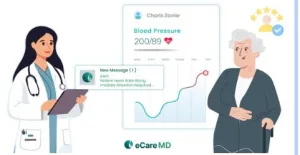

There is always news of high-risk patients who encountered an emergency situation that could have avoided the mishap. While this remains true and unchangeable for most aspects of healthcare, the proportion is significantly higher in chronically ill patients.
Though the introduction of chronic care management programs has been of significant help for many, there are still cases that tell us the same story. While interacting with some of the healthcare organizations, several factors were seen associated with this, but the major one has been the lack of data at the right time and untimely CCM predictive analytics.
While there is no one to be blamed for this, given the piling pressure on the healthcare providers, there are still some things that they can do to make their lives easier and care delivery better. Yes, we are talking about chronic care management software with high-risk patient identification functionality and predictive analytics healthcare.
But how exactly does this work?
Well, let’s explore how chronic care predictive analytics can be used to identify high-risk patients before it’s too late, which can literally change the face of your practice.
So without further ado, let’s get started!
The Reactive Care Problem: Why Traditional CCM Falls Short
The traditional approach of care has been reactive in nature, meaning only when something happens, it has been reported. While this has been the only way we knew of earlier, with access to data and other sources, reactive care can now be easily turned into proactive care, especially for CCM programs.
Let’s look at why the traditional falls short for CCM:
- Crisis-Driven Care Coordination & Missed Prevention Opportunity: Usually, when a crisis situation arises, for instance, a heart attack, then care provided to them is coordinated at the last minute. Which, if not paid attention to, can complicate things. However, if the person had been monitored, then their body would have given some indicators that would have actually helped in prevention.
- Limited Visibility into Patient Risk Factors & Deterioration Patterns: In traditional methods, the data available is usually limited, outdated, or might be subjective observations. With limited visibility into the patient health pattern, coordinating appropriate care can be difficult, leaving little to no scope for timely interventions.
- Inefficient Resource Allocation & Staff Overwhelm: Being a healthcare provider, you know the trouble you go to allocate the right resources and rightly manage the care activities. Moreover, providing equal attention to the necessary patients in such cases is also difficult.
- Poor Patient Outcomes & Satisfaction with Reactive Approaches: While doctors are doing a great job in handling emergency situations, they still fall short a lot of time. And that is the problem with reactive approaches, something’s always a miss, leading to poor patient outcomes, starting the domino effect, impacting everything.
Citing all these problems, the CCM program was introduced by CMS. However, just starting a CCM program is not enough. For the program’s success, you need a patient care management system with high-risk patient identification, to effectively turn a reactive approach into a proactive one.
The Power of Predictive Analytics in Proactive Care Management
There are systems already in the market that can help you in high-risk patient identification. However, just having that is not enough, this is where predictive analytics CCM software comes into the picture. Let’s see how it can help you in adopting a proactive care delivery approach.
- Early warning Systems & Risk Stratification Algorithms: CCM predictive analytics will be powered by AI and will be great at analyzing data. This, coupled with real-time data analysis, can help identify patterns that might escape a human’s eye, and based on that, a risk scoring model can be implemented to plan timely interventions.
- Multi-Factor Risk Assessment & Comprehensive Data Integration: Chronic conditions are quite hard to understand, and in CCM programs, you will encounter patients with multiple diseases. In such cases, your chronic care management software needs to be integrated with a care management system to analyze data such as social determinants, medication adherence, patient-reported outcomes, lab results, vital signs, and even biometric trends. This way, a comprehensive approach can be adopted to proactively manage care delivery.
- Automated Alerts & Intervention Recommendations: One of the best applications of chronic care predictive analytics has been identification, but there’s no point in it only being identified, right? That is where a chronic care management software like eCareMD comes in, which can send automated alerts to the provider to plan interventions.
- Population Health Insights & Trend Identification: Since you will be using a high-risk patient identification software for your CCM program, leverage it to analyze the health of all your patients. This can be a great initiative for your population health management program.
Key Predictive Indicators & Risk Factors in CCM Populations
Before the health of a chronically ill patient escalates to emergency situations, the body gives certain indications. These indicators can be the guiding light for your predictive analytics healthcare system to determine the risk factor. Let’s see how your chronic care management software with CCM predictive analytics can help you in that:
- Clinical Indicators & Biomarker Trends: The values you would look for typically will be lab value trajectories, for instance, A1C trends, kidney function decline, and lipid changes. These are major indicators of mildly high-risk patients. If the CCM software has integration capabilities, then analyzing vital signs patterns and the effectiveness of medications can do the trick to give you a nearly accurate indication of an escalating situation.
- Behavioral & Adherence Pattern Analysis: Changes in patient behavior are often considered as an indicator of deteriorating health. With your care management systems in place, tracking medication adherence patterns, appointments, and engagement levels can give you a hint.
- Healthcare Utilization & Service Patterns: Your patients in the CCM program use your chronic care management software to access care. The change in their pattern in how frequently they access healthcare services, especially emergency departments, can help you identify the high-risk patients and curate a preventive care plan for them. Other indicators in this part can also be specialist referrals, needs, hospitalization risk factors, prescription refill patterns, and pharmacy interaction data. And the best part is that all this can be easily accessed in your CCM software.
Technology Infrastructure for Effective Predictive Analytics
Chronic care predictive analytics with the use of a CCM software is completely dependent on the technical capabilities of your predictive analytics CCM software. On that note, here is the necessary technology infrastructure for your CCM software to effectively implement predictive analytics:
- Data Integration & Interoperability Requirements: Data is all you need for the success of your predictive analytics venture. For this, you need to integrate your chronic care management system with EHR systems, lab systems, pharmacy data, and patient portals. Also, if you are using wearables, then integration with wearable devices, RPM devices, and patient-generated health data is necessary. However, real-time data streamlining and automated data quality validation are something that you should look for.
- Machine Learning Algorithms & AI Capabilities: Implementing NLP for analyzing clinical notes to determine the risk factor is essential. After all, proactive care models are based on that, to use historical data and trends to predict outcomes. This is a continuous process, and you must train your system on accurate data to generate accurate feedback.
- User Interface Design & Clinical Workflow Integration: It would be better for your healthcare provider to have intuitive dashboards that present risk scores and suggest actionable insights for care coordinators. Also, it should be equipped with mobile accessibility for real-time risk assessment and intervention capabilities in emergency situations. Along with that, alert fatigue prevention through intelligent notification prioritization and customization can also be possible, so checking that is also suggested.
- Privacy Protection & Regulatory Compliance: In the digital healthcare landscape, you will mostly be dealing with sensitive information of your patients. That is why you need to adhere to the necessary regulations such as HIPAA, FDA, GDPR, HITECH, etc. Along with that, an audit trail should be maintained with transparency in the algorithmic decision-making process. And have excellent patient consent management practices.
Implementation Strategy: From Data to Actionable Insights
For the data to be converted into actionable insights, it needs to go through a lot of processes, and your chronic care predictive analytics is going to play a crucial role in that. To help you ease into the implementation process, refer to this table, where you will find a 3-phase implementation process:
| Phase | Key Activities | Objectives |
| Phase 1 – Data Infrastructure Setup & Baseline Establishment | – Implement chronic care management solution with full data integration
– Analyze historical data to establish patient risk baselines – Train staff on predictive analytics and risk-based care models |
Build a strong data foundation and prepare teams for data-driven care |
| Phase 2 – Pilot Program & Algorithm Validation | – Test predictive models with 50–100 high-risk patients
– Validate algorithm accuracy and intervention impact – Refine workflows based on care team feedback |
Assess effectiveness of predictive tools and prepare for scale |
| Phase 3 – Full Deployment & Continuous Optimization | – Roll out predictive risk stratification across all CCM patients
– Continuously monitor outcomes and refine algorithms – Expand to include more chronic conditions and risk indicators |
Drive proactive care at scale and adapt strategy based on real-world data |
If you are still using a generic care management system, then adapting to this change can be a little difficult for your staff members. That is why communicating clearly about the benefits of predictive analytics and how it can help them in improving care practices is important.
On top of that, they should be provided with extensive hands-on training so that it becomes easier and they are actually able to use the chronic care management software with predictive analytics efficiently.
Conclusion
As healthcare practices are slowly adopting holistic care approaches, the rise of proactive care delivery can be clearly seen, especially in those practices that have adopted CCM programs.
But just having a CCM program is not enough; you also need to deliver on your commitment for its success. For that, you need complete chronic care management software equipped with predictive analytics for better preventive and proactive care.
So, what are you waiting for? Oh yes, you probably don’t know where to get started, right? Well, click here and let’s get started by building your own healthcare ecosystem.
FAQs
- How accurate are predictive analytics in identifying patients at risk for hospitalization or complications?
Predictive analytics in healthcare offer promising accuracy in identifying patients at risk for hospitalization or complications. Their effectiveness significantly depends on the quality and comprehensiveness of the data used, the sophistication of the AI models, and how well biases are mitigated. They help enable early intervention and personalized care.
- What types of data are needed to implement effective predictive analytics in CCM programs?
Effective predictive analytics in CCM programs requires diverse data: historical contract performance, financial data, operational metrics, customer interaction data, and external market trends. This comprehensive view enables accurate forecasting of risks, opportunities, and outcomes.
- How do predictive analytics integrate with existing EHR systems and clinical workflows?
Predictive analytics integrate with EHRs by leveraging historical patient data (diagnoses, labs, medications) to forecast future health events like disease onset or readmissions. These insights are embedded into clinical workflows, often via decision support systems, to provide real-time, data-driven recommendations, enabling proactive interventions and personalized care.
- What’s the typical ROI timeline for implementing predictive analytics in chronic care management?
Implementing predictive analytics in chronic care management typically shows ROI within 6-12 months, though significant returns can be seen even sooner (3-6 months) in data-rich environments. The payback comes from reduced readmissions, optimized resource allocation, improved patient outcomes, and increased operational efficiency.
- How do predictive analytics help care coordinators prioritize their daily patient interactions?
Predictive analytics helps care coordinators prioritize by identifying patients at highest risk for adverse events, readmissions, or worsening conditions. By analyzing historical and real-time data, it flags individuals who need immediate attention, enabling proactive interventions and optimizing resource allocation for more effective and efficient patient care.
- What privacy and security considerations are important for predictive analytics in healthcare?
Predictive analytics in healthcare requires robust data anonymization to protect patient privacy from re-identification risks. Secure storage, access controls, and strong encryption are crucial to prevent data breaches and cyberattacks. Additionally, ensuring algorithmic fairness and transparency is vital to avoid biased outcomes and maintain patient trust.