
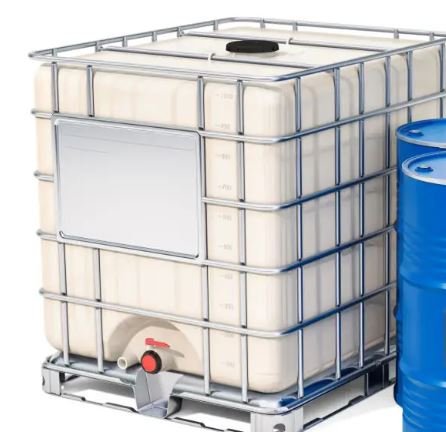
Intermediate Bulk Containers (IBCs)-also known as IBC totes, pallet tanks, or IBC tanks-serve as an industrial standard for the storage and transport of liquids, pastes, granular solids, and other bulk materials. Engineered for efficient handling, compatibility with palletized shipping, and compliance with UN/DOT regulations, IBCs bridge the gap between small drums and large tank containers. Their cubic shape maximizes storage density and simplifies forklifting and stacking. This report presents a comprehensive overview of the standard volumes (in both US gallons and liters) and physical dimensions available for IBC containers, organized by container type.
The secondary market for used IBC totes offers cost-effective solutions for businesses requiring bulk storage capacity. Most commonly available are 275-gallon (1,040 liters) and 330-gallon (1,250 liters) units, representing the two dominant sizes in North American and European markets respectively. Used IBCs typically feature high-density polyethylene (HDPE) tanks mounted in galvanized steel cages with integrated pallet bases.
Volume Capacities: Gallons and Liters
IBCs are fabricated in discrete, regulated capacity increments defined under Title 49 of the Code of Federal Regulations (CFR) for UN/DOT approval. Volumes range from 110 US gallons (416 L) up to 793 US gallons (3,000 L), with the most common sizes intended to replace multiple 55-gallon drums in a single unit.
Rigid Plastic (“Caged”) IBC Totes
These composite IBCs feature a blow-molded high-density polyethylene (HDPE) inner bottle encased in a galvanized steel cage. Standard US gallon capacities and their metric equivalents include :
| US Gallon Capacity | Metric Capacity (L) | Common Products |
| 275 gal | 1,040.9 L | New, rebottled, reconditioned caged |
| 330 gal | 1,249.2 L | New, rebottled, reconditioned caged |
All-Plastic (Rotational Molded) IBC Totes
Constructed entirely from HDPE via rotational molding, these totes offer chemical compatibility and lightweight durability. Available volumes :
| US Gallon Capacity | Metric Capacity (L) | Model Examples |
| 120 gal | 454.2 L | Standard Stackable, Premium Stackable, Excalibur |
| 135 gal | 511.0 L | DEF Totes |
| 220 gal | 832.8 L | Standard Stackable, Ultratainer |
| 250 gal | 946.4 L | Excalibur |
| 275 gal | 1,040.9 L | Multiple model types |
| 300 gal | 1,135.6 L | DEF Totes |
| 330 gal | 1,249.2 L | Voyager, Voyager Plus |
| 535 gal | 2,025.2 L | Voyager XL |
| 550 gal | 2,081.9 L | Megatainer |
Metal IBC Totes (Stainless Steel / Carbon Steel)
Metal IBCs provide enhanced durability and are suited for aggressive chemicals or high-temperature applications. Standard capacities include :
| US Gallon Capacity | Metric Capacity (L) | Material Types |
| 110 gal | 416.4 L | Stainless Steel, Carbon Steel |
| 120 gal | 454.2 L | Stainless Steel |
| 140 gal | 529.9 L | Stainless Steel |
| 165 gal | 624.6 L | Stainless Steel |
| 180 gal | 681.4 L | Stainless Steel, Carbon Steel |
| 245 gal | 927.4 L | Stainless Steel |
| 250 gal | 946.4 L | Stainless Steel, Carbon Steel |
| 300 gal | 1,135.6 L | Stainless Steel, Carbon Steel |
| 350 gal | 1,324.8 L | Stainless Steel, Carbon Steel |
| 446 gal | 1,688.3 L | Stainless Steel |
| 450 gal | 1,703.4 L | Stainless Steel, Carbon Steel |
| 550 gal | 2,081.9 L | Stainless Steel |
Extended and Specialized Volumes
- Flexible IBCs (FIBCs): Fabric bulk bags available in capacities up to 3 m³ (793 US gal), used for powders and solids but outside the rigid shipping container category.
- Large-Format IBCs: Some manufacturers offer custom variants up to 3,000 L (793 US gal), though these exceed common pallet dimensions and may require special handling.
Volume Summary
The most prevalent IBC capacities in industrial practice are 275 US gal (∼1,041 L) and 330 US gal (∼1,249 L), offering a turnkey replacement for five to six 55-gallon drums in a single, pallet-compatible unit.
Physical Dimensions
While capacities vary, IBCs adhere to a standard pallet footprint for compatibility with global material-handling equipment. The base dimensions remain nearly constant; only the height changes with capacity.
Standard Base Size
- Length x Width: Approximately 1,200 mm x 1,000 mm (48″ x 40″) to align with GMA pallet standards.
- Alternate Common Footprint: Some models use a square 45″ x 45″ base, mainly for European markets.
Height Variations by Capacity
| Capacity (US gal) | Height (Approx.) | Height (Metric) | Source |
| 110 gal | 36.5″ | 927 mm | |
| 120 gal | 42″ | 1,067 mm | |
| 250 gal | 35″ | 889 mm | |
| 275 gal | 42-46″ | 1,067-1,168 mm | |
| 300 gal | 56″ | 1,422 mm | |
| 330 gal | 48″ | 1,219 mm | |
| 535 gal | 90.25″ | 2,293 mm | |
| 550 gal | Varied (∼90″) | ∼2,286 mm |
Note: Exact dimensions vary by manufacturer and design features (e.g., tapered walls, conical bottoms).
Container Types and Construction
Rigid vs. Flexible
- Rigid IBCs: Incorporate a pallet base, steel cage, and HDPE or metal inner vessel. They are UN/DOT certified for hazardous materials and designed for multiple reuse cycles with reconditioning.
- Flexible IBCs (FIBCs): Bulk bags constructed from woven polypropylene, lacking a rigid structure or pallet integration. Capacities overlap with smaller rigid IBCs but are not pallet-compatible.
Material Considerations
- HDPE (Plastic) Inner Bottles: Corrosion-resistant and suitable for food, chemicals, and water.
- Stainless Steel: Ideal for high-purity or aggressive chemicals.
- Carbon Steel: Offers robustness for heavy-duty or high-temperature applications.
- Bag-in-Box / Cardboard Variants: Disposable IBCs for single-use applications, typically up to 950 L, featuring an inner liner and outer cardboard/cradle.
Regulatory Compliance
All IBCs intended for the transport of hazardous or dangerous goods must display UN markings indicating:
- Packing Group suitability
- Maximum allowable filling density
- Manufacture date and period of service
Title 49 CFR limits rigid IBC volumes to 3 m³ (793 US gal) to retain “IBC” classification for shipping.
Applications and Selection Guidelines
- Chemical Processing: 275 gal and 330 gal HDPE caged IBCs for corrosive fluids.
- Food & Beverage: FDA-compliant plastic IBCs, often 120 gal-550 gal, for syrups and oils.
- Water Storage: 275 gal and 330 gal totes for rainwater harvesting or emergency reserves.
- Hazardous Goods: Stainless steel or UN-rated plastic IBCs up to 330 gal.
Key Selection Criteria:
- Capacity Needs: Match volume to batch size or transport regulations.
- Material Compatibility: Ensure inner vessel material resists stored media.
- Handling Equipment: Confirm base dimensions suit existing pallets and forklifts.
- Regulatory Requirements: Check UN markings and certification for hazardous cargo.
Intermediate Bulk Containers offer standardized, pallet-compatible volumes ranging from 110 US gallons (416 L) to 550 US gallons (2,082 L) in plastic and metal constructions, with specialized variants extending up to 793 US gallons (3,000 L). Dimensionally, IBCs maintain a constant footprint (∼48″ x 40″ or 45″ x 45″) while varying in height proportional to capacity. The ubiquitous 275 gal (1,041 L) and 330 gal (1,249 L) models dominate industrial use due to optimal trade-offs between storage density and manageability. Selection hinges on volume requirements, chemical compatibility, handling infrastructure, and regulatory compliance.