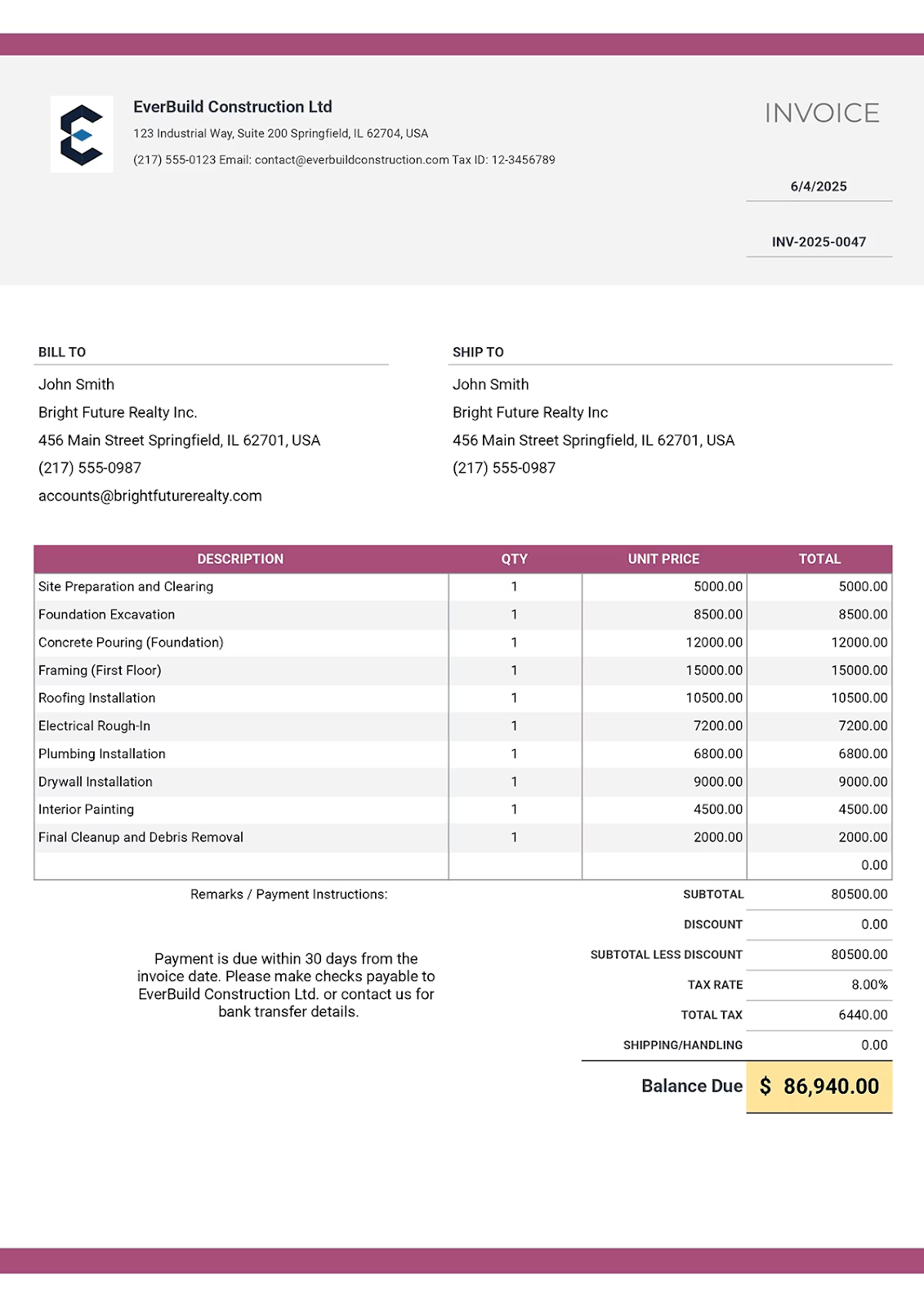

There’s a beautiful moment in every contractor’s career when they discover that “Net 30” is not a law of physics. It’s more like a suggestion, or perhaps a cruel joke that businesses play on each other, such as telling someone the meeting starts at 2 PM when you know it begins at 2:30.
I was reminded of this recently while looking at a contractor invoice template that cheerfully suggested “Net 30 days” as if this were a reasonable expectation rather than an optimistic fantasy. This got me thinking about the strange economics of contractor payments, the mythology we’ve built around invoice terms, and why the construction industry has accidentally created the world’s most elaborate Ponzi scheme—except instead of Bernie Madoff, it’s run by general contractors with pickup trucks.
The Great Payment Theater
Let’s start with the fundamental absurdity of contractor invoice terms. Every construction invoice template you’ll find online includes a section for “payment terms,” as if this were a negotiation between equals rather than a desperate plea from someone who needs to eat this month.
The reality is that payment terms in contracting work about as well as terms and conditions on social media platforms—everyone agrees to them, nobody reads them, and they’re essentially meaningless when things go wrong. A subcontractor invoice template might say “Due upon receipt,” but what it means is “Please pay me sometime before I die of old age.”
The construction industry has created a complex narrative around these payment terms. Contractors download a self-employed contractor invoice template, fill in “Net 15” or “Net 30,” and pretend this creates some binding social contract. Meanwhile, the client looks at the invoice, nods thoughtfully, and files it in what I like to call the “maybe someday” pile.
The Invoice Float Game
Here’s where it gets interesting from a cash flow perspective. The time between when a contractor sends an invoice for contract work and when they receive payment has become its micro-economy. It’s like floating in banking, except instead of earning interest on the delay, you’re slowly going insane waiting for your phone to ring.
Consider the life cycle of a typical construction billing invoice. The subcontractor finishes the work on Monday, sends the invoice on Wednesday, and the general contractor “processes” it for two weeks. The general contractor then sends it to the client, who “reviews” it for another week, and it sits in accounts payable until someone’s cousin’s wedding forces them actually to cut checks.
This creates a bizarre shadow economy where contractors essentially provide free loans to their clients. Think about it: You do $10,000 worth of work today, but you don’t get paid for 45-60 days. That’s a zero-percent loan that you didn’t agree to, secured by your desperate need to eat food and pay rent.
The Psychology of Professional Templates
The truly fascinating aspect is how contractors respond to this systemic payment dysfunction. Instead of demanding change, they download better invoice templates. It’s like responding to a leaky roof by buying a fancier bucket.
A construction invoice template becomes a kind of magical thinking—if only the invoice looks professional enough, if only the line items are detailed enough, if only the company logo is crisp enough, then surely this time the payment will arrive on schedule. It’s the business equivalent of wearing your lucky socks to a job interview.
I’ve seen independent contractor invoice templates that are works of art. Color-coded categories, detailed breakdowns, terms and conditions that would make a law firm proud. The contractor spends hours perfecting their general contractor invoice template, carefully formatting every field, and then sends it into the same payment black hole that swallowed last month’s invoice.
The Subcontractor Pyramid Scheme
The construction industry has accidentally created the world’s most elaborate accounts receivable pyramid. The property owner pays the general contractor (maybe), who pays the subcontractor (eventually), who pays the sub-subcontractor (hopefully), who pays the materials supplier (good luck).
Each layer in this pyramid adds its payment delays, processing fees, and creative interpretations of what “Net 30” actually means. By the time money trickles down to the bottom, the original work might have been completed months ago. It’s like a game of financial telephone, except instead of the message getting garbled, your cash flow gets garbled.
The beautiful irony is that everyone in this chain is using contractor invoice examples they found online, all promising the same mythical payment terms, all equally powerless to enforce them. It’s like everyone agreeing to play by the rules of Monopoly while knowing that the banker is embezzling from the community chest.
The Real Innovation Nobody Talks About
But here’s what fascinates me about the invoice template economy: The actual innovation isn’t in the templates themselves—it’s in the payment workarounds that contractors have developed.
Competent contractors have figured out that the problem isn’t invoice formatting; it’s cash flow management. They’ve started requiring deposits, milestone payments, and progress billing. They’ve learned to invoice weekly instead of monthly, to charge late fees that are effective, and to terminate clients who consistently pay late.
In other words, they’ve stopped believing in the thirty-day payment fairy tale and started treating contracting like the cash-intensive business it is. The most successful contractors I know barely use invoice templates at all—they use payment platforms, automated billing systems, and contracts that make payment terms enforceable rather than aspirational.
The Construction Finance Revolution
This is part of a broader transformation in how small businesses think about payments. The same technology that gave us Venmo and CashApp is slowly infiltrating the construction industry. Contractors are discovering that they don’t have to accept 60-day payment cycles just because that’s how it’s always been done.
The construction billing invoice of the future won’t be a PDF attachment—it’ll be a payment request that gets settled immediately, like buying coffee with your phone. We’re already seeing early versions of this with platforms that let contractors get paid the same day they complete work, for a small fee that’s infinitely better than waiting two months for free.
The Template Paradox Revisited
Which brings us back to those innocent-looking invoice templates scattered across the internet. They represent both the problem and the solution. The problem is that they perpetuate the mythology of traditional payment terms. The solution is that they’ve democratized professional billing for millions of small contractors who previously had no idea how to request payment professionally.
Every contractor who downloads a subcontractor invoice template is participating in a grand experiment in the professionalization of small businesses. They might not get paid any faster, but at least they’ll look professional while not getting paid.
The Bottom Line (Eventually)
The contractor invoice template phenomenon is, in reality, a story about power imbalances disguised as a tale about document formatting. Contractors need better templates, just as drowning people need better swimming techniques—it might help around the margins, but it doesn’t address the fundamental problem.
The real innovation will come when contractors stop asking “How do I make my invoice look more professional?” and start asking “How do I get paid faster?” That’s when the construction industry will finally evolve from a cash flow nightmare into something resembling a functional marketplace.
Until then, we’ll keep pretending that “Net 30” means something; contractors will continue to download prettier templates, and the great payment theater will persist. At least everyone will look professional while they’re going broke.