
Did you know that industries worldwide lose billions annually due to material failures caused by improper testing and preparation? AI and data analytics integration in tensile specimen preparation is rapidly changing this reality. These technologies bring exceptional precision and efficiency, guaranteeing that materials are tested to the highest standards, reducing errors, and preventing costly failures.
AI-driven equipment adjusts machining parameters in real-time, compensating for material property variations. This not only prevents inconsistencies but also guarantees specimens meet exact specifications. By using data analytics, manufacturers can optimize resource usage, cutting down on waste and energy usage.
As industries demand faster, more reliable testing processes, the fusion of AI and advanced analytics sets high benchmarks in tensile specimen preparation. From real-time quality control to predictive maintenance, these innovations are revolutionizing how materials are tested and prepared for demanding applications.
Improving Precision in Specimen Preparation
AI is revolutionizing tensile specimen preparation by minimizing inconsistencies and improving accuracy. Traditional methods often rely on manual operations, which are prone to human error, leading to variations that can impact material testing results reliability. With AI-driven systems, these challenges are addressed through automation and intelligent adjustments.
Modern tensile specimen preparation equipment, powered by AI, uses machine learning algorithms to analyze material properties and adjust machining parameters in real time. For example, cutting speeds, tool paths, and even pressure can be automatically adjusted, so that each specimen adheres to exacting standards. This adaptability not only enhances the consistency of prepared specimens but also reduces the need for rework, saving both time and resources.
Moreover, AI enables dynamic responses to anomalies during preparation. If a material’s behavior deviates from expected parameters, the system can correct instantly to maintain precision. Even the smallest deviation from testing data can have significant implications for safety and performance in industries that require a high degree of accuracy.
Optimizing Resource Use
It has been shown that one of the most significant benefits of integrating AI and data analytics into tensile specimen preparation is the ability to optimize resource management. Traditional preparation methods often result in material waste and energy inefficiencies due to trial-and-error processes or outdated techniques. AI-driven systems address these issues by simplifying operations and maximizing efficiency.
For instance, AI algorithms analyze data from previous preparations to determine the most efficient way to cut and shape specimens from raw materials. This results in minimal waste and higher yields per batch of materials. These optimizations translate into significant cost savings for industries.
Energy consumption is another area where AI makes a difference. By optimizing preparation equipment settings-such as machining speeds, power usage, and idle times—AI systems reduce unnecessary energy expenditures. This lowers operational costs and supports sustainability initiatives, helping industries meet environmental standards and goals.
Furthermore, predictive analytics driven by AI improves equipment efficiency. By analyzing historical data and performance metrics, AI systems can identify inefficiencies and recommend adjustments to improve overall resource management. This holistic approach guarantees that every aspect of the specimen preparation process is optimized, increasing its sustainability and cost-effectiveness.
Predictive Maintenance and Equipment Longevity
AI is not only transforming how tensile specimens are prepared but also how equipment is maintained. Traditional maintenance schedules rely on fixed intervals or reactive approaches, often resulting in costly downtime and equipment failures. With AI-driven predictive maintenance, these inefficiencies are becoming a thing of the past.
By regularly monitoring equipment performance through sensors and data analytics, AI systems can detect early warning signs of wear and tear. For instance, irregular vibrations, temperature changes, or deviations in machining precision can indicate potential issues. AI algorithms analyze these patterns to predict failures before they occur, allowing maintenance teams to address problems proactively.
This predictive approach minimizes unplanned downtime and makes certain that tensile specimen preparation equipment operates at peak efficiency. In an environment where every hour of downtime can result in significant financial losses, predictive maintenance is a valuable tool.
In addition to preventing failures, AI also extends equipment lifespan. By providing real-time insights into usage patterns and wear conditions, AI systems help operators adjust settings to reduce strain on critical components. For example, AI may suggest optimizing cutting speeds or pressures to prevent unnecessary stress on machinery, prolonging its durability.
Data-Driven Quality Control
Using artificial intelligence and data analytics, tensile specimen preparation is undergoing significant changes also by making sure that every specimen meets precise standards before testing begins. Traditional quality control methods often rely on manual inspections or post-preparation evaluations, which can overlook minor deviations or inconsistencies. With AI, quality control is becoming a fully integrated, real-time process.
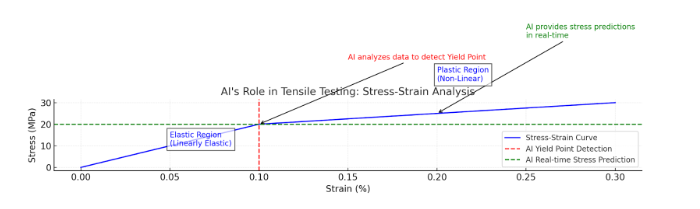
Advanced AI systems monitor every stage of specimen preparation, from initial material cutting to final surface finishing. Using high-precision sensors and imaging technologies, these systems collect detailed data on parameters such as dimensional accuracy, surface roughness, and machining consistency. AI algorithms analyze this data in real-time, instantly identifying any deviations from required standards and providing immediate feedback.
For example, if a prepared specimen shows even a slight change in its dimensions, the AI system can halt the process, notify operators, and suggest adjustments to equipment settings. This provides assurance that only specimens that meet exact specifications will proceed to testing, reducing the risk of inaccurate results and material waste.
Data analytics also assists in long-term quality control by identifying patterns and trends among multiple preparations. By way of example, repeated anomalies in certain batches may indicate an issue with raw materials or equipment settings. By analyzing these trends, AI systems help manufacturers fine-tune their processes for improved consistency over time.

Challenges and Future Directions
While AI and data analytics integration in tensile specimen preparation is groundbreaking, it is not without challenges. Industries face several barriers to adopting these advanced technologies, including high initial costs, the need for high-quality data, and the requirement for specialized technical expertise.
Barriers to Adoption
AI systems are expensive, including hardware, software, and training, is one of the primary hurdles. Smaller businesses, in particular, may find it difficult to invest in these technologies despite their long-term benefits. Additionally, AI systems are highly data-dependent, requiring large, high-quality datasets to function effectively. For industries with limited access to such datasets or inconsistent data collection methods, realizing AI’s full potential can be difficult. Lastly, AI-driven equipment implementation and maintenance demand skilled professionals, which adds to operational complexity.
Potential Solutions
To overcome these barriers, manufacturers are exploring collaborative approaches and scalable solutions. Shared industry platforms and AI-as-a-Service (AIaaS) models are emerging as cost-effective ways to access advanced technologies. These models allow businesses to leverage AI without significant upfront investment. Moreover, advancements in data management tools are making it easier for companies to collect, process, and analyze data, improving AI systems’ usability even in data-limited environments.
Efforts to simplify AI interfaces and provide user-friendly software are also underway, reducing dependency on highly specialized personnel. Training programs and partnerships with technology providers help industries build expertise needed to manage AI-driven systems effectively.
Future Possibilities
Looking ahead, AI’s role in tensile specimen preparation is poised to expand significantly. Future innovations may include fully autonomous preparation systems that require minimal human intervention, further reducing errors and improving efficiency. AI-driven platforms could also be integrated with cloud technologies, enabling remote monitoring and real-time collaboration across global facilities.
Additionally, as AI becomes more advanced, it will likely facilitate the development of smart materials that interact with testing equipment, providing instant feedback on their own performance. These materials, paired with predictive analytics, could redefine how specimens are prepared and tested, unlocking new possibilities for research and industrial applications.
Towards the Future of AI in Tensile Specimen Preparation
AI and data analytics integration in tensile specimen preparation represents a major leap forward in material testing. By improving precision, optimizing resource use, enabling predictive maintenance, and revolutionizing quality control, these technologies have redefined how industries approach specimen preparation and testing.
While challenges such as high costs, data dependency, and the need for specialized expertise remain, ongoing innovations are steadily addressing these barriers. Scalable AI solutions, user-friendly interfaces, and collaborative platforms make advanced technologies more accessible to businesses of all sizes.
The future of tensile specimen preparation lies in fully autonomous systems, integrated cloud integration, and smart materials that interact with testing equipment. These advancements promise improved efficiency and a stronger focus on sustainability, as industries continue to reduce waste and optimize resource use.