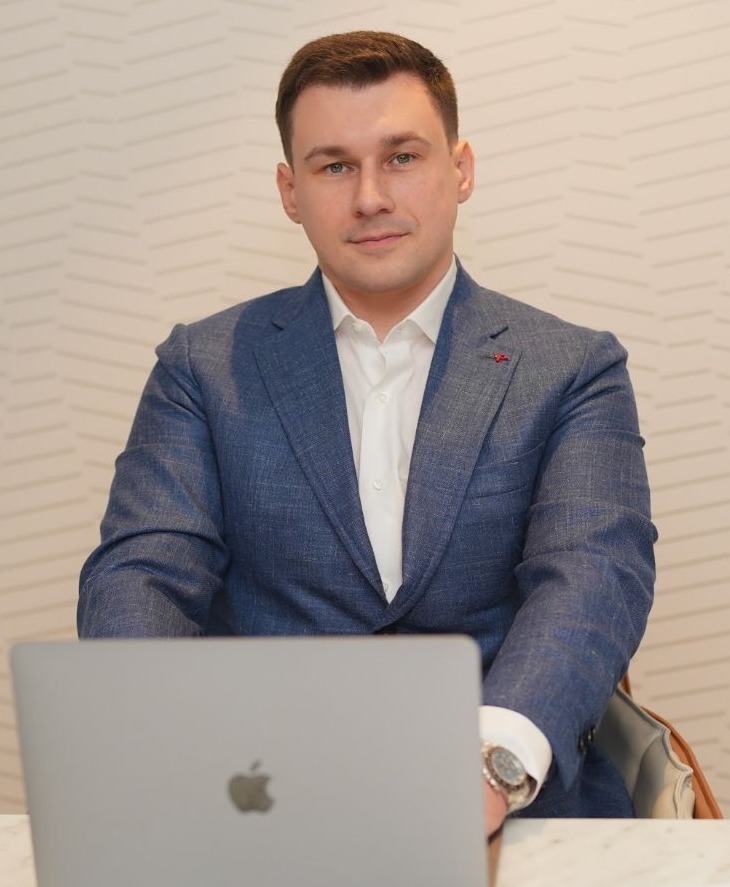
When Ukrainian logistics faced the test of war, many companies simply tried to survive. Mykyta Semeniak, founder of Weiz Logistics, chose a different path – he transformed crisis into opportunity by creating a fundamentally new management model that’s changing the industry’s rules.
“I didn’t want to blindly copy Western approaches – they don’t account for our reality,” says Semeniak, pointing to new logistics routes on a map of Ukraine that emerged after February 24, 2022. “But traditional methods in our market often proved ineffective in crisis conditions.”
This dilemma pushed Semeniak to create a hybrid methodology combining two powerful approaches: the customer-oriented “Strategic Figure Eight” by Vernon Hill and the structured “Business Success Triad” by Alex Hormozi.
From Theory to Unique Practice
Semeniak’s bachelor’s degree gave him fundamental knowledge, but his truly valuable lessons came from facing real challenges in Ukrainian logistics. His early years revealed the industry’s key problem: fragmented processes and lack of customer-centricity.
“Watching the industry dinosaurs, I was struck by their inertia,” Semeniak explains. “A logistics company with 15 years of experience might take a week to process a request, losing time in endless interdepartmental approvals.”
While studying Western management models, Semeniak discovered Vernon Hill’s “Strategic Figure Eight.” This methodology puts the customer at the center of all business processes but required significant adaptation to Ukrainian realities.
The “Strategic Figure Eight”: Ukrainian Version
In its classic interpretation, the “Strategic Figure Eight” focuses on creating a unique customer experience through eight key interaction points. Semeniak reimagined this concept for Ukraine’s logistics landscape.
“I noticed our clients value predictability and reliability more than interaction comfort,” Semeniak explains. “So we modified the ‘Figure Eight,’ emphasizing process transparency and regular communication.”
Semeniak’s key innovation was implementing a micro-reporting system. Unlike the Western approach where clients receive information only at checkpoints, Semeniak’s methodology involves regular micro-updates. This radically transforms the customer experience – clients always know what’s happening with their cargo.
Another important adaptation was localizing decision-making authority. In every logistics operation, Semeniak identified points where managers could make independent decisions without lengthy approval processes.
The “Business Success Triad”: Structural Foundation
Alongside customer-centricity, Semeniak worked on operational efficiency. Here, Alex Hormozi’s “Business Success Triad” methodology helped, reimagined for the logistics industry.
“In logistics, the ‘product’ isn’t just transportation,” Semeniak explains. “It’s a comprehensive solution including cargo safety, timely delivery, and informational support.”
That’s why Semeniak developed a seven-parameter quality assessment system for each shipment, including not only standard timing and cost metrics but also indicators like “information transparency” and “adaptability to changes.”
In the triad’s marketing component, Semeniak focused on measurable value. Instead of classic service promotion, he offered clients specific guarantees: fixed response times, clear delivery deadlines, and transparent pricing.
For sales, the innovation was a diagnostic questioning system. Weiz Logistics managers don’t simply take orders – they conduct detailed client needs analysis through a standardized list of 14 questions to offer optimal solutions.
Methodology Synergy: The Secret to Effectiveness
The real breakthrough came when Semeniak combined these approaches into a unified system. The “Figure Eight’s” customer-centricity set the direction, while the “Triad’s” structure ensured efficient implementation.
“The key discovery was that these methodologies don’t compete – they complement each other,” says Semeniak. “For example, the principle of ‘eliminating unnecessary sales steps’ from the ‘Figure Eight’ perfectly aligns with the ‘sales automation’ component from the ‘Triad.'”
Semeniak created an integrated model where each element strengthens the others. Classifying requests into four complexity categories (green, yellow, orange, red) allowed applying different tool sets for different situations while maintaining a unified service philosophy.
His special know-how became the “decision-making matrix” – an algorithm determining what actions to take depending on cargo type, urgency, route, and other factors.
“The main problems in logistics arise not from lack of solutions but from choosing incorrectly among existing options,” Semeniak explains. “Our matrix minimizes the human factor in this choice.”
The Technological Foundation
Interestingly, Semeniak didn’t develop expensive software to implement his management concept. Instead, he created a modular system that works even with basic tools.
“We started with ordinary Excel spreadsheets and Telegram channels for communication,” Semeniak recalls. “Later we added specialized modules, but the principle remained the same – technology should adapt to methodology, not vice versa.”
This pragmatism allowed quick implementation of changes and adaptation to changing conditions. When familiar logistics routes became unavailable at the war’s start, the Weiz Logistics team quickly restructured their system without suffering from rigid dependence on specific software.
The key technological element of Semeniak’s methodology became the parallel processing system. Unlike the linear approach where each stage begins after the previous one ends, here several work directions launch simultaneously.
“Imagine a client requesting transportation of non-standard equipment from Dnipro to Poland,” Semeniak explains. “In the traditional model, you first calculate the route, then select transport, then prepare documents. In our system, all three processes start in parallel, reducing total request processing time by 60-70%.”
Team Management: The Human Success Factor
Semeniak’s methodology couldn’t work without a properly organized team. He developed a special approach to team formation and role distribution.
“In logistics, companies often prefer hiring people with industry experience, but I chose a different strategy,” he explains. “We look for specialists with systems thinking skills and the ability to make quick decisions. We can teach logistics specifics, but restructuring someone’s thinking approach is much harder.”
Semeniak implemented a unique competency rotation model where employees periodically change roles within their department. This not only broadens their professional horizons but ensures interchangeability, critically important in unstable conditions.
“I noticed many companies suffer from ‘irreplaceable’ employees,” says Semeniak. “When such a specialist gets sick or quits, entire processes stop. In our system, we minimize these risks.”
An important management element became daily micro-briefings lasting no more than 15 minutes. The team synchronizes information, exchanges critical updates, and determines the day’s priorities. This practice, borrowed from the IT sector, proved extremely effective in logistics.
Measurable Results: The Numbers Speak for Themselves
The effectiveness of Semeniak’s methodology is confirmed by concrete indicators. In its first year, the company significantly improved all key metrics: request processing time dropped from 19 to 3 hours, repeat business grew to 78%, operational profitability increased by 14%, and logistics failures decreased by a third. Particularly impressive are the results for non-standard shipments – organization time reduced by 54% compared to the industry average of 15-20%. Meanwhile, Weiz Logistics successfully expanded its operational geography to include most European countries.
The Future of the Methodology: Global Potential
Semeniak’s management methodology continues to evolve. Future plans include further integration of predictive analytics and artificial intelligence elements to optimize logistics solutions.
“We’re currently developing a system that will analyze historical route data and suggest optimal solutions based on the current situation,” Semeniak shares. “But the human factor will remain key – technology will help make decisions, not replace the process.”
Industry experts note that Semeniak’s methodology has potential for scaling beyond the logistics industry. Its core principles – parallel processes, preventive risk management, customer-centricity – can be adapted for other sectors of the Ukrainian economy facing high uncertainty.
But the most significant contribution of Semeniak’s methodology is that it changes the paradigm of Ukrainian business perception. These are no longer just local companies adapting Western approaches, but creators of their own innovative solutions that can be competitive globally.
“I want Ukrainian logistics to be associated not with post-Soviet legacy but with innovation and efficiency,” Semeniak concludes. “And I believe we’re already on that path.”
Author: Liz Trudov